


Last updated: July 2026
Founded by Chase Coleman, one of Julian Robertson’s best-known “Tiger Cubs,” Tiger Global Management has become a leading crossover investment firm. It combines public equity investing with private venture capital under a single investment platform.
This article breaks down the Tiger Global portfolio, delivering a comprehensive analysis of its current 2026 13F long book and highlighting Coleman’s top high-conviction technology and growth holdings. Beyond the public stock portfolio, we explore Tiger Global‘s origins and investment philosophy. The firm’s crossover strategy combines aggressive investing across both public and private markets.
The Tiger Global Portfolio Today
| Rank | Ticker | Company | ~% of portfolio | Value | Shares |
|---|---|---|---|---|---|
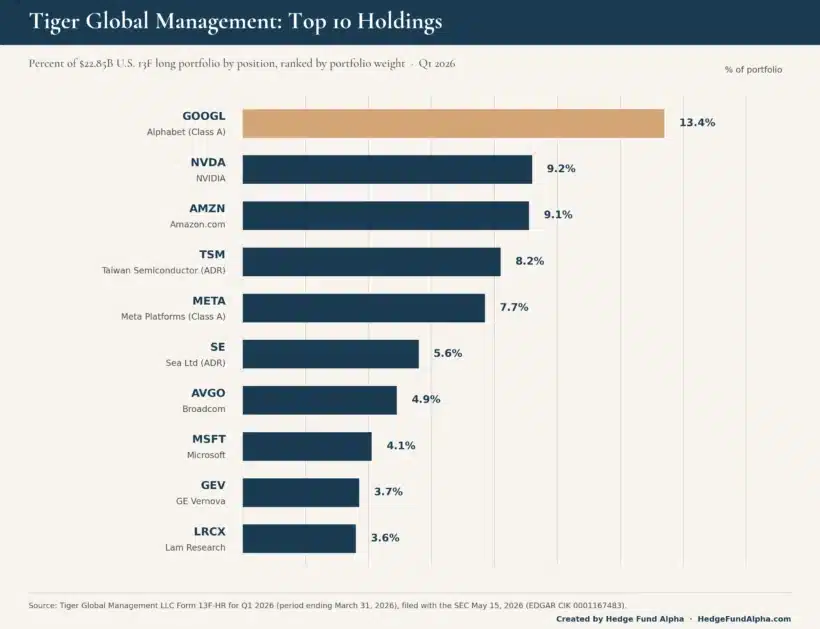
| 1 | GOOGL | Alphabet (Class A) | ~13.4% | ~$3.06B | 10,631,402 |
| 2 | NVDA | NVIDIA | ~9.2% | ~$2.09B | 12,011,752 |
| 3 | AMZN | Amazon.com | ~9.1% | ~$2.08B | 10,000,000 |
| 4 | TSM | Taiwan Semiconductor (ADR) | ~8.2% | ~$1.88B | 5,565,074 |
| 5 | META | Meta Platforms (Class A) | ~7.7% | ~$1.77B | 3,086,864 |
| 6 | SE | Sea Ltd (ADR) | ~5.6% | ~$1.28B | 15,415,835 |
| 7 | AVGO | Broadcom | ~4.9% | ~$1.11B | 3,584,814 |
| 8 | MSFT | Microsoft | ~4.1% | ~$925.4M | 2,500,000 |
| 9 | GEV | GE Vernova | ~3.7% | ~$849.3M | 972,994 |
| 10 | LRCX | Lam Research | ~3.6% | ~$833.4M | 3,900,439 |
| 11 | SPOT | Spotify Technology | ~3.4% | ~$766.5M | 1,580,761 |
| 12 | CPNG | Coupang (Class A) | ~2.9% | ~$653.2M | 34,595,407 |
Source: Tiger Global Management LLC Form 13F-HR for Q1 2026 (as of March 31, 2026), filed with the SEC on May 15, 2026 (EDGAR, CIK 0001167483). Reflects US-listed long positions only, not the firm’s private/venture holdings or total AUM.
As of its Q1 2026 filing, Tiger Global reported ~$22.85 billion in US-listed long positions across 54 holdings, a ~23% decline in portfolio value from the prior quarter.
The position count held steady at 54, but that stability is deceptive. Tiger Global exited seven holdings outright, including Flutter Entertainment, Veeva Systems and Grab, together worth roughly $2.3 billion at the end of 2025, and replaced them with seven new ones. The remainder of the ~$6.9 billion decline came from trimming existing stakes and from falling prices, as the Q1 2026 drawdown in growth and semiconductor names weighed on the book.
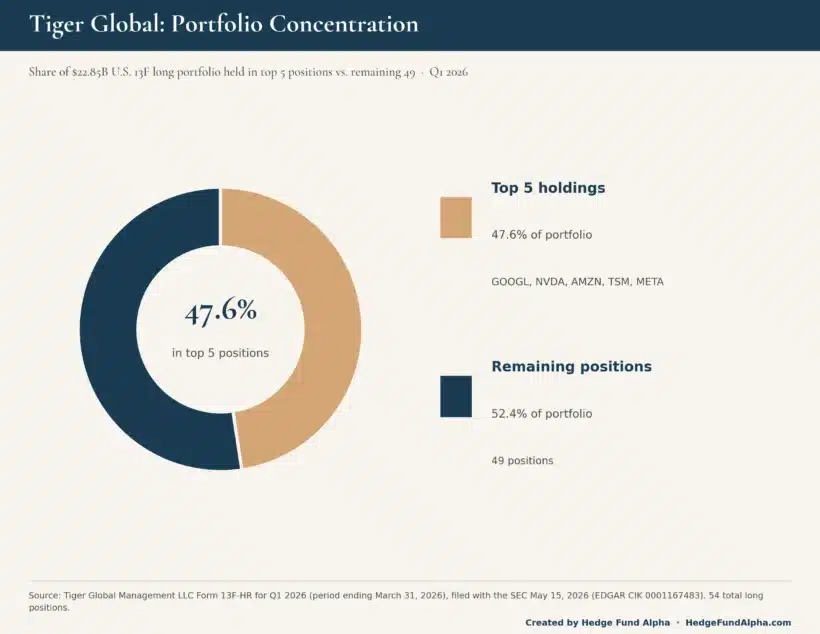
The portfolio is highly concentrated: its five largest positions account for roughly 48% of the 13F book. These positions are largely centered on mega-cap technology companies and semiconductor leaders, including Alphabet, NVIDIA, Amazon, and TSMC. This reflects Tiger Global’s strong conviction that AI, cloud computing, and semiconductor infrastructure will continue to drive long-term growth.
Beyond its largest holdings, the portfolio remains focused on technology and digital innovation. Tiger Global maintains significant investments in semiconductor equipment through Applied Materials and in fintech companies such as Corpay, Chime, Nu Holdings, Wealthfront, and Block. The firm also has meaningful positions in consumer internet and media businesses, including AppLovin, Take-Two Interactive, Reddit, Zillow, Netflix, and MercadoLibre. Additional investments in ServiceNow and Apollo Global Management further diversify the portfolio while maintaining its emphasis on long-term growth opportunities.
What Tiger Global Bought and Sold
During the transition from Q4 2025 to Q1 2026, Tiger Global increased its focus on AI hardware and critical infrastructure. Chase Coleman increased Tiger Global’s exposure to semiconductors and key technologies supporting the artificial intelligence boom. The firm added significantly to existing positions in TSMC, Applied Materials, Broadcom, and NVIDIA, while also increasing its stake in e-commerce company Coupang.
The firm concentrated more capital in its highest-conviction hardware investments. To do so, it reduced exposure to software, gaming, digital payments, and alternative asset management by trimming holdings in Microsoft, Take-Two Interactive, Block, ServiceNow, and Apollo Global Management.
The quarter also marked a significant portfolio reshaping, with Tiger Global fully exiting positions in Flutter Entertainment, Veeva Systems, Grab, Workday, Elastic, Hinge Health, and Circle, among others. At the same time, the firm added several new investments, including Latin American e-commerce leader MercadoLibre, semiconductor company Intel, optical technology provider Lumentum, and construction technology marketplace EquipmentShare.
Tiger Global’s Investment Strategy
While the 13F filing shows Tiger Global’s public equity holdings, it represents only one part of the firm’s broader crossover investment strategy. Tiger Global operates across both public markets and private venture capital. The firm focuses heavily on technology and growth companies at different stages of their development.
In private markets, Tiger Global changed traditional venture capital by focusing on speed and scale. Instead of taking a slow approach, the firm became known for investing capital quickly:
- Lightning-Fast Deployment: Tiger streamlined its due diligence process and quickly deployed large amounts of capital to compete with traditional venture funds.
- The Hands-Off Approach: Unlike legacy VCs that demand board seats and heavy operational oversight, Tiger adopts a strictly hands-off posture. They deliberately avoid taking board seats, allowing founders to run their businesses uninterrupted while Tiger leverages external consultants for post-investment support.
- Premium Pricing: Tiger focuses on growth rather than traditional value investing. The firm is willing to pay higher prices to secure investments in promising technology companies and compete in highly competitive funding rounds.
This high-velocity strategy carries real structural vulnerabilities. Paying peak multiples for unproven technology leaves the portfolio badly exposed when growth disappoints: if a startup never finds product-market fit, the write-downs can be steep. Crossover investing compounds the problem. Because Tiger Global holds private startups and public equities side by side, a shift in the broader economy or a swing in public markets can move the value of the entire book at once.
Tiger Global Performance & History
To understand Tiger Global’s current posture, one must look at the extreme volatility the firm navigated over the last five years. The firm’s signature “crossover model” combines investments in both private startups and public equities. This strategy faced significant challenges during the post-pandemic market cycle.
During the low-interest-rate period of 2021, Tiger Global’s growth-focused crossover strategy expanded rapidly. Acting as the most active venture investor globally, the firm executed roughly 350 private deals in a single year, according to PitchBook. At its peak at the end of 2021, Tiger Global’s firm-wide assets under management reached roughly $86 billion, according to the firm’s SEC filings.
When inflation surged and the Federal Reserve raised interest rates sharply in 2022, growth and technology stocks declined. Tiger Global faced pressure on both sides of its strategy, as public tech holdings fell and private investments were valued too highly.
The losses were severe, as tracked by major financial media:
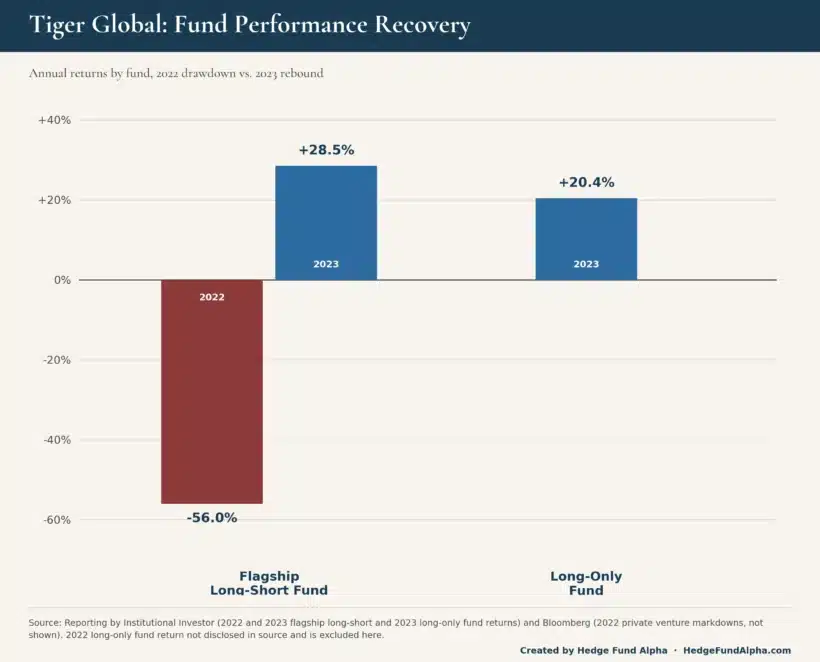
- The Flagship Fund: Tiger Global’s flagship public hedge fund plunged approximately 56% in 2022, marking one of the worst single-year losses in hedge fund history and erasing years of accumulated gains, according to reporting by Institutional Investor.
- Private Markdowns: Across its private venture capital funds, the firm wrote down the value of its investments in private startups by 33% in 2022, erasing roughly $23 billion in portfolio value, according to Bloomberg.
Tiger Global’s 2022 losses were compounded by a major retreat from China. After earning significant returns from early investments in Chinese tech companies like Alibaba and JD.com, Tiger Global reduced its exposure to the region. Rising regulatory pressure and geopolitical risks led the firm to pause new investments in China.
The repositioning showed up in the returns. Tiger Global’s flagship long-short fund gained 28.5% in 2023 and its long-only fund rose 20.4%, according to Institutional Investor, a partial recovery from 2022, though not enough to erase it. The firm’s ambitions in private markets stayed reduced: its next venture fund closed in 2024 at $2.2 billion, well short of a $6 billion target.
The China pivot, combined with the macro crash, forced a total portfolio reset. Tiger Global’s current 13F portfolio reflects these lessons. The firm has moved away from a “growth at any price” approach and now focuses on disciplined pricing, liquidity, and companies with strong long-term growth potential.
Frequently Asked Questions
What stocks does Tiger Global own?
As of its March 31, 2026 regulatory filing, Tiger Global’s public equity portfolio is heavily concentrated in mega-cap technology, artificial intelligence, and semiconductor giants. Its top holdings include Alphabet, NVIDIA, Amazon, Taiwan Semiconductor (TSMC), Meta, Sea Ltd., Broadcom, and Microsoft. This core group forms the bedrock of a highly focused 54-position public book.
How big is Tiger Global’s portfolio?
Tiger Global’s U.S. public long equity portfolio is valued at ~$22.85 billion as of the first quarter of 2026. It is important to note that this 13F figure only represents the firm’s liquid, publicly traded U.S. stock holdings. It does not include Tiger Global’s total Assets Under Management (AUM), which are much larger because they also include private equity and venture capital funds.
Who runs Tiger Global?
The firm is run by its billionaire founder, Chase Coleman. Coleman is one of the most prominent “Tiger Cubs,” a group of elite hedge fund managers trained by legendary investor Julian Robertson at Tiger Management. Robertson later provided the initial funding for Coleman to launch Tiger Global Management in 2001.
Is Tiger Global a hedge fund?
Tiger Global operates as a crossover investment firm. While it manages a traditional long/short public equity hedge fund, it also operates a large private equity and venture capital business. This two-part structure allows the firm to invest in disruptive technology companies from early startup funding through IPOs and into the public market.
What is Tiger Global’s investment strategy?
Tiger Global utilizes a high-conviction growth and technology-focused strategy. Across both public and private markets, the firm identifies powerful secular trends (like cloud computing and the AI infrastructure cycle) and deploys capital rapidly to secure large stakes. In the private markets, they are known for their fast deployment speed and a highly hands-off approach that grants founders maximum operational autonomy.
Related Content
- Chris Hohn Portfolio: TCI’s Top Holdings (Q1 2026)
- George Soros Portfolio: Soros Fund Management’s Top Holdings (2026)
- Charlie Munger Portfolio: His Holdings And Investing Legacy
- Howard Marks Portfolio: Analyzing His Risk Management Strategies
- Jeremy Grantham Portfolio Analysis: A Look at The Guru’s Top Holdings
- Joel Greenblatt Portfolio: Using His Magic Formula to Pick Winning Stocks