


Last updated June 2026 — London-based TCI Fund Management is a highly concentrated activist value fund. Founded in 2003 by Chris Hohn, the firm is recognized for its detailed fundamental research and targeted engagement with corporate management. Managing approximately $45 billion in 13F equities, TCI maintains a focused portfolio, dedicating the vast majority of its capital to a small handful of global leaders.
TCI’s investment framework combines value investing principles with shareholder activism. The firm achieved a record net gain of approximately $18.9 billion in 2025, reflecting the performance of its core strategies. The fund avoids broad diversification, choosing instead to deploy its capital into select secular compounders. Through this approach, the firm seeks to drive operational improvements and maximize long-term shareholder value across its holdings.
Chris Hohn’s Q1 2026 Portfolio at a Glance
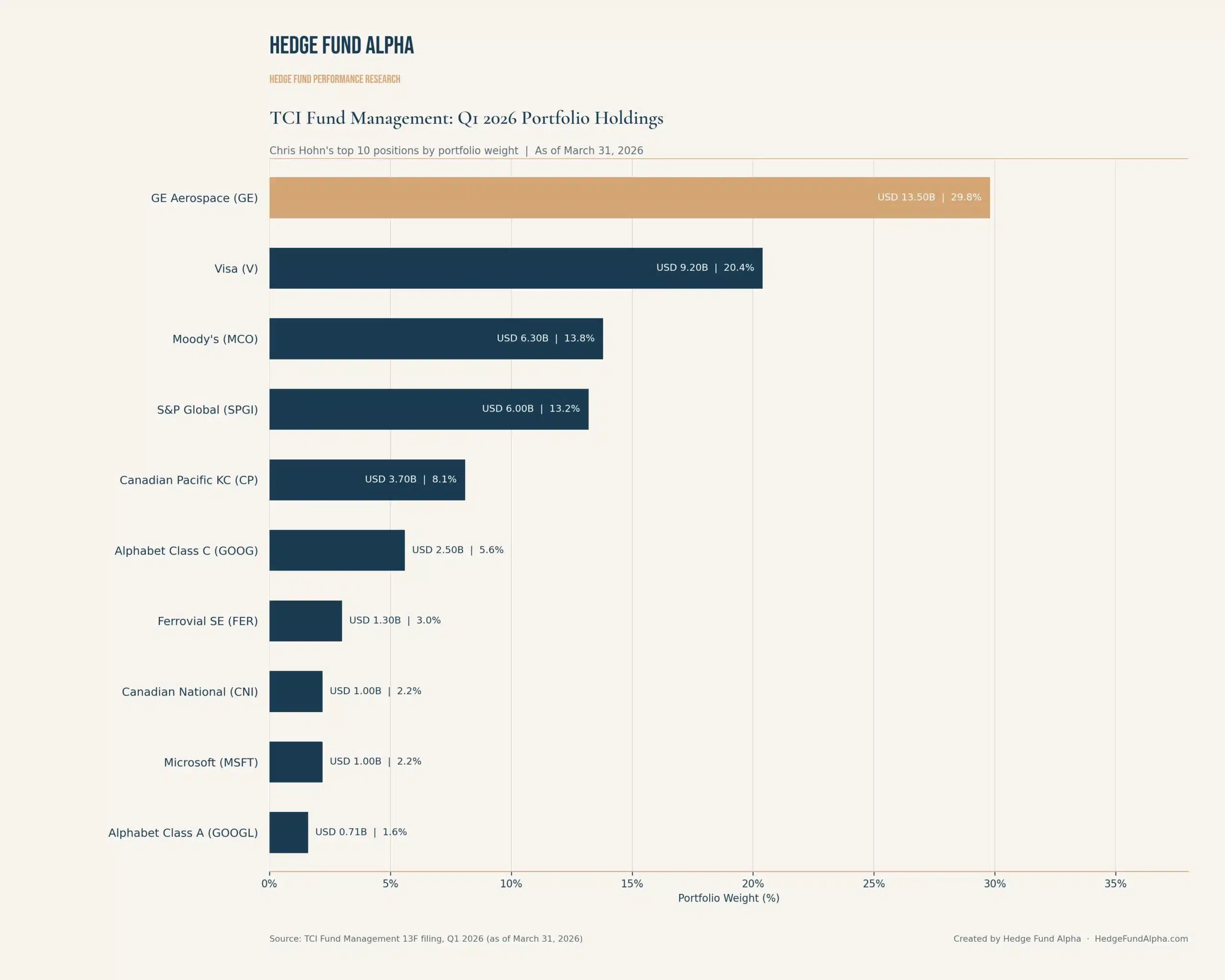
| Rank | Ticker | Company | % of the portfolio | Value | Shares | Note |
|---|---|---|---|---|---|---|
| 1 | GE | GE Aerospace | ~29.8% | ~$13.5B | ~47.5M | Was “GE”; kept thru split |
| 2 | V | Visa Inc – Class A | ~20.4% | ~$9.2B | ~30.5M | Held, increased |
| 3 | MCO | Moody’s Corp | ~13.8% | ~$6.3B | ~14.3M | Held, increased |
| 4 | SPGI | S&P Global Inc | ~13.2% | ~$6B | ~14M | Held, increased |
| 5 | CP | Canadian Pacific Kansas City | ~8.1% | ~$3.7B | ~46.5M | Held, trimmed |
| 6 | GOOG | Alphabet Inc – Class C | ~5.6% | ~$2.5B | ~8.9M | Exited Q3’25, re-entered |
| 7 | FER | Ferrovial SE | ~3% | ~$1.3B | ~20.7M | NEW (activist infra, ~10% of co.) |
| 8 | CNI | Canadian National Railway | ~2.2% | ~$1B | ~9.8M | Held, heavily cut |
| 9 | MSFT | Microsoft Corp | ~2.2% | ~$1B | ~2.7M | SLASHED ~84% (AI call) |
| 10 | GOOGL | Alphabet Inc – Class A | ~1.6% | ~$0.71B | ~2.5M | NEW class line |
Source: TCI Fund Management 13F filing for Q1 2026, as of March 31, 2026.
What Changed in the Chris Hohn Portfolio
TCI’s recent regulatory filings reveal significant capital reallocations. The portfolio remains highly concentrated. Approximately nine distinct corporate names comprise nearly 100% of its equity assets. However, the underlying composition shifted across technology, industrials, and infrastructure.
TCI executed a major restructuring of its technology exposure, headlined by an 84% reduction in its Microsoft (MSFT) position. The fund lowered this stake from roughly 10% of the book down to a residual 2% holding. In doing so, Chris Hohn challenged the consensus market narrative. He reframed Microsoft from a definitive AI winner into a potential casualty of rapid technological change. Hohn cited generative AI as a structural disruption risk to the core Office productivity suite. He also expressed caution regarding Azure’s long-term competitive position. This divestment occurred during the same period that Bill Ackman’s Pershing Square was actively adding to its own Microsoft exposure.
TCI subsequently rotated its mega-cap technology capital into Alphabet as its preferred AI play. The fund re-established its Class C (GOOG) position, which it had fully exited in Q3 2025, while introducing a brand-new Class A (GOOGL) line. Together, these combined Alphabet holdings now represent roughly 7% of the total book, priced at approximately $3.2 billion.
In the industrial segment, TCI strategically navigated the three-way corporate split of General Electric into GE Aerospace, GE Vernova (GEV), and GE HealthCare (GEHC). The fund liquidated all shares of the power and healthcare spin-offs, choosing to retain only GE Aerospace (GE). Following this consolidation, GE Aerospace became the portfolio’s top holding, commanding roughly 29.85% of assets, or approximately $13.5 billion.
Concurrently, the fund increased its exposure to its financial infrastructure trio: Visa, Moody’s, and S&P Global. This payments, ratings, and data cluster has become the primary backbone of the portfolio. Together, these three names account for roughly 47% of total capital. Visa alone serves as the second-largest position at approximately 20% of the book.
To further anchor its infrastructure focus, TCI initiated a significant new activist stake in Ferrovial (FER), a Spanish-Dutch infrastructure and toll-road operator. The fund built a position representing roughly 10% of the company’s outstanding shares. This equates to $1.3 billion, or roughly 3% of TCI’s total book.
To fund these extensive capital rotations, Hohn significantly reduced the fund’s legacy railroad allocations. Canadian National (CNI) was heavily cut from 15.81% to roughly 2.2% of assets. In parallel, Canadian Pacific Kansas City (CP) was trimmed from 14.18% to approximately 8.1%. Despite these major adjustments, the portfolio’s core layout remains intact, maintaining its distinct mandate of high-conviction ownership.
Chris Hohn’s Top Holdings in Detail
GE Aerospace (GE)
As of the Q1 2026 reporting period, GE Aerospace operates as the portfolio’s primary anchor, representing approximately 29.85% of total equity assets. This position reflects a transition from the historical General Electric holding.
The change followed the corporate parent’s structural split into separate aerospace, energy, and healthcare entities. TCI liquidated its spin-off exposure and concentrated its investment in the aerospace business. At quarter-end, the fund held 47.51 million shares priced at approximately $13.48 billion.
Visa (V)
Visa remains the fund’s second-largest position, commanding approximately 20.39% of the equity book. TCI increased its commitment to the global payments network during the quarter, bringing its total share count to 30.47 million. This strategic addition values the core holding at approximately $9.21 billion.
Moody’s (MCO) & S&P Global (SPGI)
TCI’s credit ratings and financial data core consists of positions in Moody’s and S&P Global. Together, these holdings serve as a primary driver of the fund’s financial infrastructure exposure.
During Q1 2026, the fund increased its share count in Moody’s by 7.71% and expanded its S&P Global position by 19.04%. These adjustments resulted in a Moody’s position of 14.33 million shares, valued at $6.25 billion and representing 13.84% of the book. They also left TCI with 14.04 million shares of S&P Global, with a price tag of $5.97 billion and accounting for 13.22% of the portfolio.
Canadian Pacific Kansas City (CP)
Following a broader reallocation within the transportation sector, Canadian Pacific Kansas City functions as the fund’s primary remaining railroad position. The holding accounts for approximately 8.10% of total assets. TCI holds 46.52 million shares of the transcontinental rail operator, representing a market value of approximately $3.66 billion.
Alphabet (GOOG / GOOGL)
TCI reconfigured its big-tech exposure by executing a capital rotation back into Alphabet across two distinct share classes. The fund re-established its Class C (GOOG) position after fully exiting it in a previous quarter. The holding totaled 8.85 million shares valued at $2.54 billion, or 5.62% of the book. Concurrently, TCI introduced a new Class A (GOOGL) position consisting of 2.46 million shares valued at $706 million, representing 1.56% of total capital. This established a combined Alphabet position of over 7%.
Ferrovial SE (FER)
Ferrovial SE represents the portfolio’s most notable new activist entry, aligning with the fund’s historical preference for long-duration infrastructure assets. The Spanish-Dutch transport and toll-road operator accounts for 2.94% of the equity book, with a position of 20.74 million shares valued at $1.33 billion. This position grants TCI an influential ownership stake of approximately 10% in the underlying company.
Canadian National (CNI) & Microsoft (MSFT)
The portfolio’s cut-down tails consist of Canadian National and Microsoft, which have both been reduced to roughly 2.24% of total equity exposure. Canadian National was heavily scaled back to 9.85 million shares, valued at $1.01 billion. The move reflects a consolidation of the fund’s logistics footprint. Concurrently, Microsoft was reduced by approximately 84% to 2.73 million shares, priced at $1.01 billion. This sharp divestment was driven by an AI-disruption thesis. The thesis posits that advances in generative AI present structural long-term risks to Microsoft’s enterprise productivity franchise and to Azure’s cloud infrastructure margins.
Why Hohn Cut Microsoft
The primary headline from TCI Fund Management’s Q1 2026 portfolio update was a structural re-evaluation of its decade-long investment in Microsoft (MSFT). During the quarter, Chris Hohn reduced TCI’s exposure to the software giant by approximately 84%. Before the sale, the position represented roughly 10% of the fund’s portfolio, or about $8 billion. Afterward, it was reduced to a residual holding of 1% to 2%. This multi-billion-dollar divestment represented a shift in perspective on the company’s long-term competitive positioning.
The divestment challenged the consensus narrative, reframing Microsoft from a definitive AI winner into a potential casualty of technological change. The rationale focuses on two primary structural risks:
- Office Franchise Vulnerability: Rapid advancements in generative AI introduce direct disruption risks to the Office productivity suite, as new workflows could bypass Microsoft’s traditional software ecosystem.
- Azure Competitive Pressures: TCI identified growing risks to Azure’s long-term market position, citing intensifying infrastructure competition and shifting cloud dynamics.
TCI did not abandon the technology sector entirely. Instead, it rotated capital toward Alphabet, making it the fund’s preferred large-cap technology exposure to the AI theme. After fully exiting its Class C (GOOG) shares in Q3 2025, the fund re-established the position in Q1 2026 while simultaneously introducing a new Class A (GOOGL) line. This combined Alphabet allocation now represents roughly 7% of total capital (~$3.2 billion), reflecting a preference for Alphabet’s vertical integration and proprietary model training infrastructure.
Bill Ackman’s Pershing Square initiated a brand-new $2 billion stake in Microsoft during the early 2026 market correction. Ackman focused on attractive near-term valuations and the immediate monetization of Azure. Hohn, by contrast, prioritized defensive moats and chose to step away as capital expenditure requirements across the sector intensified.
Key Sectors
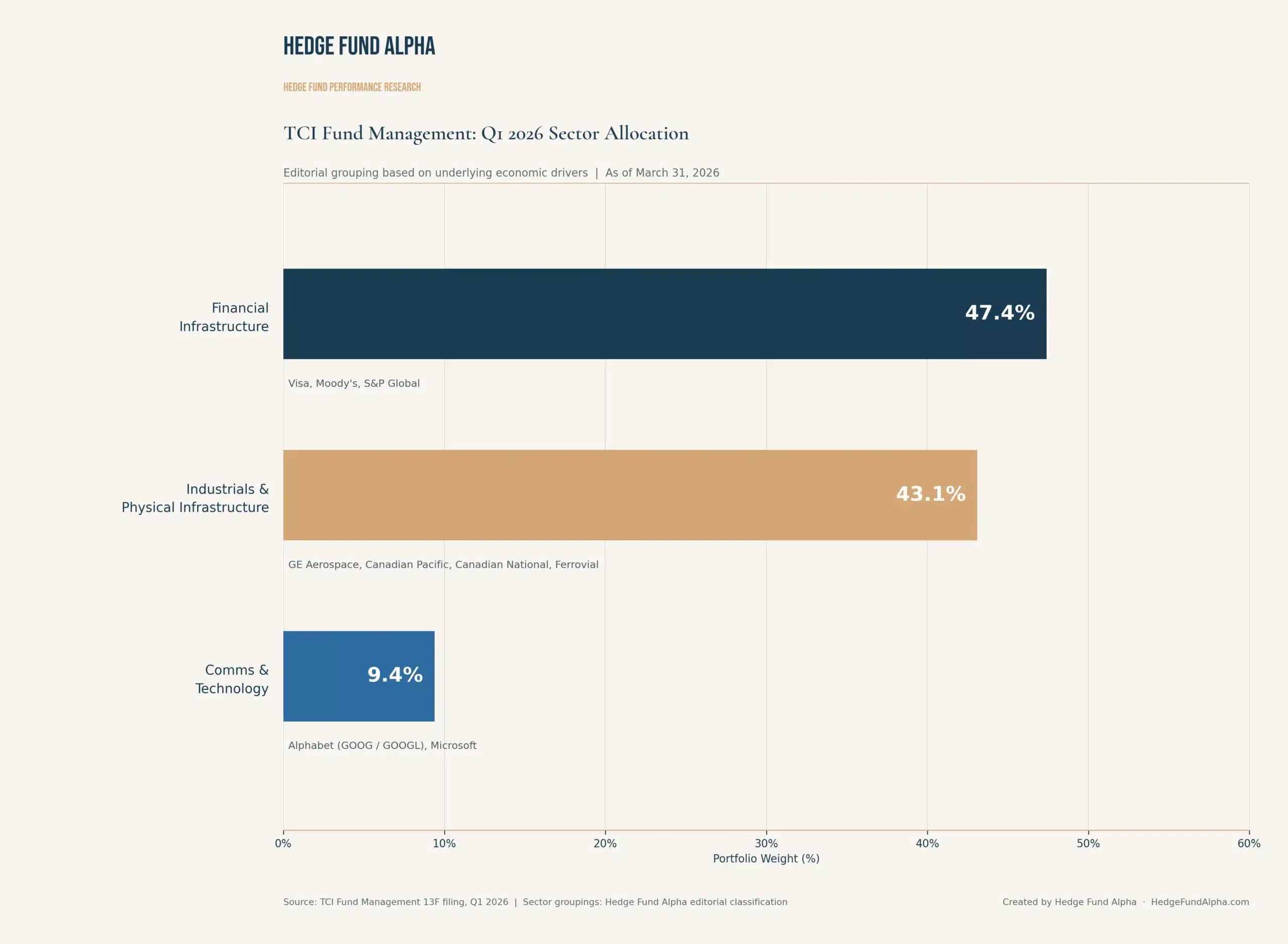
TCI’s capital allocation reflects a concentrated approach to specific business models. Standard market aggregators do not publish a uniform sector table for this portfolio. Therefore, the classifications below represent an editorial grouping based on underlying economic drivers rather than official regulatory definitions.
- Financial Infrastructure (~47%): This represents the fund’s largest allocation. It focuses on asset-light transaction networks, global exchanges, and data providers with high barriers to entry. Core positions in this category include Visa, Moody’s, and S&P Global (SPGI).
- Industrials and Physical Infrastructure (~43%): This is the portfolio’s second major pillar. Capital is directed toward transport, logistics, and industrial firms that benefit from structural demand and tangible asset moats. Key holdings include GE Aerospace, Canadian Pacific (CP), Canadian National (CNI), and Ferrovial.
- Communication Services and Technology (~9%): This represents a selective, scaled-back exposure. The allocation follows the fund’s strategic pivot away from legacy enterprise software platforms. It consists primarily of Alphabet (Class A and C shares) alongside the residual position in Microsoft (MSFT).
Chris Hohn’s Investment Philosophy & Strategies
Chris Hohn integrates the core principles of value investing, picked up from Warren Buffett, with structured shareholder activism. Influenced by long-term fundamental analysis, his investment process focuses on identifying companies with sustainable business models and durable competitive advantages.
TCI secures an informational advantage by employing specialized analysts with deep industry expertise. This targeted research helps the firm assess competitive landscapes and discover overlooked or undervalued assets globally. While the fund maintains a highly concentrated portfolio, it deliberately seeks geographic diversification across international markets.
The central pillar of TCI’s strategy is executing activist campaigns to influence corporate direction. The firm leverages its ownership stakes to pressure management teams into making operational improvements, spinning off non-core assets, and reforming capital allocation.
Take A Look At Chris Hohn explains His Investment Strategy:

TCI’s history across global markets highlights a persistent willingness to challenge corporate governance and capital structures:
- Deutsche Börse (2005): TCI successfully blocked the German exchange operator’s proposed acquisition of the London Stock Exchange. The campaign forced the removal of the CEO and resulted in substantial capital returns to shareholders.
- ABN AMRO (2007): The fund built a prominent stake in the Dutch bank and publicly campaigned for its breakup. This pressure ultimately led to a multi-bank consortium acquisition of the institution.
- J-Power (2008): TCI targeted the Tokyo-based utility to push for increased dividends, independent board representation, and a reduction in cross-shareholdings. TCI raised its ownership stake from 9% to 20%, though the campaign ultimately fell short due to regulatory pushback.
- Canadian National Railway (2021–2022): The fund actively opposed the railroad’s multi-billion-dollar bid to acquire Kansas City Southern, labeling the transaction as financially imprudent. TCI’s engagement forced a management shakeup and a renewed focus on core railroad operations.
- Ferrovial (Current): TCI holds a substantial stake of approximately 10% in the global infrastructure operator. The fund has utilized its position to support the firm’s strategic corporate relocation to the Netherlands and its dual listing on the Nasdaq, aiming to maximize North American infrastructure asset value.
Key Takeaways
Extreme Portfolio Concentration: TCI maintains an exceptionally focused allocation strategy. It consolidates its $45 billion 13F equity book into approximately nine distinct corporate names, which together account for nearly 100% of its total equity exposure. This highly concentrated architecture is anchored by GE Aerospace, which holds the top position at roughly 30% of the book.
The Financial Infrastructure Backbone: Asset-light financial data and transaction networks form the primary core of the portfolio. This segment represents an editorial grouping of roughly 47% of total assets. Recent capital additions to Visa, Moody’s, and S&P Global emphasize the fund’s conviction in businesses with high barriers to entry.
They also reflect a preference for recurring revenue streams and steady pricing power.
The Strategic Microsoft AI Divestment: Challenging the consensus market narrative, TCI executed a significant 84% reduction in its Microsoft (MSFT) stake. This lowered the position to a residual 2% holding. The multi-billion-dollar divestment reflects a thesis that positions generative AI as a long-term structural disruption risk to the Office productivity suite and Azure’s margins. It prompted a capital rotation into Alphabet as the fund’s preferred technology exposure.
Frequently Asked Questions
What are the top holdings of the TCI Fund?
The firm’s top core holdings, in order of portfolio weight, are GE Aerospace, Visa, Moody’s, S&P Global, and Canadian Pacific.
Who runs TCI Fund Management?
TCI was founded in London in 2003 by Chris Hohn, who continues to run the firm and direct its investment activities.
What is Chris Hohn’s biggest holding?
The fund’s largest position is GE Aerospace, which commands an outsized allocation of approximately 30% of the total 13F equity portfolio.
Why did Chris Hohn sell Microsoft?
TCI reduced its Microsoft position by approximately 84% in Q1 2026. Hohn cited structural concerns over artificial intelligence acting as a direct disruption risk to the core Office productivity ecosystem, alongside growing unease regarding Azure’s long-term competitive position.
How big is the Chris Hohn / TCI portfolio?
As of Q1 2026, TCI manages approximately $45 billion in 13F regulatory equities. The firm’s total regulatory assets under management (AUM), which includes cash and non-13F assets, is larger.
Related Content
- Chris Davis Portfolio: Key Investment & Portfolio Performance Analysis
- Chuck Akre Portfolio: 3 Stocks This Investing Great is Buying Up
- Ken Fisher Portfolio Revealed: His Top Stock Holdings
- David Tepper Portfolio: How This Billionaire Crushes the Market
- Ron Baron Portfolio Magic: Building Your Financial Future
- Tom Russo Portfolio Performance Analysis & Current Holdings