


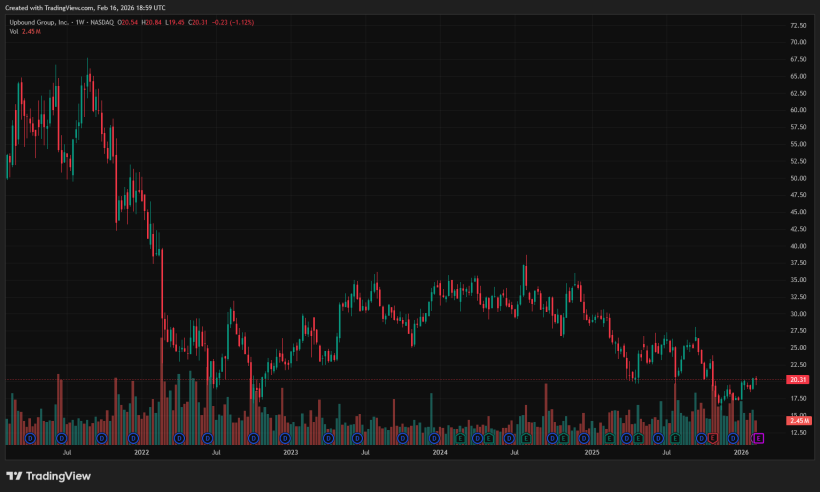
Upbound Group Inc (NASDAQ:UPBD) is being priced like a complicated, leveraged, credit-sensitive retail operator. And honestly… the structure kind of deserves that discount: a store-heavy legacy business sitting next to a higher-quality platform engine, all wrapped together with leverage and lease obligations.
That’s exactly why this screens like an activist setup. The “fix” isn’t storytelling. The fix is structural:
- Separate / sell the store complex (and anything else that drags the multiple)
- Delever with clear rules (so the equity stops trading like a leveraged credit sleeve)
- Shrink the share count hard while the market is still mispricing the whole wrapper
If you do that, you stop asking the market to underwrite a messy hybrid—and you give it a cleaner “Platform HoldCo” it can actually pay for.
Key takeaways
- Upbound already breaks out the business in a way that supports a credible separation: platform-driven economics (Acima) vs store-heavy operations (Rent-A-Center & Mexico), with Brigit sitting as a DTC fintech lever.
- The balance sheet is both the constraint and the forcing function: cash of about $107m vs total debt around $1.55b (net debt ~ $1.46b) plus operating lease liabilities around $286.7m. This is why “just wait for a rerate” isn’t a plan.
- The activist value engine here is mechanical: asset sale → debt paydown → buybacks. In the framework used, divesting roughly ~41% of revenue implies pro-rata debt paydown of ~$0.64b, with remaining proceeds funding aggressive repurchases.
- Under reasonable scenarios, the buyback math can basically be the story: illustrative outcomes show the share count compressing from ~56m to the mid-30m’s or even the high-20m’s, depending on divest value.
The setup
At the reference price used in the memo (~$20.3/share), Upbound trades like a blended “risk bucket” rather than a platform. The market isn’t giving you credit for platform optionality while stores, leverage, leases, and regulatory/legal noise dominate the underwriting.
So the activist approach is straightforward: remove what the market refuses to value, and let the remainder re-rate.
What the business actually is
Upbound is already effectively a portfolio.
"Keep" bucket: Platform & DTC
- Acima: partner-distributed lease-to-own platform (the scalable engine)
- Brigit: DTC fintech product layered on top (the optionality lever)
"Sell / separate" bucket: Stores & Mexico
- Rent-A-Center: store ops are operationally heavy, margin-noisy, and they anchor the multiple to “retail & credit risk”
- Mexico: smaller, but it’s part of the “store/region complexity” bundle
Q3’25 segment revenue snapshot (as used in the memo):
| Segment | Revenue ($m) |
|---|---|
| Acima | 625.3 |
| Rent-A-Center | 461.1 |
| Brigit | 57.7 |
| Mexico | 20.7 |
| Total | 1,164.7 |
The point isn’t the quarter. The point is the structure: a buyer can diligence this, and a board can separate it.
Why the market discount exists
This is what caps the valuation:
1) Leverage & fixed obligations
Upbound carries material debt and lease liabilities. Even if operations improve, the equity multiple stays constrained until the balance sheet looks less “fragile.”
Balance sheet anchors (as used in the memo):
| Item | Amount ($m) |
|---|---|
| Cash | ~107 |
| Total debt | ~1,549 |
| Net debt (company cited) | ~1,457 |
| Operating lease liabilities | ~286.7 |
2) Stores create operational noise
Stores drag you into a messy operational story (labor/occupancy, delivery, refurb/recovery, credit outcomes, etc.). The market does not pay “platform multiples” for that wrapper.
3) Regulatory/legal headline risk keeps investors cautious
Even when manageable, this stuff caps marginal buyers and creates a “why bother?” discount.
So yes—the discount is rational. The opportunity is that the company can change what it is.
The activist thesis: “Buy the platform, sell the stores”
Step 1 — Force a real strategic process
Not a press release. A real dual-track process:
- Separate / sell the store complex (RAC & Mexico together or separately)
- Run a parallel “whole company” backstop process to keep bidders honest
Step 2 — Hard-wire the capital allocation waterfall
This is the part boards like to wiggle out of. Don’t let them.
Rules-based waterfall (the memo’s framework):
- Pay down debt pro-rata to the revenue you divest (keeps leverage defensible)
- Hold a defined separation/transition reserve
- Everything else goes to buybacks (tender & open market)
The memo uses divested revenue share of ~41.4% (RAC & Mexico), implying roughly ~$0.64b debt paydown on about ~$1.546b net-basis debt.
Step 3 — Reintroduce the remainder as “Platform HoldCo”
Post-sale, the market can underwrite a simpler story: platform economics & DTC optionality, with lower public-company bloat and less operational noise.
The real value engine: buyback torque
If you sell assets while the stock is still cheap, repurchases can do more work than any “multiple expansion” pitch.
Illustrative proceeds waterfall assumptions (as used in the memo):
- Divest EV cases: $1.0b / $1.24b / $1.4b
- ~5% leakage
- ~$0.64b debt paydown
- $0.12b transition reserve
- Buybacks at ~$20.3/share
- Starting shares ~56.16m
Illustrative share count outcomes:
| Divest EV case | Buyback cash (approx.) | Ending shares (approx.) |
|---|---|---|
| 1.00b | ~0.23b | ~44.9m |
| 1.24b | ~0.42b | ~35.5m |
| 1.40b | ~0.57b | ~28.0m |
That’s the game. You don’t need to “win” a debate with the market. You change the denominator, simplify the narrative, and remove leverage fear.
Valuation framework: what could this be worth after the split?
A) “Self-help re-rate” (platform multiple & corporate cost-out & fewer shares)
The memo runs a sensitivity around:
- Platform multiple (7x / 8x / 9x)
- Corporate cost-out (+$30m / +$55m / +$80m)
- Share count outcome based on divest value
In the memo’s base case (divest EV $1.24b, 8.0x multiple, +$55m cost-out), implied value is about ~$39/share (roughly +93% vs ~$20.3 reference).
B) Backstop: sell the whole company
If the board won’t execute a split, the activist backstop is a full sale.
Using LTM Adjusted EBITDA of about ~$505.7m and net debt around ~$1.457b, the memo frames a 6.0x–7.5x takeout range equating to roughly $28–$41.5/share.
What the activist does in the first 120 days
Days 0–30: build stake & force the process
- Accumulate a meaningful stake (enough to matter, not enough to get ignored)
- Private engagement: demand a formal review, advisors, timetable
- Push for better disclosure around unit economics / loss and recovery KPIs so the market stops assuming the worst
Days 30–60: escalate if they stall
- If stonewalled: go public (clean thesis, no drama)
- Push for independent committee governance
- Begin buyer outreach under NDA
Days 60–120: data room → IOIs → LOIs
- Run the process fast and tight
- Negotiate TSAs and stranded cost elimination aggressively
- Make the capital allocation waterfall explicit (don’t let proceeds drift into “strategic reinvestment”)
Board “asks” (non-negotiables)
- Run the process (no theater).
- Publish a rules-based proceeds waterfall: debt paydown & fixed reserve & buybacks.
- Corporate reset plan with dates and dollar targets (cost-out, TSA duration, platform KPI reporting).
Risks
- Credit turns (loss rates spike, recoveries weaken).
- Regulatory/legal overhang worsens or drags longer than expected.
- Store asset sale value disappoints (thin buyer universe, buyers demand steep haircuts).
- Stranded costs remain and eat the “platform multiple” uplift.
- TSA/separation execution gets sloppy (this is where deals bleed value if you don’t manage it).
Bottom line
Upbound is priced like a blended problem. You don’t fix that with quarterly updates and hope.
You fix it by changing the structure:
- Sell/separate the store-heavy engines
- Delever with clear rules
- Buy back stock aggressively while the market is still skeptical
That’s how you turn a "messy wrapper discount" into a per-share value event.
Disclaimer: Not investment advice. This is an activism/structure discussion for informational purposes.