


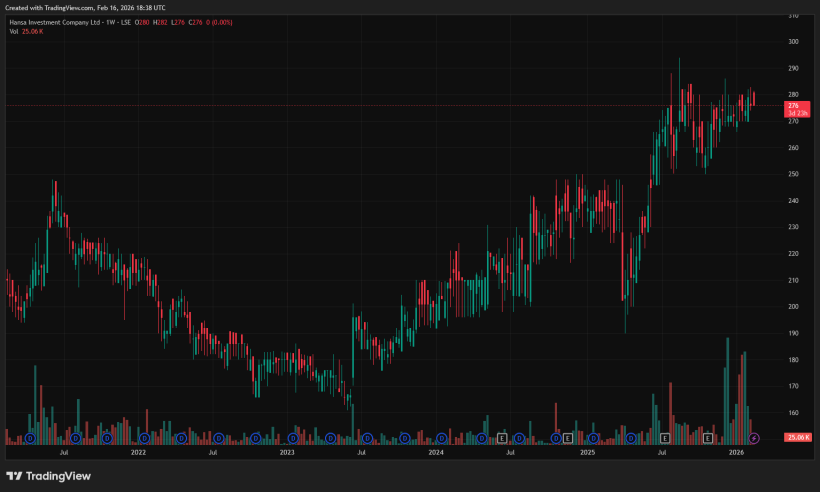
Hansa Investment Company Limited (LON:HAN) is not a “hidden assets” story. The assets are marked, disclosed, and largely liquid. The story is simpler — and more frustrating: for years, the public market has charged Hansa a deep structural discount because investors don’t believe the wrapper will reliably deliver NAV to shareholders on a reasonable timetable.
Even after the HY2025 NAV uplift, that problem hasn’t gone away. At a 280p share price, the Ordinary (voting) shares still trade at roughly a 31% discount to the last reported 405.4p NAV (HY2025). That discount is the opportunity — if (and only if) the Board moves from “incremental” buybacks to a rules-based discount control program with teeth.
[Hansa HY2025 Half-Year Report (30 Sep 2025); Hansa FY2025 Annual Report (31 Mar 2025)]
The market snapshot: why this still screens like a set-up
Using the last reported NAV for the Ordinary line (405.4p) and the latest price we’re looking at (280p), the discount is still large enough to be a live value-realisation trade — not because the portfolio is special, but because buying back stock below NAV is mechanically accretive.
Importantly, activism in investment trusts isn’t about forecasting earnings. It’s about forcing the structure to stop leaking value.
The “activism math” is also clean because the voting line is easy to frame. The Ordinary share class is the voting line, and the share count disclosed is 40.0m Ordinary shares. On that basis:
- Voting-line market cap is roughly £112m
- Voting-line NAV-equity value is roughly £162m
- The gap — the “discount leakage” embedded in the voting line — is roughly £50m
That is real money sitting in plain sight.
[Hansa HY2025 Half-Year Report (30 Sep 2025)]
What Hansa actually is: a liquid portfolio trapped in a trust discount
Hansa is a London-listed, Bermuda-incorporated investment company with a multi-sleeve structure: core funds/thematic assets, a strategic holding in Ocean Wilsons, direct global equities, diversifying funds, and a small private assets sleeve.
Because the portfolio is reported at fair value, NAV is already the sum-of-the-parts. If the stock trades at a 30–40% discount anyway, the market is telling you the problem isn’t valuation — it’s trust, structure, and capital allocation credibility.
FY2025 also makes clear this is persistent: the discount has lived in the high-20s to mid-40s range across the last decade. The market doesn’t believe the wrapper will close the gap without being forced.
[Hansa FY2025 Annual Report (31 Mar 2025)]
The Board’s stated buybacks help - but they’re not a solution
Hansa’s messaging is directionally positive: buybacks are prioritised, with a stated policy targeting 2–4% annualised on a rolling basis. The problem is that a multi-decade structural discount doesn’t close because of “some buybacks.” It closes when the market believes discount control is non-discretionary — i.e., rules-based, repeatable, and sized properly.
If the Board reserves the right to buy back “a bit” each year, investors rationally assume the discount can persist indefinitely.
[Hansa FY2025 Annual Report (31 Mar 2025); Hansa HY2025 Half-Year Report (30 Sep 2025)]
Why the Ocean Wilsons simplification matters (and why it’s not enough on its own)
HY2025 highlights that the “Possible Combination” process with Ocean Wilsons was still live at that time, with a Bermuda court hearing delayed following a shareholder objection and scheduled for late October 2025.
This kind of simplification matters because it can remove double-discount mechanics and reduce the complexity haircut. But simplification alone rarely closes a structural discount unless it is paired with a policy regime that converts NAV into per-share value in a way shareholders can underwrite.
[Hansa HY2025 Half-Year Report (30 Sep 2025)]
The value engine: discount control plus capital recycling
The cleanest way to think about Hansa is that the Board controls two things that matter:
- What exposures sit inside the wrapper, and
- Whether the wrapper is obligated to close the discount.
A credible program usually looks like this:
1) Capital recycling
Sell what the market can own directly (replicable beta, listed vehicles, liquid direct equities), then recycle proceeds into tenders/buybacks. This isn’t about “selling everything.” It’s about removing the easiest-to-criticise sleeves first — the ones that make investors ask, “Why should I accept a 30–40% discount to own an ETF?”
2) Rules-based discount control
A hard framework typically includes:
- If the rolling average discount exceeds X% for Y months → execute a tender for Z% (repeatable)
- Authority for ongoing on-market buybacks above a secondary threshold
- A simple monthly scorecard: discount, shares retired, NAV per share accretion, progress vs targets
The goal is to turn “hope the market re-rates us” into a forced maths trade.
The mechanical point: buybacks below NAV work, but credibility is everything
Here’s the point the market cares about: if the trust buys back shares at a discount, NAV per share rises for remaining holders. That is not theory — it’s arithmetic.
Using the HY2025 baseline (NAV 405.4p, discount roughly 31% at 280p) and a very plain set of illustrative steps:
- Retire 20% of shares at the current discount → NAV per share moves up meaningfully
- Retire a further 15% of remaining shares at a tighter discount (assuming credibility improves) → NAV per share lifts again
But the re-rating does not come from accretion alone. The re-rating comes when the market believes the process is enforceable, not optional.
This is why “2–4% a year” is not a solution: it’s not a commitment that changes investor expectations.
The register reality: this is an alignment trade, not a proxy fight
Any serious engagement plan starts with the ownership structure. The Ordinary line holds the votes; the ‘A’ line is non-voting. FY2025 disclosures also show meaningful concentrations in the voting line.
That matters because a hostile proxy fight is usually a dead end in structures like this. The workable route is alignment-first: show the large holders that discount control is the cleanest way for them to monetise the same gap everyone else sees.
In other words: this doesn’t need theatrics. It needs a credible policy package.
[Hansa FY2025 Annual Report (31 Mar 2025); Hansa HY2025 Half-Year Report (30 Sep 2025)]
The clean pitch
Hansa’s problem is not the portfolio. It’s the discount.
At 280p, the Ordinary shares still embed a large valuation haircut versus the last reported NAV. If the Board wants that to change, the market needs more than commentary and incremental buybacks. It needs a rules-based discount control regime, paired with portfolio simplification and a clear execution cadence (monthly scorecard, explicit triggers, repeatable tenders).
If that package appears, the discount can tighten and stay tight. If it doesn’t, the stock can remain “cheap forever,” regardless of how well the underlying assets perform.
Disclosure / disclaimer
This is not investment advice. It is a research-driven, scenario-based analysis using the company’s published reports and publicly disclosed figures. Investors should do their own work and consider liquidity, volatility, and execution risk.