



When it comes to raising a new fund, sometimes marketing can be one of the most difficult tasks, but one hedge fund team discovered a way to raise money without doing any marketing at all.
In an interview with Hedge Fund Alpha, Gabriel Sammut and Matteo Muscat of Bilbel Capital shared everything from their investing strategy to how the former family office opened to outside investors without spending a dime on signing new investors.
Editor’s note (Jan 27, 2026): We are not investment advisers or securities lawyers, and nothing on this site should be construed as investment or legal advice. Please refer to our full disclaimer elsewhere on the site. We try to be thoughtful and selective about who we interview, but an interview should not be interpreted as an endorsement. We’re also not a due-diligence or research firm; beyond basic background checks, we don’t conduct comprehensive investigations into funds.
Ahead of publication, we sought to confirm Bilbel’s regulatory status and review any publicly available filings. We initially thought that registration with FINRA was expected in the near term, but that understanding turned out to be incorrect although it was a misunderstanding or miscommunication on our end. After publication, we became aware of the issue and temporarily pulled the piece while we reviewed additional information.
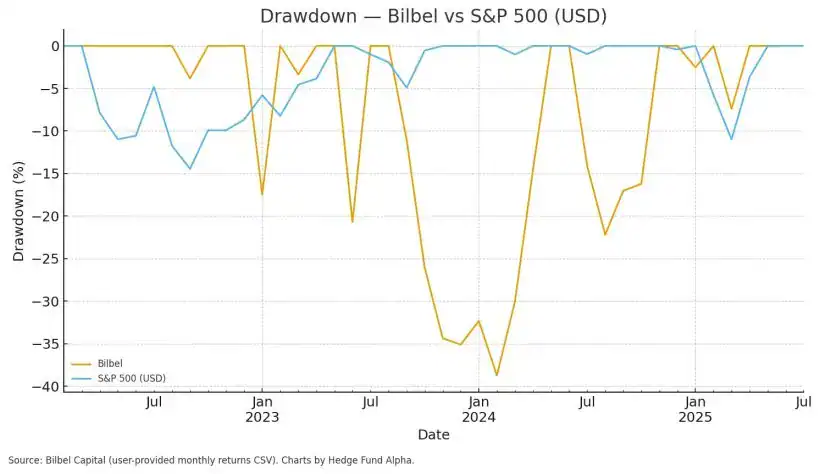
Bilbel then provided fund materials that appeared consistent with typical private-fund documentation and shared a list of established service providers (we have not independently contacted those providers). Based on the information we reviewed, we decided to re-post the original article. As with performance claims from any fund, readers should treat returns as unaudited unless explicitly stated otherwise. Bilbel also noted that performance has been driven by a highly concentrated position that appreciated significantly in recent years, which appears broadly consistent with that stock’s performance over the same period.
Bilbel sent the following from their lawyers:
Bilbel Capital LLC serves as the General Partner of Bilbel Capital Fund LP, a Delaware limited partnership, and provides investment management services to the Fund. The Fund relies on the Section 3(c)(1) exclusion under the Investment Company Act of 1940 and offers interests pursuant to Rule 506(c) of Regulation D, limited to verified accredited investors. Bilbel Capital LLC is not currently registered with the SEC as an investment adviser. It operates under an applicable exemption and completes any required regulatory filings consistent with that status. The firm maintains investor onboarding controls, including accredited investor verification and sanctions/KYC information requests consistent with offering requirements and the Fund’s subscription documentation. If SEC registration becomes required or otherwise appropriate as assets or regulatory status change, Bilbel Capital LLC will file and register accordingly.
Article continues below.
What’s in a name?
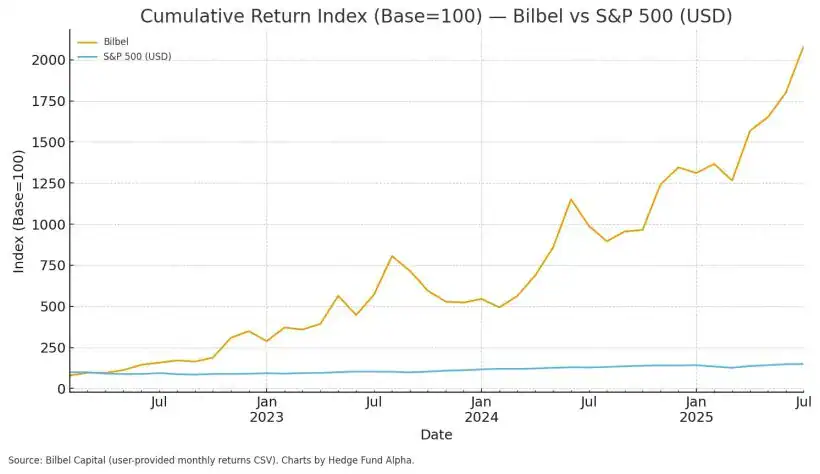
Bilbel Capital has been a family fund for the last three-and-a-half years, but it will be opening up to outside accredited investors in October 2025. Between February 2, 2022 and July 31, 2025, the family office has returned 1,984.74%, although Sammut emphasized that those types of returns won’t be sustainable going forward because returns depend on how much money is under management.
Also see: Armed with AI and Social Media, Retail Investors Are Confounding Some Institutional Investors
Bilbel Capital got its name from Sammut’s great-grandfather, whose nickname was Bilbel. During his life, his family was the only family living on a road with one farm in Qawra, Malta. As more farms started being built on that road, it came to be called Bilbel Street, and that’s where the entire Bilbel family started and continues to live today. Sammut and Muscat are both part of the Bilbel family.
From university to trading

When Sammut was 18, he began studying math and statistics at university, quickly realizing that wasn’t what he really wanted to do. He began looking for better ways to make money by searching the billionaires list and examining each one. When he came to Warren Buffett, Sammut realized that investing was something he could be good at.
“The more I learned about investing, the less I started enjoying my university classes,” he said. “So I eventually drifted out of university, and during this time, I received an offer to start working as a trader. So basically, I was hedging risk for algorithmic strategies. And I did that for a while, and I also worked as a trading analyst for a JPMorgan company. And after that, I returned to my first job as a trader, and now I'm working full time on Bilbel Capital.”
Sammut decided to go into fund management not long after he started learning about investing. He told himself that he’d spend about two years studying.
“I thought that after two years, I would know enough to at least not have a catastrophic event,” Sammut explained. “So I will know enough such that I think it would make sense to actually start investing. But when I started investing, I always had it in my mind that one day I could manage other people's money.”
Fundraising at Bilbel Capital

Muscat studied business management and was introduced to the world of investing through Sammut. Muscat especially became interested in what Sammut was doing when Sammut started writing letters and sharing his knowledge on Twitter. However, he knew that investing wasn’t necessarily his strength, so he saw other ways he could help make Bilbel Capital a reality.
“I realized that one of the ways I could help was through marketing and through taking part in the fundraising process, because obviously, now we're starting to look for investors to join our fund,” Muscat said. “… I took ownership of the social media accounts of Bilbel Capital, as well as the fundraising processes and setting up marketing initiatives to eventually try to reach as many people as possible and to build a community which is as big as possible.”
Also see: Brazilian Hedge Fund Shares Theses for OpenAI Beneficiary and Swiss Botox Alt Maker
How Bilbel Capital attracted outside investors
Marketing Bilbel Capital started with creating knowledge and value through content that explained concepts in a simple way to the firm’s followers. After the letters and social media content efforts were underway, the Bilbel team introduced their monthly podcast and Founder’s Insights Fridays, a campaign that involves sharing an insight from Sammut every Friday.
“As a result of the content following, the visitors on our website increased,” Muscat explained. “Our mailing list of subscribers also increased, and then I obviously took note of all the people who followed us because I wanted to try to see how many of those who followed us would actually be interested in potentially investing. To be honest, it was a very positive surprise, because I realized that those who followed us did not just follow us simply for the sake of following us. There were a very good number of those who followed us who were actually interested in potentially investing with us, and that that was a positive step.”
Building a community
Muscat received replies from most of those who followed Bilbel Capital asking for additional information and wanting to book meetings to learn more. However, he also said their main goal is to educate the community, and then the investors who signed on are “the byproduct” of that community. Muscat doesn’t view people as customers, noting that the relationship between a fund and an investor is a partnership based on trust and alignment.
“So that's why, first, we make sure to provide knowledge and gain trust, and then slowly, slowly start with the relationship through gradual contact, until potentially, some of those who follow us decide to get into a partnership with us,” he added. “The last point I would like to add is that till now, we have still not used any marketing budget. All the initiatives we've taken so far were all free.”
Also see: How Adam Wyden Continues to Win Big Over the Years Part 5: The 2022 Bear Market
How Sammut and Muscat joined forces
Sammut and Muscat started working together because of their aligned views. According to Muscat, they both always wanted to create something that grows large, and they realized their different skill sets could help and contribute.