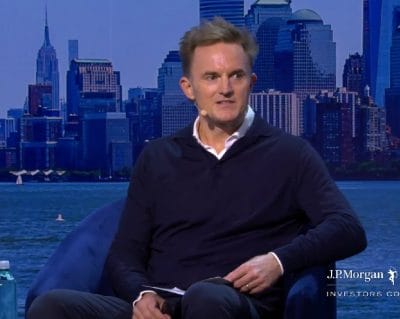


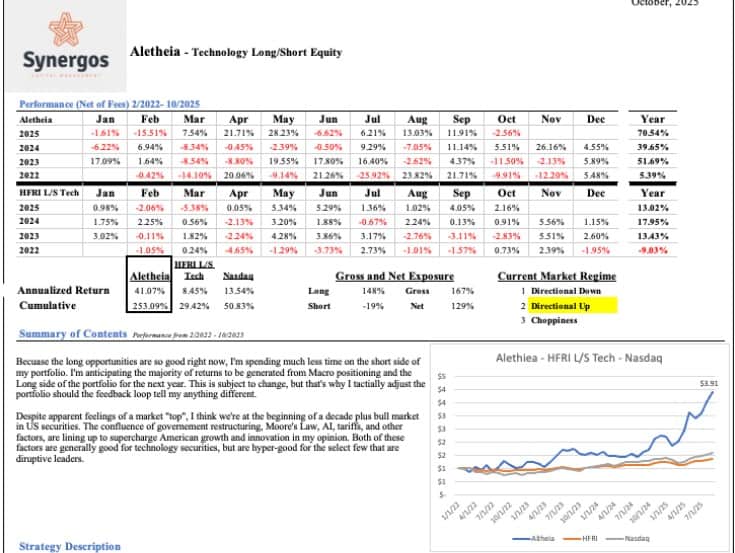
Synergos Capital Management is putting up impressive returns in 2025. Synergos Capital’s long/ short Aletheia strategy, is up 70.54% year to date. The other strategy, the long-only Kaleo fund, has gained 46.83% year to date. But this year is far from an anomaly, with the investment firm putting up strong returns across all of its hedge funds year after year, since inception. In an interview with Hedge Fund Alpha, Michel Klus, CAIA, of Synergos Capital shared his strategy and lessons learned over the years.
Background on Michel Klus
Klus’ parents escaped communist Czechoslovakia in 1969, which has significantly shaped his life, giving him appreciation for the freedom we have in the U.S. His grandparents on both sides of his family had very successful businesses that were taken away from him, and his father was jailed and charged with espionage for being found with American Marlboro cigarettes.
“I grew up with this narrative of anti-communism,” Klus said. “And the reason that comes into play is because I invest in that way. So we still have this war in our society today, and what I do is I make sure that none of the companies I invest in support anything that's Marxist, socialist or communist. I don't think you're going to find anybody else like that, but it's pretty simple. A lot of people have died for this country, and I'm not going to take any money and support our adversaries like I think is happening quite a bit these days in the investment market.”
Born in South Africa, Klus’ family moved to Dallas, Tex. when he was six. He spent most of his youth there, having always loved investing.
Also see: One of the Last Remaining O&G Managers: How to Profit from the Electric Grid Boom
At the Baylor University Endowment
Klus studied finance at Baylor University, wanting to do investing from day one. However, being in Waco, Texas, he didn’t find lots of options there in terms of internships.
“There was like typical retail banking and stuff or commercial banking, which I didn't want to do,” Klus said. “However, Baylor had an endowment that had actually done performance-wise really good the previous two years before my junior year and I was like, wow, I need to get in there and learn from those guys. So I just bugged them. It was a billion-dollar endowment at the time, and there were two that were in the office, John Hook and Scott Pittman, and I just bugged them like hey, I'll work for free. Give me work.”
Klus worked for the endowment during school, earning an internship during his junior year, which eventually turned into a full-time job after he graduated. He finds his endowment exposure to be very interesting, especially in that kind of small setting with good investors, because it gave him a hands-on, top-down view into a “myriad of different investment strategies.”