


Some hedge fund managers have put up numbers that are so good that allocators and investors might have trouble believing. What if there were a way to validate that track record, proving that they actually got the returns they’re reporting? Now there’s a new firm that will do exactly that.
validityBase is a set of tools used to showcase the value of predictive data and prove the track records reported by managers. Dan Averbukh and Greg Kapoustin started the firm based on a simple question: how can I prove the amazing track record of the algorithm I built?

Proving the legitimacy of algorithms and strategies
Averbukh and Kapoustin previously ran a systematic arbitrage trading fund called Clerkenwell Asset Management, which focused on opportunities enabled by market dislocations and frontier technologies. As the fund grew, they started to receive pitches on trading strategies and a variety of algorithms, and they had difficulties trying to determine whether the trading strategies and algorithms they were being pitched were legitimate.
Sure, they looked good on paper, but Averbukh and Kapoustin wanted to know if they would’ve gotten the presented results if they had actually invested in the strategy.
“How are we to know if the worst day of trading isn't there, or if somebody ran 1,000 different versions of their strategy, and they're showing us the one that worked?” Averbukh asked. “It was really hard for us to validate that information and we… couldn't quite get comfortable that what we were being presented was trustworthy enough and also credible enough for us to pitch to investors.”
A billion-dollar model?
Averbukh and Kapoustin began considering that problem, approaching it from an abstract point of view. One potential scenario involves building an algorithm to predict whether the S&P 500 will go up or down tomorrow. Six months later, the model has proven itself capable of accurately predicting the S&P.
“So at that point, I know I'm sitting on a billion-dollar model, because if I can predict the market correctly every day, the world is my oyster,” Averbukh said. “But when I go to a potential allocator or employer and I say, ‘Hey, I've got this billion-dollar algorithm. It predicts the S&P correctly every day. Do you want to seed my fund? Or do you want to buy my algorithm?’”
In such a scenario, most potential clients or employers will say they don’t know the person very well, so they have no way to know whether this is really a model that predicts the S&P 500 or if the model-builder first saw what happened with the index and then fit a model after the fact.
Creating a live record of predictions
validityBase is aimed at solving this problem by helping validate track records and results, showing whether an algorithm or model actually works or if the results were gotten another way, like by simply writing down the S&P 500’s moves afterward.
“We realized there actually is a way to distinguish the two,” Averbukh explained. “And the way you can do it is by allowing somebody to create a live record of their predictions or of their data as they're doing it… And from the perspective of an allocator or from the perspective of somebody evaluating my predictive data or my predictive model, it's almost as if I'd be presenting them with a live movie of the data, as if they had been sitting next to me, watching me make those predictions all along for the last six months or six years, or whatever the case may be.”
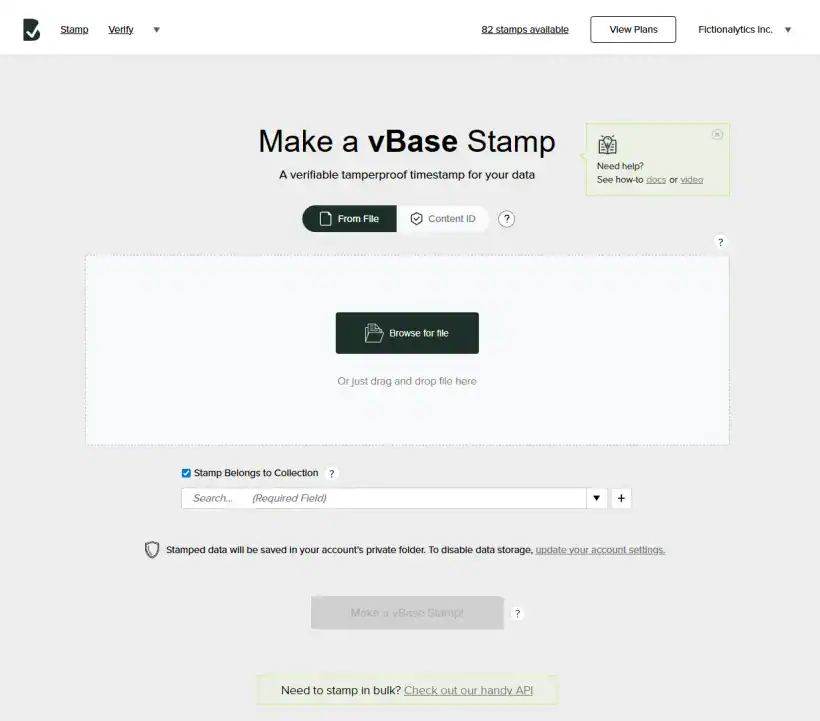
validityBase’s tools enable users to take a fingerprint of a portfolio or predictive data in a way that reveals no actual information about the portfolio but can be uniquely tied back to it. The tools then publish that fingerprint to a blockchain to create an independently verifiable timestamp for the predictive data.
Supporting emerging managers
Allocators are sometimes very skeptical about the track records they’re presented with, but not always. It ultimately depends on who’s doing the presenting. It’s easy to trust someone who has been running a fund for a decade with an administrator, auditor and hundreds of investors because they have third-party verification. Additionally, if an established manager lies about their track record and investors find out, they lose their business.
On the other hand, emerging managers may not have an audited fund set up yet, so it’s a major challenge to create a trustworthy track record.
“You run a model, or you run a paper portfolio, or you run some trading inside your Interactive Brokers account,” Averbukh said. “And when you go out into the market, and you say, ‘Check out this strategy I've been running. It's got a 3 Sharpe ratio and 10% alpha for the last two years.’ You're going to meet with a lot of skeptical looks, and a ton of people won't even really engage with you, because they say, ‘Well, he claims he's got this thing, but how do I know he didn't run 10 Interactive Brokers accounts?’”
Proving track records - with blockchain
Allocators also can’t know whether the data didn’t drop the one bad trading day that caused the model to fall apart.
“For folks who don't have an audited track record, there's not really a great way to credibly present that information, and the economics of it are such that building an audited track record costs about $50,000 per year per strategy, and that's if you're really cutting the cost of the bone,” Averbukh added. “It's a lot more if you use name-brand vendors.”
validityBase works for each individual strategy, verifying the results of those strategies and building a record that shows what the manager has been doing. Averbukh explained that the firm uses a blockchain as a sort of trust infrastructure that creates independently verifiable records.
“Because you're able to do this in a way that's automated and fairly cheap, you can build trusted track records for hundreds of times lower cost than you can with the current tools,” he added.
Replacing a manual process
The biggest issue that drives up prices is that third-party credibility for track records today relies on auditors who have to come in and manually look through the manager’s records to verify what they did. Auditors must be highly trained, highly qualified and highly reputed and spend lots of time manually digging through records. This is a labor-intensive, expensive process, and the results of such an audit are typically somewhat sparse.
An audit report will vouch for a manager’s balance sheet and income statement at the end of the year and possibly provide some information about their top five holdings as of the end of the year.
“It's very limited information that basically checks the box on, is the manager defrauding the investors? Is the manager stealing money?” Averbukh said. “But if you want information around how the manager is making money, you need much more granular track record information. You need to know more about the interim portfolios over the course of the year. What were the portfolio concentrations over the course of the year? Did the manager own one stock and let it all ride on NVIDIA? And that's how he quintupled the fund. Or was it 500 stocks, and the fund quintupled? Those are two different value propositions from a repeatability standpoint.”
Digging deeper
In addition to offering much cheaper verification, the information validityBase can verifiably communicate is far more granular and detailed for the evaluation of investment strategies. The model also goes beyond what auditors do in another way. Averbukh said auditors typically only audit a fund with an investment strategy involving live money. They won’t look at paper performance, model performance or trading signals.
As a result, managers who wish to verify model performance or are generating just a predictive data set have no established process for making their performance or their data’s predictive value verifiable.
“It's an unsolved problem, and so in those cases, you know validityBase is kind of the only alternative,” Averbukh explained. “... But the way that people that have predictive data that they might be selling to hedge funds today, the way that they market it is by means of trials. They say, ‘Hey, look at our historical data. It's very predictive, so you should pay us a lot of money for it and you can trial it for a little while first.’”
Problems for data vendors
Those who are selling predictive data to hedge funds know managers may not fully trust them, so they may offer long trial periods. However, Averbukh said that means of testing data has two problems.
First, it’s very inefficient. Even after a six-month trial, the potential client just has six months of verified data, and the model may have worked unusually well or poorly during those six months. On the other hand, the person selling the data may want to present a five-year history to show the sustainable nature of the model.
An even bigger problem for data vendors is that the six-month clock starts over again every time they meet with a new fund. After six months, the potential client says yes or no, and the cycle repeats itself with every potential client.
“What validityBase does is it creates a verifiable live record, such that from the time that you meet a potential client, it's as if they've been trialing your data for the whole length of time that you’ve been using validityBase,” Averbukh explained. “So it turns a one-to-one trust-building process into a one-to-many process, which is much more scalable and just much more effective and efficient in terms of building the trust necessary for some of these business relationships and transactions to take place.”
Constantly in development
The blockchain ecosystem validityBase uses is still in development, becoming more and more mature and easier to scale by the day. Averbukh said they’re using a blockchain for exactly what it’s designed for, but even today, to build scalable blockchain-based tools and make them enterprise ready takes some development.
With all this talk about verifying data, a key issue Averbukh has run across is questions about why anyone should trust their platform.
“I think that is a really cool piece of our value proposition, that sometimes it takes a little bit of explanation to get people to understand, which is that when you create a verifiable record of your track record, or of your alternative data or signal with validityBase, the validation metadata, as we call it, doesn't sit in validityBase’s database,” he added. “The validation metadata is published to blockchain which has the really valuable property of being truly independently verifiable. So we're kind of an easy button for this process of taking a fingerprint of your data and publishing it to a blockchain, but we’re not the ultimate source of truth.”
Long-term verification via blockchain
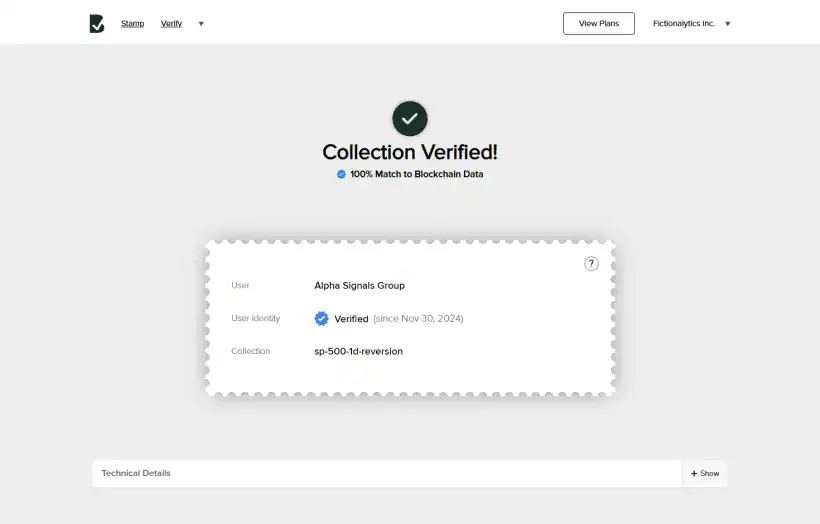
Because validityBase uses a blockchain, the track record or live history of the data that’s being created remains verifiable even if validityBase disappears or the client doesn’t want to do business with the firm anymore. Users can continue to generate the track record for the data and potential clients can keep verifying their track record, independently of validityBase.
Potential clients who are skeptical, perhaps thinking that a data vendor could influence validityBase to make their track record look better than it is, can always verify the track record independently.
“That data buyer or allocator, with not very much effort, by querying publicly available information, can verify all of our claims independently of us,” Averbukh explained. “So if there's a lot of money on the line and the end user, the end client, is skeptical of what validityBase is saying about your data, they can go and check it for themselves.”
Establishing trust
Despite its relatively young age, having been founded in early 2023, validityBase has some success stories under its belt. The company works with emerging managers, alternative data vendors, trading signal vendors, and financial publishers.
Averbukh mentioned a quant manager validityBase is working with who is actively raising money and marketing their signals. The client is able to establish trust with potential clients by sharing the independently verifiable track records for the data they have powered by validityBase.
“Once they establish the trust there, then the conversation proceeds normally about the typical questions around an investment strategy,” Averbukh added. “So people that we're working with want to highlight the fact that they're working with us because it's a way of, for them, enhancing their credibility in the eyes of their potential clients.”
Ultimate data privacy
validityBase offers two main types of workflows with tools supporting them. One of those workflows is enabling users to create a data set, which may be their portfolio history. They never share those portfolios with validityBase, so the data stays completely private. The user builds a verifiable track record without sharing trades or portfolios with anyone.
When it comes time to raise money or present the data to someone, the user can share that archive with them, and the potential clients can see that it’s a point-in-time archive of that track record or history, complete with timestamps.
“The archive is complete relative to the historical record that was previously registered, and the archive is being honestly presented,” Averbukh explained. “So this portfolio history is not one of 10,000 portfolio histories that the manager ran. It's one of one or it's one of five, or whatever the case may be.”
Ease of sharing verification
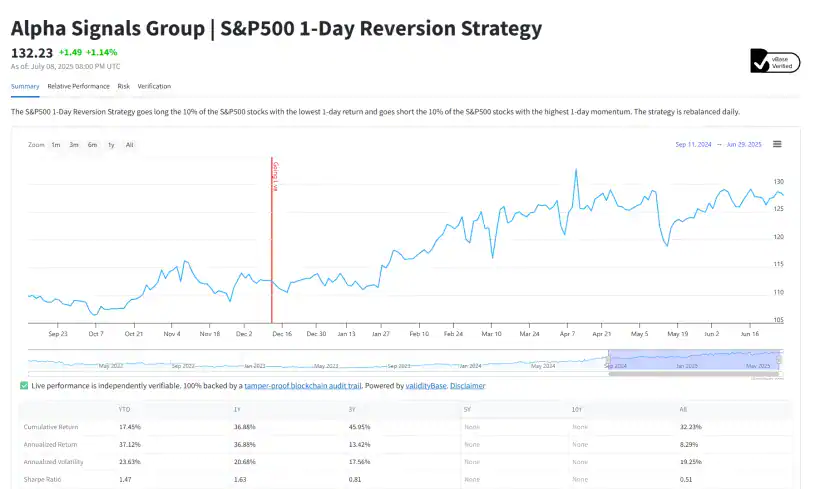
The other workflow involves sharing the verifiable history in a way that’s visually appealing. validityBase enables users to create an independently verifiable record of their investment portfolios and then creates a live verified tearsheet webpage for the strategy to make it both credible and easy to share.
“So you basically take a link and you can share that link with somebody, and the person on the receiving end can see a chart of your investment performance, as well as, if they care, all the underlying audit trails and portfolio history and verification data that they would need to make sure that this is an independently verifiable verified track record,” Averbukh added.