

Global fund administrator Citco has published its Multi-Strategy Outlook 2026, produced in collaboration with AFI. The report draws on a survey of 100 senior hedge fund industry participants and looks at how multi-strategy platforms are evolving as the segment continues to scale.
Key findings:
- Multi-strategy is expected to remain the fastest-growing hedge fund segment, with 86% of respondents expecting growth to continue into 2026.
- In 2025, multi-strategy funds delivered a weighted average return of 22.7% and attracted $53.4bn of net inflows, accounting for the majority of hedge fund inflows tracked by Citco.
- As platforms scale, operational complexity, risk management and recruitment were identified as the three biggest challenges facing multi-managers.
- The shift towards outsourcing is expected to continue, particularly across middle-office functions such as reconciliation, treasury and collateral.
- AI adoption is becoming widespread, with two-thirds of respondents expecting AI tools to be embedded across front, middle and back office, largely as a way of managing operational load as platforms grow.
Taken together, the data suggests that as multi-strategy platforms grow, operational resilience and risk control are becoming defining factors, not just performance.
Introductory note by Declan Quilligan, Head of Hedge Fund Services, Citco Fund Services
The continued prominence of multi-strategy funds in the hedge fund landscape shows no sign of abating, with our latest research revealing that 86% of industry participants expect this strong growth trajectory to persist. As we enter 2026, this report explores the opportunities underpinning this momentum, alongside the operational challenges that increasingly define success in this space.
What is clear is that operating a multi-strategy platform now demands a higher level of sophistication than ever before. Managers face three core challenges: managing complexity across multiple strategies and legal entities, maintaining robust and scalable risk management frameworks, and competing in an increasingly intense war for talent. These pressures are accelerating a generational shift toward outsourcing, particularly within the middle office, where 57% of managers are now seeking external partners to improve efficiency and control costs.
Through our work with industry-leading funds, we see firsthand how operating models are being reshaped to support scale, resilience, and long-term growth. This report provides insight into how the industry is adapting today – and what these changes signal for the future of multi-strategy investing.
Growth Engine
The growth of multi-strategy hedge funds has been a defining industry theme over the past decade, with consistently strong returns and enduringly high allocator interest.
According to Nasdaq eVestment, the sector managed $931bn at the end of Q1 2025, second only to long/short equity, meaning multi-strategy could soon surpass the $1trn mark and is on course to be the largest hedge fund strategy approach.
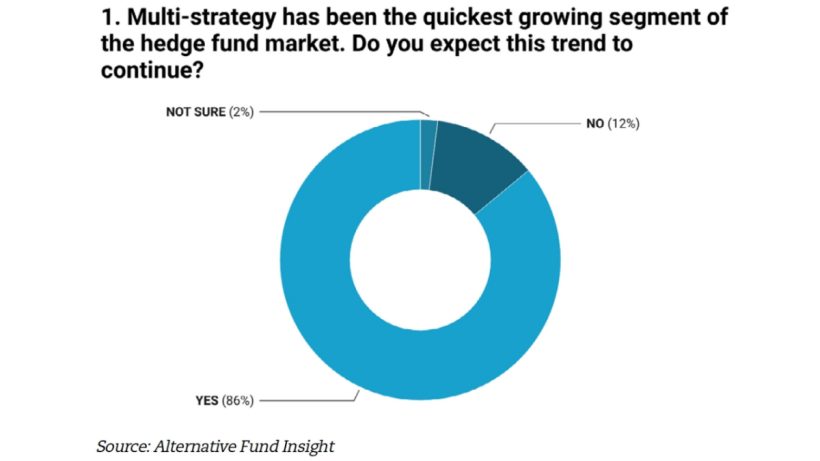
The blockbuster growth of recent years is expected to continue, with 86% of AFI survey respondents predicting multi- strategy would remain the fastest-growing segment of the market (see chart 1).
Performance and inflows both contributed to an increase in 2025. Multi-strategy hedge funds posted a 22.7% weighted average gain last year (a median of 11.2%) and pulled in net inflows of $53.4bn during that period, representing 86% of the overall amount (including single manager strategies) tracked by Citco.
Operational Focus
Growth must be managed effectively, and AFI’s survey zeroed in on the key operational challenges facing this high-return, high-cost segment of the market.
Complexity, risk management and recruitment were identified as “the big three” operational challenges facing multi- managers (see chart 2).
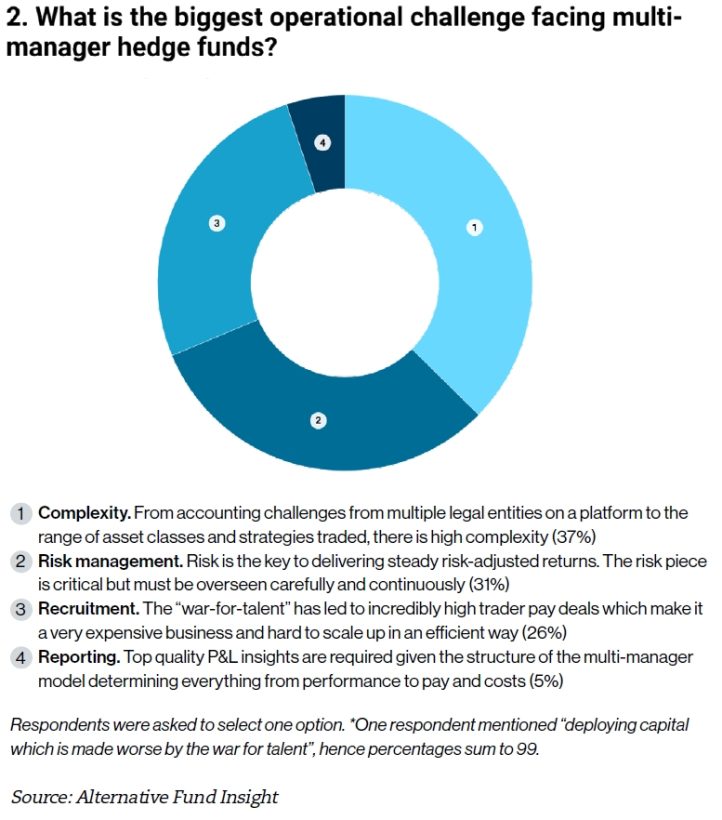
Complexity, from the wide-reaching accounting challenges posed by multiple legal entities on a platform, to the range of asset classes and strategies traded, was the top choice, selected by more than a third (37%).
That was followed by risk management, a function of the multi-strategy model which has proven essential to its success in reaching maturity and delivering steady risk-adjusted returns over the past decade. “The risk piece is critical but must be overseen carefully and continuously.”
The third most-important factor was recruitment, selected by 26%, amid a “war-for-talent” which has led to incredibly high trader pay deals which ratchet up costs and add risk to scaling up rapidly.
Read the full report here.