
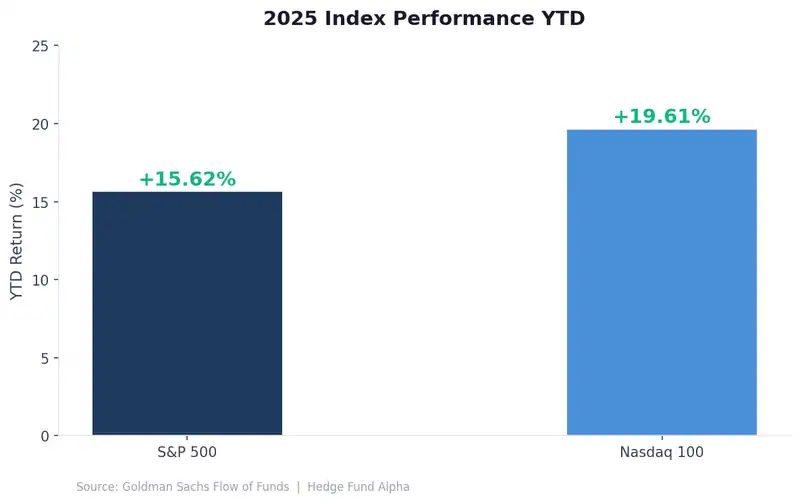
Goldman Sachs published its year-end flow of funds review covering positioning, volatility, fund flows, and the outlook for 2026. The report finds markets entering year-end with muted volatility, with elevated but clearer hedge fund positioning, and strong seasonal tailwinds. The top 10 S&P 500 constituents now account for over 40% of the index by market cap and contribute nearly a third of S&P 500 earnings growth; Goldman believes that the S&P 500 will move higher in 2026 due to those factors.
Index Concentration
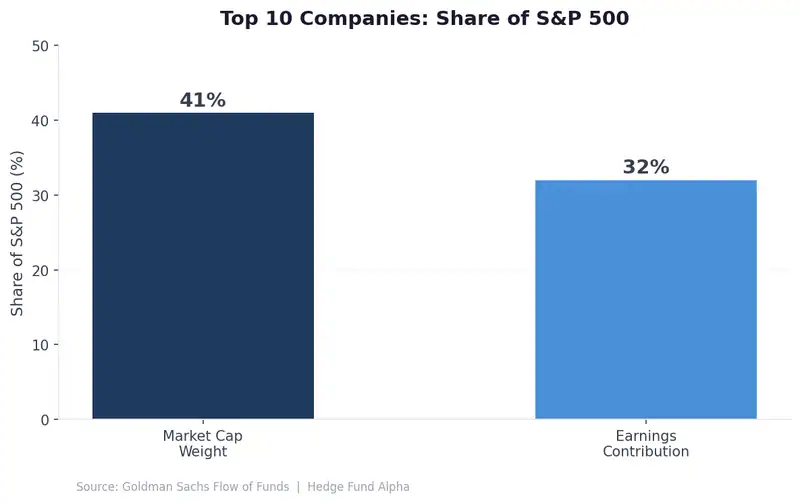
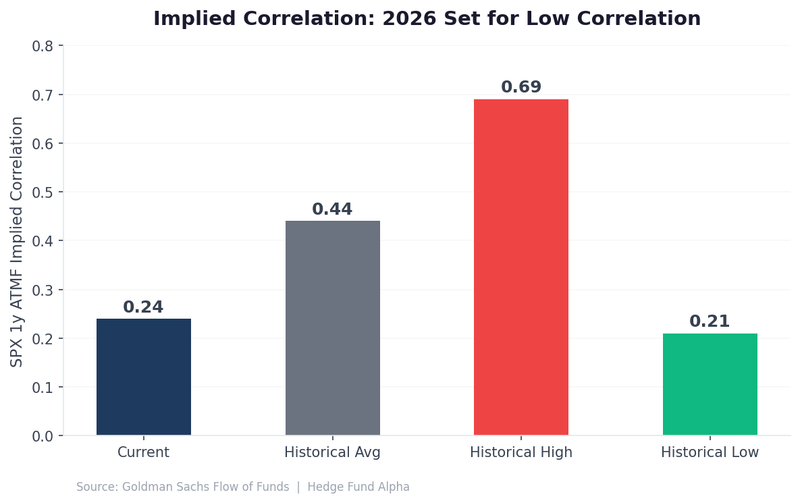
The concentration at the top of the S&P 500 continues to intensify. The 10 largest companies represent 41% of the index by market cap and 32% of earnings, both near historical highs. This situation supports large-cap leadership but also creates dispersion opportunities. The SPX 1-year ATMF implied correlation is at 0.24, near the low end of its historical range (high: 0.69, low: 0.21), suggesting 2026 could be one of the lowest correlation years on record - favorable conditions for active stock picking.
Volatility: Suppressed Across the Board
Implied and realized volatility are near year lows. SPX 2-week implied volatility is in the 21st percentile on a one-year lookback, while 10-day realized vol is approximately 7.5%, in the 14th percentile. Dealer gamma positioning is slightly long, acting as a buffer. The low-vol environment provides fuel for systematic re-leveraging, though a moderate selloff could flip dealers flat-to-short gamma and amplify downside moves.