


Abstract: Recently an influential academic study and many lawsuits have claimed that the VIX has been manipulated since 2008. In this paper, we construct a regression model with explanatory variables that are exogenous to the index and examine the model prediction errors. We find that the movements in the daily levels of the VIX are explained by market fundamentals and not by manipulation. We also specifically examine the VIX futures expiration days and demonstrate that the VIX closing values and VIX futures settlements prices on those days are consistent normal market forces and are not artificial.
Atanu Saha
Dr. Saha is the Chairman of Data Science Partners, a research and economic consulting firm. He specializes in the application of economics and finance to complex business issues, with a focus on data analysis.
Burton G. Malkiel
Professor Malkiel is the Chemical Bank Chairman's Professor of Economics, Emeritus at Princeton University. His books include A Random Walk Down Wall Street. He had served as a member of the Council of Economic Advisers, president of the American Finance Association, and dean of the Yale School of Management.
Alexander Rinaudo
Mr. Rinaudo is the Chief Executive of Data Science Partners. He has over 15 years of experience bringing together academic research, industry experts and legal counsel to develop economic and financial analysis for complex business issues.
1. INTRODUCTION
The Chicago Board Options Exchange Volatility Index (VIX) is the most popular measure of the market's expectation of volatility over the near-term future. Introduced in 1993, the VIX is considered to be the premier gauge of investors sentiment. Since the index tends to rise during falling markets, it is often called "the fear index". The VIX hit a high of over 80 during the 2008 market meltdown. During the slowly rising market of 2017, the VIX averaged around 11. There has been a growing acceptance of VIX and VIX-linked products (such as VIX futures and options) for use as risk management tools and trading of these instruments has expanded dramatically over time. Because of its excellent liquidity and its negative correlation with broad stock market movements, VIX-linked products are particularly useful hedging instruments. Portfolio managers can mitigate downward movements in the general level of stock prices by buying volatility, i.e. by buying VIX futures and options.
The market for VIX-related financial instruments, such as futures, options and exchange traded funds, has risen steadily over the years. While estimates of VIX exposure vary, one analyst suggests it could be as high as $60 billion.1 Given the size and reach of numerous financial products linked to the VIX, any artificial inflation or deflation of the index can have widespread ramifications, including substantial damages suffered by various parties.
The Claims That the VIX Has Been Manipulated
The VIX index gauges the implied 30-day volatility of the market calculated from options on the Standard and Poor's 500 stock index (S&P 500). Futures and options on the VIX itself have a relatively large volume of trading. The value of the VIX is calculated from a wide range of out-of-the money options, and some of the far-out-of-the money options are thinly traded. In a recent study, Griffin and Shams (2018) have argued that a manipulator could manipulate the VIX futures settlement prices by trading in the thinly-traded, far out-of-the-money less liquid options used to calculate the VIX. They found that during settlement periods, volume spikes have occurred in these thinly traded options referencing the VIX. They conclude that such trading patterns are consistent with market manipulations during the period 2008 to the present.

The Griffin and Shams (2018) study has been quite influential and it has been cited in many recent lawsuits alleging manipulation of the VIX. The plaintiffs in these suits claim, for example, that "a select group of financial institutions and trading firms with sophisticated, expensive technology"2 are engaging in "rampant manipulations of the VIX index.”3 The news media outlets have also paid considerable attention to this issue. For example, The New York Times cites markets experts who believe that traders “who persistently short the VIX have distorted the market,”4 and Barron’s reported in April 2018 that investors “suspected that someone was trying to manipulate the VIX, which had spiked suddenly just a few weeks before, roiling financial markets.”5

The goal of this paper is to take a direct approach to examine the hypothesis that the VIX has been manipulated from 2008 to the present. Surely, the proof of the pudding is whether VIX levels themselves have displayed a different pattern during the period from 2008 to the present than it did in earlier periods. We also examine whether the VIX levels were artificially inflated or deflated on the VIX futures and options expirations days. It is important to note that our analysis uses daily closing levels of the VIX. As a result, in this paper we do not examine whether the effect, if any, of the alleged manipulation of the VIX lasted only for a brief period of time within the futures expirations days. Such an analysis, which requires intra-day data, is beyond the scope of this paper.

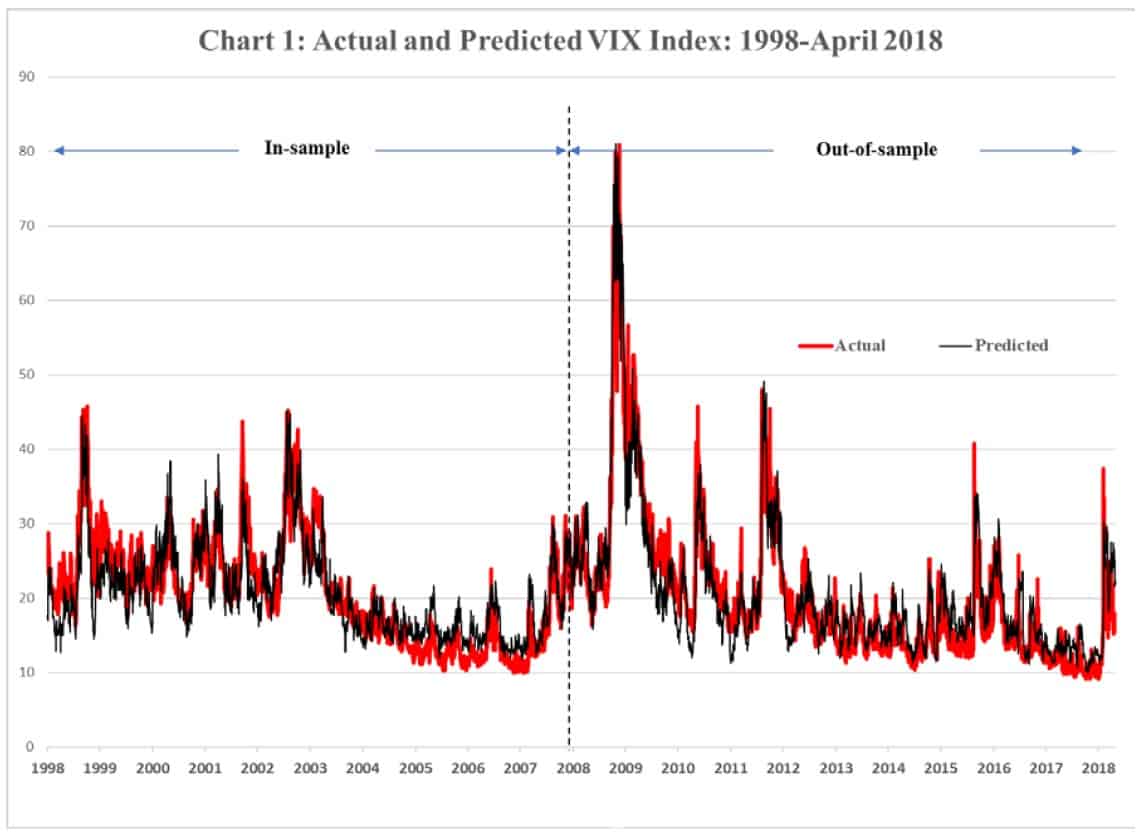
This paper's analyses have two components. First, we examine the daily closing levels of the VIX over the past two decades. We fit a model that regresses the VIX on a set of regressors using data from the ten-year period 1998-2007 (the 'in-sample'); we then use the same set of regressors to predict the VIX over the period at issue: 2008 through April 2018 (the 'out-of-sample'). If the VIX were manipulated since 2008, then the out-of-sample prediction errors (i.e., the regression residuals) would be expected to be higher than the 'in-sample' errors. This is because, if there was manipulation, then its effects would become evident in the errors, which reflect the portion of the VIX's movement unexplained by the model’s regressors, which are free from any manipulation claims. Various tests show that the 'out-of-sample' prediction errors are not statistically different from the 'in-sample' ones. These results suggest that in both periods – the period at issue and the ten years preceding it – market forces explain the VIX and there is no indication of artificiality in the level of the VIX. We also examine an out-of-sample period excluding the “crisis” period of the fourth quarter of 2008 and find no evidence of artificiality in the VIX.

The second component of this paper's analyses focuses on the expiration days of VIX futures. Recall, Griffin and Shams found unusual trading pattern on these expiration days, and thus, we inspect whether there is evidence of manipulation in these specific days. In particular, we examine how many of the 234 VIX futures and options expiration days in the 2008 to April 2018 period have statistically significant residuals. We find that the number of significant days is no different than what one would expect based on random chance, and thus our results do not support a claim of manipulation on VIX futures expiration days. We also examine whether the settlement prices of the VIX futures contracts were artificial. Again, we find that empirical evidence does not support the claim of artificiality of the settlement prices. In sum, we have examined the claim of manipulation for: (a) the period 2008 to the present, (b) the VIX values on settlement days and (c) the VIX futures settlement prices. All three analyses suggest that the VIX is explained by market fundamentals and strongly reject the hypothesis of manipulation.
This paper is organized as follows. In the next section, we provide a brief background for the VIX and review the relevant literature. In the third section, we describe the data and methodology used for our analyses; we also set out the regression model and the general framework for the analysis. In the fourth section, we discuss the regression results, focusing on the various parametric and non-parametric tests of the difference between 'in-sample' and 'out-of-sample' regression residuals. In the fifth section, we describe the data on VIX futures expiration days and then examine whether the residuals on those days are statistically significant. In the final section of the paper, we briefly discuss why our results are not necessarily incongruent with the findings of Griffin and Shams.
See the full PDF below.