

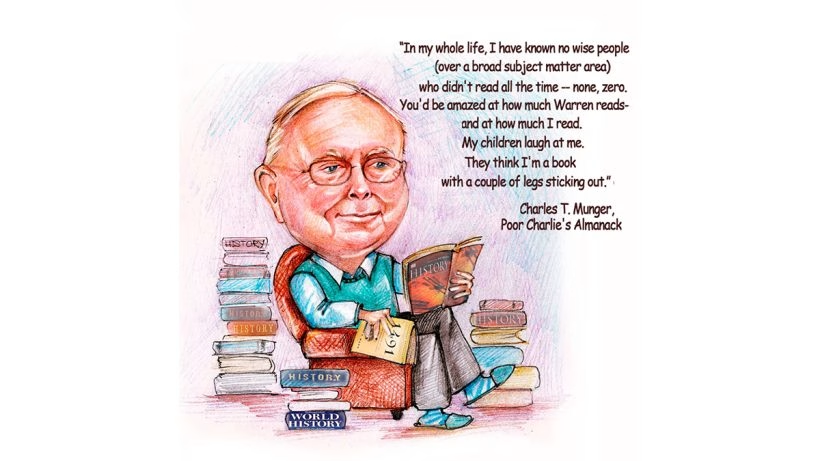
“You’ll do better if you go into something where you have a considerable aptitude.” - Charlie Munger
“A good man always knows his limitations.” - Clint Eastwood as Inspector Harry Callahan in “Magnum Force” (1973)
Charlie Munger once said he “was behind the door when humility was handed out.”
But Charlie humbly recognized early in life that nature’s gifts were not equitably distributed and that his own were select and delimited.
In an early display of the deep wisdom that would later crystallize in him, young Charlie perceived his neighbor and friend, Eddie Davis, possessed mechanical abilities and spatial intelligence that Charlie himself could never approach.
But Charlie did not yield to what is now known as psychology’s Dunning-Kruger Effect: the base human instinct to exaggerate talents and press your luck rather than face one’s limitations objectively.
Everyday Dunning-Kruger Effects
Most investors believe they are better than average, yet few beat or even meet market averages.
Similarly, drivers notoriously overestimate their driving skill.
Everyone believes they have a good - even great - sense of humor.
But who dares perform a minute of open mike stand-up.
Charlie deftly illustrated the Dunning-Kruger Effect at a Berkshire Hathaway meeting, with a poke at Warren Buffett’s professed ability to shake a leg in Warren’s now-legendary joy in “tap-dancing to work:”
“If Warren had gone into the ballet, nobody would have ever heard of him.” - Charlie Munger
Here’s Warren and Charlie on choosing one’s calling:

“Not a Prodigy”
Charlie recognized he had a “good” mind, but was “not a prodigy.”
Success would not be handed to him. He would need to employ what he humorously termed “tricks” to leverage his intellectual gifts.
“Best 30-Second Mind in the World”
"Charlie has the best 30-second mind in the world. He goes from A to Z in one go. He sees the essence of everything even before you finish the sentence." - Warren Buffett
Processing speed in computers has its biological analog in our brains.
Psychologists call it “g” or “general intelligence.”
In an earlier era it was termed “quick-wittedness.”
Ted Williams, the greatest hitter in baseball, processed visual data so rapidly he could read the label on a rotating 78rpm disc.
A high-speed intellect distinguishes what works, what doesn’t and what can’t be fixed.
Hence Warren and Charlie’s famous decision piles:
- Yes
- No
- Too Hard!
Birth of the Fundamental Algorithm
Lee Kuan Yew, first Prime Minister of Singapore, told Charlie Munger to “figure out what works and do it.”
Charlie promptly recognized this instruction was not merely helpful but essential.
He distilled it to three words: “Repeat What Works.”
Then pronounced it, “The Fundamental Algorithm of Life:”
the operating system gently humming within all reality.
Not intuitive, not counterintuitive, just an essential principle that, like compound interest and Newtonian physics, must be learned, remembered and applied.
For more see “Charlie Munger and The Fundamental Algorithm of Life”
“Wit and Wisdom”
"Humor is just truth, only faster!" - Gilda Radner
Mix careful observation, breath-taking processing speed, an appetite for fun and brace for Charlie Munger’s legendary lightning wit:
Did Charlie play the piano?
“I don’t know. I never tried.“
Recommending a difficult read:
“If you can’t understand it, give it to a more intelligent friend.”
On the then upcoming millennial compliance problem:
“I find it interesting that there is such a problem. You know it was predictable that the year 2000 would come.”
On paying huge sums to create tiny spreads on vast amounts of money:
“Any idiot can do it. And, as a matter of fact, many idiots do do it.”
And lastly:
“What I needed to get ahead was to compete against idiots. Luckily, there’s a large supply.”

Multidisciplinary Thinking
"If you skillfully follow the multidisciplinary path, you will never wish to come back. It would be like cutting off your hands." - Charlie Munger
"Who is wise? Those who learn from everyone." - Ethics of the Fathers
"You must know the big ideas in the big disciplines and use them routinely - all of them, not just a few. Most people are trained in one model - economics, for example - and try to solve all problems in one way. You know the saying: To the man with a hammer, the world looks like a nail. This is a dumb way of handling problems." - Charlie Munger
Part of Charlie’s humility is seeking wisdom from all who possess it, not just some:
"I believe in the discipline of mastering the best that other people have ever figured out. I don’t believe in just sitting down and trying to dream it all up yourself. Nobody’s that smart." - Charlie Munger
Mistakes of Others
Charlie recognized that mistakes are costly and the best way to avoid them is to bear witness.
I always hated rubbernecking delays until I learned they reflected beneficent Nature teaching what to avoid:
A corollary to The Fundamental Algorithm:
Stop What Doesn’t Work!
"We recognized early on that very smart people do very dumb things, and we wanted to know why and who, so that we could avoid them." - Charlie Munger
Avoiding Stupidity
Charlie also perceived that avoiding stupidity can be more important than being smart.
"It is remarkable how much long-term advantage people like us have gotten by trying to be consistently not stupid, instead of trying to be very intelligent." - Charlie Munger
"Knowing what you don’t know is more important than being brilliant." - Charlie Munger
"True knowledge is knowing the extent of one’s ignorance." - Confucius
And Charlie deftly deflected a left-handed compliment from a reporter confounded by Berkshire’s spectacular success:
"One of these guys at one Berkshire meeting from one of the foreign publications said, ‘Why do a couple of guys in a little place like Omaha do so much better than all these powerful minds and great institutions?’ And I said that I think Warren and I know the edge of our competency better than other people do." - Charlie Munger
"It’s not a competency if you don’t know the edge of it." - Charlie Munger
The Myth of the Hero
Humanity loves stories: myths, fairy tales and legends.
We believe in the lone hero: Moses, Jesus, Newton, Einstein.
We do not think of our modern-day heroes, our stars, having armies of publicists, stylists, promoters, writers, directors, producers, gofers, plastic surgeons and superagents who tend to a public image that is shaped and polished to delight us and sell us.
But nobody makes it alone.
"If I have seen further it is by standing upon the shoulders of giants." - Isaac Newton
True humility is acknowledging we are but the product of genes, chance of birth, nurturance and randomness.
"My wealth has come from a combination of living in America, some lucky genes, and compound interest." - Warren Buffett
Humanity’s Blind Spot: Berkshire’s Superpower
"You’re blind, ump! You’re blind, ump! You must be out of your mind, ump!" - "Six Months Out of Every Year" from "Damn Yankees," Richard Adler and Jerry Ross (1958)
The human mind is evolved, not designed.
It has huge but finite capacity.
As Charlie teaches, our perceptual/cognitive apparatus has shortcuts and blind spots, which impair our judgment and, worse still, mask that impairment from ourselves.
The Dunning-Kruger effect is being certain when you’re being stupid.
"I'm smart. Not like everybody says." - John Cazale as "Fredo Corleone" in "The Godfather" (1972)
"The greatest shortcoming of the human race is our inability to understand the exponential function." - Albert Allen Bartlett, Physicist
If you don’t understand the exponential function you can’t perceive the incredible power of compound interest.
You buy lottery tickets instead of index funds.
You believe in luck but don’t make your own luck.
You steal apples but don’t plant a garden.
You don’t understand how Berkshire Hathaway was built:
One brick at a time, over six decades.
"The real action from compounding takes place in the final twenty years of a lifetime." - Warren Buffett
See also, “The Great Exponential Blind Spot”