



Comments prepared by Naomi Fink, Chief Global Strategist at Amova Asset Management ($270.8 billion AUM), as they relate to the latest Bank of Japan Monetary Policy Meeting decision.
Bank Of Japan And “Yen Carry”: A Duration Mismatch
The Bank of Japan kept rates on hold at 75bps – as widely expected – in January, following its 25bp rate hike in December. The Bank of Japan has been, since the end of its Negative Interest Rate Policy in March 2024, increasing overnight rates at a gradual pace – with hikes of 25bps observed every six months or slower. As such, in the absence of a sudden acceleration in inflation or inflation expectations, its move to remain on hold is consistent with its gradual normalization regime.
Signals Normalization At Least As Fast As To Date
However, there are elements within the BOJ's statement that signal that the Bank has some ways to go before reaching "neutral" policy. One such indicator is the dissent of known BOJ hawk Takata, demonstrating that the BOJ remains under marginal pressure from within to continue withdrawing stimulus over time.
Another indicator that the Bank of Japan is likely to continue withdrawing stimulus at least at the same pace as since 2024 is its upgrade to inflation projections in its quarterly Outlook. January's Outlook now skews inflation above target for longer than October's projection, with the lower end of the Policy Board's forecast barely retreating below the BOJ's 2% target in fiscal 2026 and 2027; BOJ Monetary Policy Committee members' January forecast ranges put core CPI at 1.9% to 2% in FY 2026 and 1.9% to 2.2% in FY 2027, compared to 1.6% to 2.0% range for 2026 and 1.8% to 2.0% in 2027 in October. This is even amid a modest upgrade to growth in FY 2026 (from 0.7% to 1%). The modest downgrade to real growth in 2027 – reflecting the upgrade to inflation projections – remains a note of caution on inflation.
Fiscal Risk Is Still Implicit, And Tilts Toward Hikes
We note, moreover that the Bank of Japan includes "the effects of government measures to address rising prices" as an implicit factor to look through in gauging price moves, prioritizing instead the continuation of "the mechanism in which wages and prices rise modestly in interaction with each other."
Although the Bank of Japan, per its institutional protocols, refrains from endorsing or criticizing government fiscal measures, its signal that it plans to look through fiscal pressures on prices in favor of upward-trending wage-price developments plus its increased focus on foreign exchange provides markets with some insight into how independent monetary policy may interact with prospective fiscal expansion.
Yen Too Weak: Excess “Carry” At Hand
Importantly, the BOJ now flags Foreign Exchange (yen weakness) as an explicit risk to the economy and prices. This was a material shift from October, where FX was noted but less central to the Outlook.
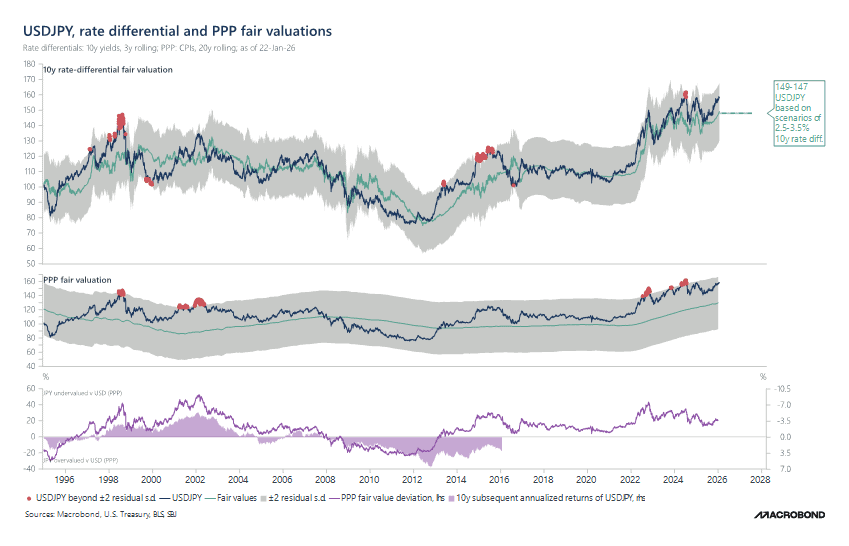
The recent yen and JGB-selling that accompanied announcements of fiscal expansion by the Japanese government may potentially invite unwanted inflation. We illustrate below how US dollar-yen moves have been motivated by high demand for yen claims (the "yen carry trade"), which has not only pushed the yen further away from purchasing power parity (which we estimate around 100 yen per dollar) but also to a level inconsistent with shorter-term measures of "fair value" (based on relative real yields) versus the dollar:
Chart 1: Cross-border yen claims and USDJPY (per BIS data)
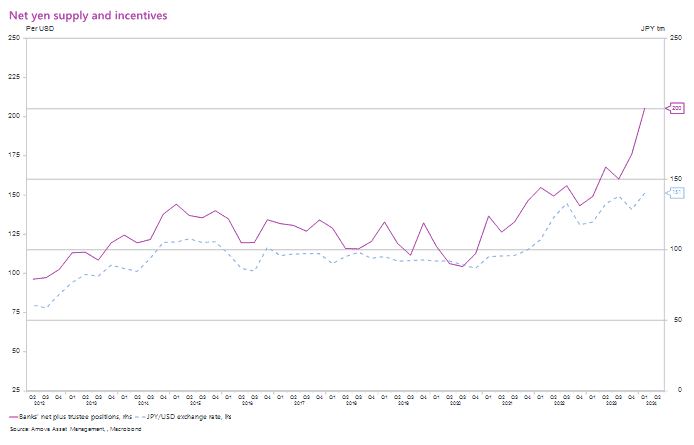
Chart 2: Estimates of "fair value" in USDJPY
Timing: Fast Carry, Slow Policy
From a policy perspective, the upgrade to inflation as well as continued above-trend growth, plus the Bank of Japan's declared resolve to continue hiking rates so long as data meet the projections set out in the Outlook argue for at least as fast a pace of hikes going forward as that experienced since the start of the normalization cycle in March 2024. The caveat here is that the pace of normalization has been slow; at its fastest, the BOJ has delivered two rate hikes per year. This provides opportunities for faster actors in the market – including "carry traders" to continue to challenge the BOJ's resolve by keeping the yen under pressure. That said, the mid-term signal is that the Bank of Japan may have enhanced incentives to slow yen liquidity that until now has provided plentiful opportunities for risk asset investments and given the weakness apparent in the yen – beyond justification in relative real or nominal interest rates – the opportunity for hawkish surprises going forward also remains significant.