



Tourlite Fund's commentary for the fourth quarter ended December 31, 2025.
To Our Partners:
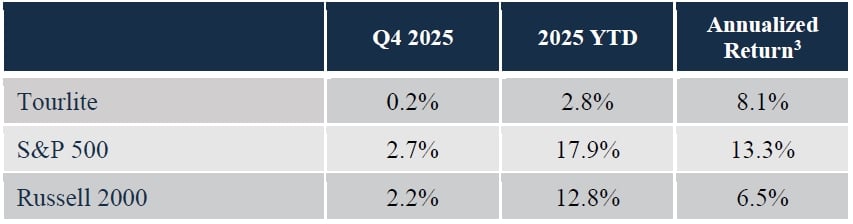
Tourlite Fund, LP returned 0.2% for the Fourth Quarter and 2.8% for the full-year 2025. Since inception, the Fund has delivered annualized returns of 8.1%, compared to 13.3% for the S&P 500 and 6.5% for the Russell 2000.
Performance Commentary
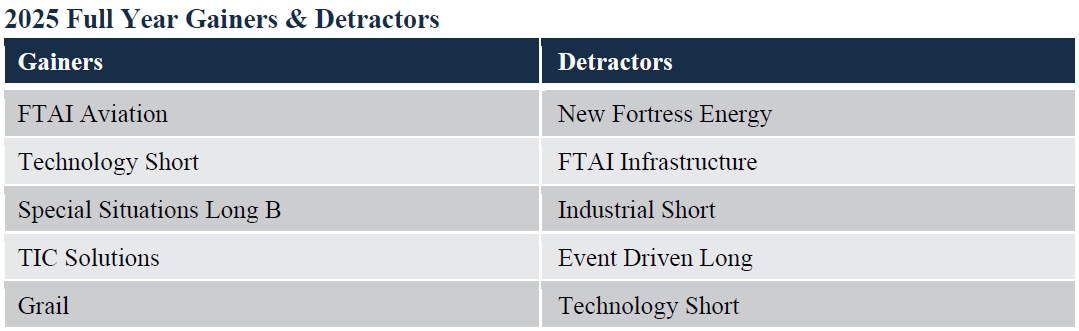
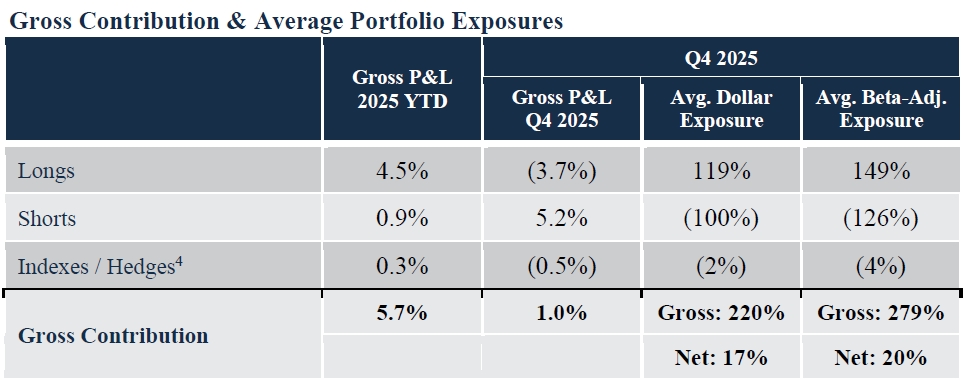
In 2025, the fund's performance fell below our target return range, driven primarily by disappointing stock selection in our long book, which remains heavily weighted toward event-driven ideas. Our short book generated meaningful alpha, contributing 0.9% to performance against an S&P 500 up 18% and a Russell 2000 up 13%. Our longs struggled as several off-the-beaten-path investments failed to realize their expected catalysts. While we are disappointed in this year's results, we believe the fundamental views underpinning many of our top positions remain intact heading into 2026. As of this writing, several of our highest-conviction long positions have seen encouraging starts to the new year.
In hindsight, part of the underperformance stemmed from recycling positions too early. APi Group in the fourth quarter of 2024 and Roivant in the middle of this year are notable examples. In both cases, portions of our thesis had played out, and we believed our variant view versus the market had narrowed, yet these businesses remained well-positioned and continued to experience growth and multiple expansion after we exited. By rotating into ideas earlier in their catalyst lifecycle, we fell into what Peter Lynch famously called "watering the weeds and cutting the flowers."
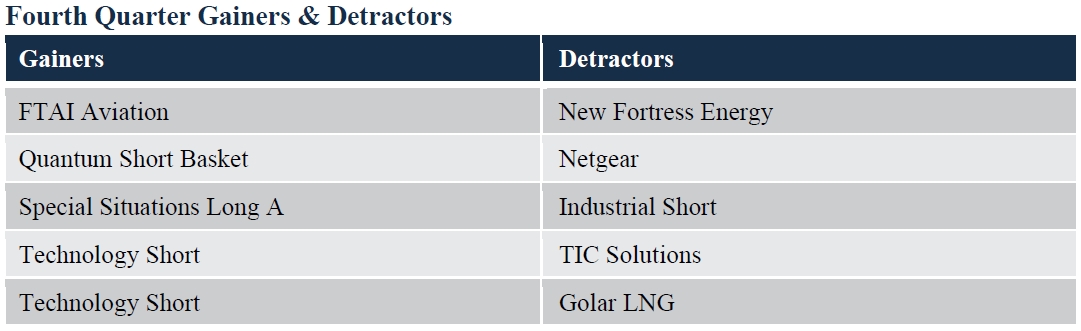
Despite a difficult year for short selling amid rallies in speculative stocks, we view the positive contribution from our short book as a meaningful achievement. Throughout the year, sectors tied to quantum computing, nuclear energy, eVTOLs, and drones appeared particularly disconnected from fundamentals. For example, we held a small short position in one quantum company prior to its parabolic run-up, establishing a broader quantum basket short from October through November resulting in a positive net contribution from the group.
Market Outlook
As we enter 2026, we expect a favorable setup for equities and risk assets as we see a combination of strong economic growth and declining inflation. With midterm elections approaching in November, the Administration is likely to prioritize policies that maintain economic strength, making any significant slowdown politically untenable. We anticipate this will manifest through pro-growth initiatives and fiscal support that sustains the continued momentum from the post-pandemic recovery. Meanwhile, reported inflation has been moderating and we expect this disinflationary trend to continue through mid-year, creating room for the Fed to deliver additional rate cuts. The combination of easing monetary policy, supportive fiscal measures, and favorable year-over-year comparisons should keep economic activity robust in the near-term.
Aligning with this view, near the end of 2025 and into early 2026, we have seen a rotation in markets. The Russell 2000 has outperformed the technology-heavy S&P 500 and Nasdaq while sectors such as industrials, materials, and consumer discretionary have outperformed technology. This aligns with stronger economic growth and little concern about inflation.
However, there are growing risks as the inflationary consequences of aggressive policy emerge. As a new Fed chair takes office and continues reducing rates, we expect inflation pressures to come back later in the year. The shift from balance sheet reduction to expansion, combined with election-year fiscal stimulus, will eventually reignite price pressures even as headline numbers temporarily improve. This creates a setup for a bifurcated year: the first half favors risk-taking as growth remains strong and inflation subsides, while there will likely be a point during the year that requires increased caution as inflation reasserts itself.
If this perceived risk materializes where the Fed must become more restrictive, we believe it will create another generational opportunity for short sellers. Many fundamental short sellers have endured drawdowns during speculative markets, only to see sharp reversals when momentum finally breaks, as in late 2021 and 2022. Last fall and the start of 2026 have been difficult markets for short sellers as speculative assets and consensus shorts have outperformed higher quality companies. We maintain selective short exposure in these areas and actively trade around volatility, positioning to take advantage when the eventual unwind occurs. Once it does, finding short opportunities will be “like shooting fish in a barrel.”
While market leadership remains concentrated in AI and momentum-driven stocks, we don’t view that as the core issue. Valuations are elevated relative to historic levels, but earnings growth remains positive and the broader economy has generally proved resilient. The greater concern lies in the renewed bubble forming across speculative themes, where liquidity and retail enthusiasm have driven valuations beyond fundamentals.
Portfolio Commentary
During the quarter, our average net beta-adjusted exposure was 20%. Gross exposure ranged between ~175% and ~260%, with an average of 220%. We maintain our view that a “normal” net exposure range of 20-30% remains optimal for our portfolio construction.
Our portfolio’s sector concentration was as follows: consumer (~20%), industrials (~50%), technology (~25%), and others (~5%).5 As discussed in our prior letters, we remain short consumer and long industrials. Our average dollar exposure for each sector was: consumer (-23%), industrials (+66%), technology (-23%), and others (-4%).
FTAI Aviation (FTAI)
In our prior letter, we outlined a path for FTAI to reach $250 per share over the next twelve months. Since then, the company has announced a new initiative, FTAI Power, to repurpose CFM56 engines for data center power generation. Management believes they can eventually deliver over 100 engines annually at a $25 million sale price with 40% margins, representing a potential $1 billion EBITDA opportunity. Despite the recent move in the share price, we believe meaningful upside remains and believe shares could eclipse $300 this year as the company is on a path to achieving EBITDA of $3 billion over the next 2 years.
We see several catalysts on the horizon. Following the success of the upsized strategic capital initiative, we expect updates on a second SCI vehicle this year; LinkedIn data suggests FTAI continues to hire investment and investor relations professionals as they build out this business. On the product side, the fourth-quarter approval of a third PMA part should support continued market penetration for MRE, and we will be watching for updates on HPT blade adoption. Finally, FTAI Power is expected to begin ramping in the second half of 2026.
FTAI Infrastructure (FIP)
Looking ahead to 2026, we expect FIP to take strategic action with Long Ridge, refinance its bridge loan from the Wheeling acquisition, and potentially divest Repauno as the company continues its transition toward a pure-play rail business. As these catalysts unfold, we believe FIP could be worth more than $15 per share over the next year.
To recap 2025: in August, FIP announced a transformative deal to acquire Wheeling & Lake Erie Railway and refinance its holding company debt. The market initially reacted negatively, focused on high headline leverage and the issuance of preferred equity warrants tied to the new combined RailCo. We believe this reaction misses the longer-term picture as many of FIP's infrastructure assets are still ramping toward full earnings potential or remain under development, inflating current leverage metrics.
The value proposition rests on several key assets. Management has guided to $200 million of normalized EBITDA for the new Transtar RailCo; at a conservative 12x multiple for short-line rail, this alone implies more than $10 per share. Repauno secured new cavern permits for Phase 3 in October, with Phases 1 and 2 expected to generate roughly $90 million of EBITDA and Phase 3 potentially adding another $100 million within two years, at a 10x multiple, this could be worth $12 or more per share. Long Ridge, generating $165 million of EBITDA at a 10x multiple, contributes approximately $6 per share, with additional upside of a similar magnitude if a data center agreement is executed.
New Long: Montana Aerospace (AERO SW)
We recently initiated a position in Montana Aerospace, a Swiss-listed aerostructures manufacturer trading at a significant discount to intrinsic value. The aerospace supply chain is facing a severe bottleneck, while Boeing and Airbus build rates should inflect positively to meet decade-high demand, the legacy tiered supplier base remains fractured and financially distressed following years of disruption. We believe vertically integrated Montana, for which 90% of products are single-sourced, is positioned to be the structural winner.
By combining complex assembly capabilities in Europe and the U.S. with high-volume, low-cost manufacturing in Vietnam, Montana offers what we view as the "holy grail" for OEMs: quality, cost efficiency, and reliable delivery. As Boeing and Airbus ramp production through 2030 to clear backlogs, we expect Montana to take meaningful share from legacy providers that simply cannot keep pace.
We see several catalysts over the next year. The company recently completed the divestiture of its non-core Energy segment, transforming into a pure-play aerospace business. On margins, we see a clear path from the mid-teens to approximately 20% as utilization rises, the capex cycle matures, and the company benefits from growth in higher-margin space and defense programs. Finally, management has stated its intention to pursue a U.S. listing, which should help close the valuation gap with domestic peers as European aerostructures companies trade around 10–11x 2026 EBITDA, while U.S. comparables are closer to 14–15x. In the fourth quarter, Montana was trading less than 8x EBITDA.
New Technology Long
We hold a position in a small-cap technology company we believe offers substantial upside over the next twelve months as customer adaptation accelerates. Early adopters are reporting meaningful gains in engagement and operational efficiency. With a strong balance sheet and a growing backlog, we see the market as significantly undervaluing the opportunity ahead.
Shorts
We have established short positions in select companies across various sectors where we identify unfavorable supply-demand dynamics combined with increasingly price-sensitive customers. We expect these businesses to experience meaningful volume declines and margin compression from fixed cost deleverage, creating both earnings downside and multiple contraction.
We are also short several low-quality, high-multiple names with significant downside potential. Given current market conditions, we have been disciplined in sizing these positions to limit overall portfolio exposure to higher-beta, speculative names.
One position is a company with a market capitalization approaching $50 billion that remains unprofitable yet trades at over 10x revenue. The business exhibits concerning characteristics including related-party transactions and significant customer concentration, and experienced multiple downward revisions to revenue and earnings estimates throughout last year. Despite these fundamentals, the stock appreciated nearly 200% in 2025.
Another short is a company that recently completed a sizeable highly dilutive, vulture financing deal that was unfavorable to shareholders. We believe management has cultivated a promotional narrative around popular retail themes that misrepresent the underlying business.
Consumer Short
We are short a consumer company that we believe benefited from a temporary revenue tailwind driven by favorable one-time supply conditions in the fourth quarter. Sell-side estimates for 2026 and 2027 appear to extrapolate recent improvements without adequately accounting for the transitory nature of this boost. We expect both revenue and margins to materially disappoint relative to consensus over the coming quarters.
Closing Thoughts
We will be in Miami during iConnections the week of February 23rd. Please let us know if you are interested in connecting. Thank you for your continued trust and partnership. Please do not hesitate to reach out with any questions.
Sincerely,
Jeffrey G. Cherkin
Read more hedge fund letters here