
Hirschmann Capital's commentary for the year ended December 31, 2025.
Dear Partner,
Below are updated results for the Hirschmann Partnership (the “Fund”). In H2 2025, Class A and Class B returned 63.2% and 67.3%, respectively, versus 11.9% for the S&P 500. Despite its ultra-bearish strategy, the Fund has outperformed US and global equities since inception.
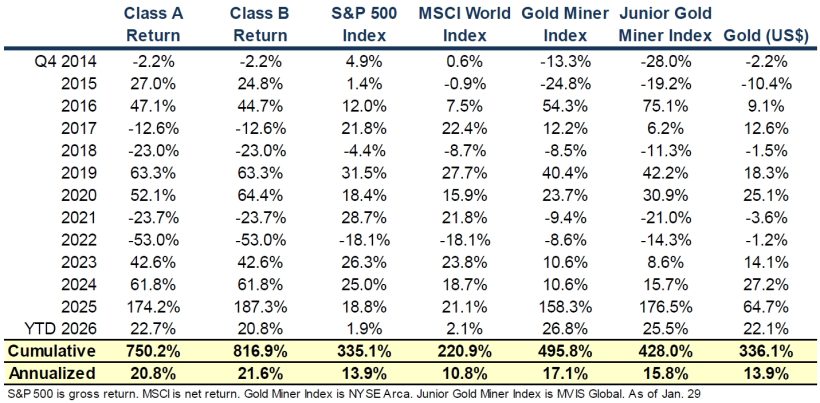
After an update on our gold mining equities (“GMEs”), I discuss historical gold portfolio allocations and compare our GMEs to other bearish strategies.
Portfolio Detail
The Fund’s portfolio is summarized below:
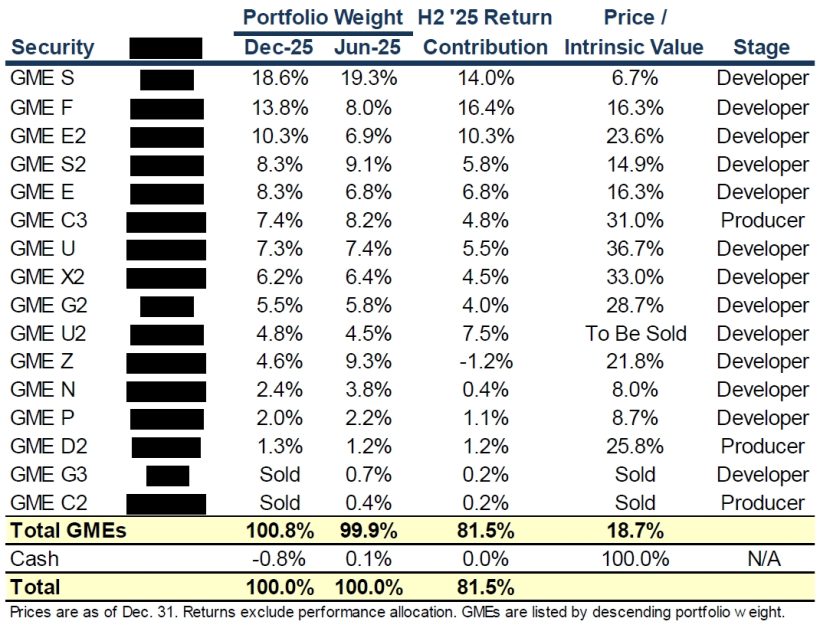
While higher gold prices benefited all holdings in H2, company-specific developments also supported several positions.
GMEs F, U, and X2 appreciated following positive feasibility studies.
GME S rose as new management rapidly secured federal and state relationships in [redacted].
GME E2 appreciated after prioritizing its permitted, lower-risk [redacted] project.
GME C3 benefited from record gold production.
GME G2 appreciated after it shifted focus from exploration to mine development.
GME U2 was acquired by a major Canadian gold producer.
Gold Valuation History
As shown in the chart below, investors have historically increased their gold allocations during periods of heightened concern about sovereign default—whether the default is outright or via inflation. Because the above-ground gold inventory is effectively fixed in the short term, a doubling of global gold allocations (e.g., 5% to 10%) should cause a proportional increase in the gold price. At year-end 2025, investors’ gold portfolio allocation stood at ~6%, well below the ~11% allocation reached in 1980, when the US government (USG) was effectively defaulting via high inflation.
As discussed in prior letters, the probability of a sovereign debt crisis is extremely high. Since 1825, all 55 net debtor countries with gross government debt exceeding 120% of GDP ultimately defaulted—whether through restructuring, devaluation, high inflation, or outright nonpayment. Examples are shown in an endnote. Crucially, this dataset excludes net creditors like Japan, which have historically proven more resilient. The US, however, is the largest net debtor in history. It has already crossed the critical 120% threshold and should be far beyond it after the next recession.
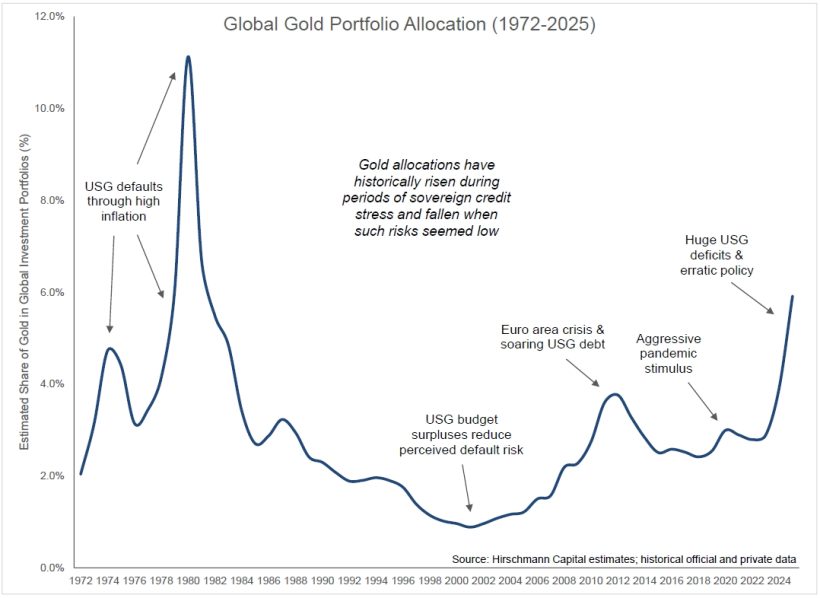
At year-end 2025, gold allocations reached their highest level since 1979–81, a rational response to the high probability of a USG default via inflation. Given that a US debt crisis should coincide with private deleveraging and a collapse of the US equity and real estate bubbles, the next crisis should be far worse than in 1980, implying that gold allocations could surpass their 1980 peak.
The Fund’s GMEs remain far more attractive than gold bullion. Investors, distracted by bubbles in US equities and cryptocurrencies, fail to appreciate how higher gold prices have improved the safety and takeover prospects of our GMEs. If gold continues to rise, the Fund’s GMEs should continue to outperform by a wide margin due to their low valuations and fixed costs. Even if gold prices plateau or decline, the Fund’s GMEs should perform well as projects advance from planning to construction and ultimately to production. Indeed, if gold prices do not change, our GMEs should more than triple over the next few years as they converge with their intrinsic values. Minimal debt and low production costs should cushion any temporary drawdown.
GMEs vs. Other Bearish Investments
During 1979–80, elevated gold allocations coincided with high inflation and an effective USG default. As expected, other asset classes reflected that stress. For example, high interest rates greatly pressured US equity valuations.
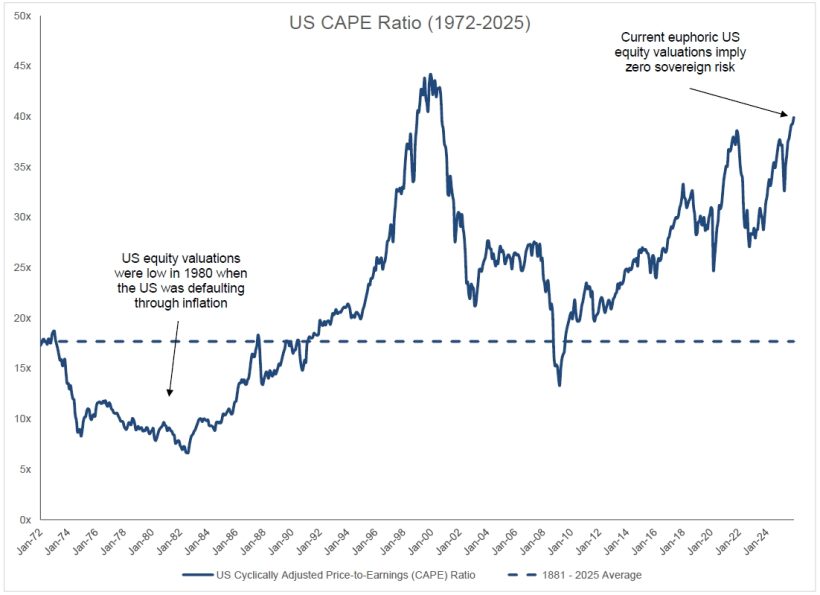
Today, gold allocations are again elevated, which suggests gold investors are assigning a substantial probability to renewed sovereign debt stress. In contrast, valuations across most other asset classes continue to imply minuscule sovereign debt risk. (US equities are one example, as the chart below demonstrates.) In sovereign bond markets, regulations (e.g., Basel III and Solvency II), along with other factors, have suppressed risk signals.
As a result, gold has become somewhat less attractive than some other bearish investments, such as equity shorts. For example, if the US CAPE ratio were to revert to its long-term average (let alone its 1980 crisis level), an S&P 500 short could gain more than 50%. In contrast, if gold were to revert to its average allocation since 1850 (~4%), gold could fall more than 30%. However, equity shorts face unlimited downside, negative carry, forced liquidation risk, and adverse tax treatment. See the movie Dumb Money, for example. Accordingly, while I continue to evaluate alternative strategies, I still view the GMEs as extremely attractive.
Other
My interests remain fully aligned with yours. I am the Fund’s largest investor, with the vast majority of my net worth invested alongside you.
As of January 2026, the Fund’s expense ratio was ~0.06%, which compares favorably to the 0.44% average for mutual funds and ETFs.4 The Fund remains focused on tax efficiency and has generated minimal short-term capital gains. Unlike more than 99% of hedge funds, the Fund has no non-deductible management fees.
K-1s are scheduled for February. As of December 31, the Fund had 33 limited partners and ~$60 million in assets under management. Partners’ account statements will be uploaded to the administrator’s portal shortly.
In November, I was interviewed on The Julia La Roche Show. I occasionally post comments relevant to the Fund on Twitter and, less frequently, on LinkedIn.
In 2025, the Fund’s auditor, Spicer Jeffries LLP, was acquired by Cherry Bekaert. Cherry Bekaert will therefore conduct the Fund’s next audit.
The Fund remains open to new investors, so feel free to distribute the redacted version of this letter. The Fund’s next letter is scheduled for mid-July.
The Fund’s most important competitive advantage will always be its patient clients, so I greatly appreciate your continued support. As always, please feel free to contact me with any questions or suggestions.
Kind regards,
Brian Hirschmann
Managing Partner
Hirschmann Capital
Read more hedge fund letters here