

Dan Loeb's Third Point Capital Q4 2025 investor letter can be found below.
Dear Investor:
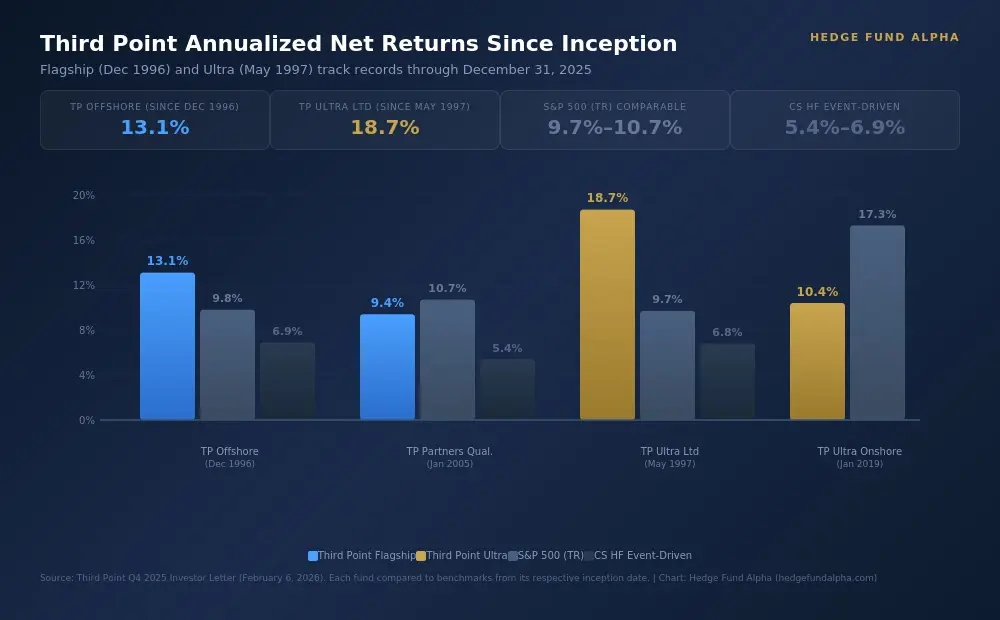
During the Fourth Quarter, Third Point returned 1.9% net in the flagship Offshore Fund and 2.1% net in the Ultra Fund. Assets under management on December 31, 2025, were approximately $24.2 billion.
Performance Summary
| 2025 Q4 | TP Offshore | TP Partners Qual. | TP Ultra Ltd | TP Ultra Onshore | |
| TP Offshore Fund, Ltd. | 1.9% | 13.1% | -- | -- | -- |
| TP Partners Qualified, LP | 1.9% | -- | 9.4% | -- | -- |
| TP Ultra Fund, Ltd. | 2.1% | -- | -- | 18.7% | -- |
| TP Ultra Onshore Fund, LP | 2.1% | -- | -- | -- | 10.4% |
| CS HF Event-Driven Index | 1.1% | 6.9% | 5.4% | 6.8% | 7.2% |
| S&P 500 Index (TR) | 2.7% | 9.8% | 10.7% | 9.7% | 17.3% |
| MSCI World Index (TR) | 3.2% | 8.3% | 9.2% | 8.4% | 15.4% |
Through December 31, 2025. Annualized Return from inception (December 1996 for TP Offshore; January 2005 for TP Partners Qualified; May 1997 for TP Ultra Ltd; January 2019 for TP Ultra Onshore LP).
The top five winners for the quarter were SK Hynix Inc., DSV A/S, Siemens Energy AG, Carpenter Technology Corp., and Pacific Gas and Electric Co. The top five losers for the quarter, excluding hedges, were CoStar Group Inc., Microsoft Corp., Meta Platforms Inc., Vistra Corp., and Primo Brands Corp.
Market Commentary
The trends that drove markets higher during Q4 have extended into the early months of 2026: an ongoing rotation from software into semiconductors, memory, and semicap equipment; continued strength in European defense equities; a broadening of market leadership from big tech to the industrials, healthcare, and consumer sectors; and an astounding appreciation in gold and rare earths. Notwithstanding the extreme volatility and selloff from the intraday peak of nearly $5,600/oz, the price of gold has increased ~15% year-to-date. Meanwhile, Bitcoin is down 20% from its year-end price and down almost 45% from its peak of over $125,000 last October.
AI dominates market headlines and is increasingly forcing a re-think of established beliefs. One of them is the long-perceived attractiveness of capital-light business models like software, information services, and digital platforms that for decades required little to no physical investment to grow and achieve dominance. Many such companies are now facing increased investor skepticism about the sustainability of their moats and scrutiny of their high-margin structures. The pressure on the sector which has been evident for some time has accelerated sharply into the early weeks of 2026, particularly with the announcement of Anthropic to dislocate businesses that provide both legal and financial analysis.
At the same time, capital-intensive businesses like construction services, aggregates, transports, and defense contractors are having their moment, as investors are waking up to their mission critical role in the rebuilding of supply chains, national security complexes, and data center infrastructure.
Healthcare is also emerging from a prolonged period of COVID hangover, volatility, and multiples derating due to funding freezes, populist rhetoric, and constraints in biotech funding. We are increasing exposure to the sector, especially in life sciences and medical devices, and finding what we see as attractive valuations for market leading franchises.
Despite market multiples and concentration that are undeniably high relative to history, we believe we remain positioned for a friendly macroeconomic and corporate environment. US GDP growth is accelerating, disinflation is firmly in place, and the imminent tax refunds should support consumer spending and alleviate affordability issues. Increasingly tricky investor positioning in US equities, evidenced by high institutional gross and net exposures as well as record high retail participation, has led us to expand our single name short book and grow exposure to foreign equities.