

Black Bear Value Partners' commentary for the fourth quarter ended December 31, 2025.
“If you can’t take a small loss, sooner or later you will take the mother of all losses.” – Ed Seykota
To My Partners and Friends:
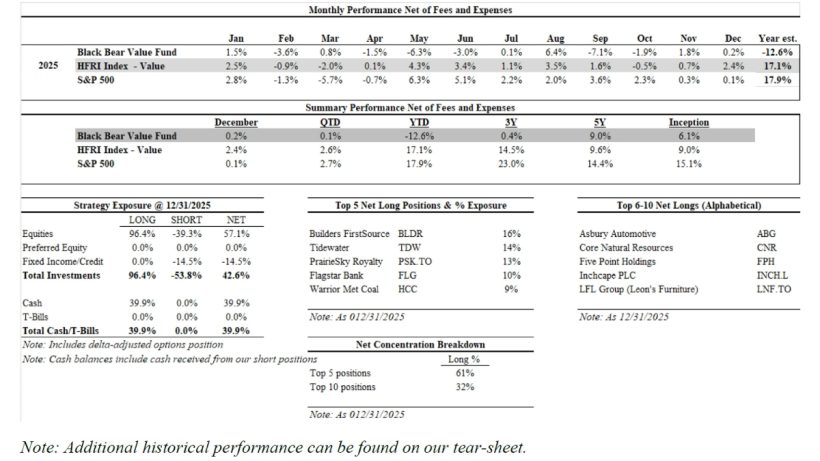
- Black Bear Value Fund, LP (the “Fund”) returned +0.2% in December and -12.6% in 2025.
- The S&P 500 returned +0.1% in December and +17.9% in 2025.
- The HFRI Index returned +2.4% December and +17.1% in 2025.
- We do not seek to mimic the returns of the S&P 500 and there will be variances in our performance.
2025 completed 2 sub-par performance years in the Fund. Losing 10-15% over a 2-year period does not cause me heartburn, but in the face of a market going straight up it can get frustrating. Our returns have been and will continue to be lumpy with very little correlation to the broader markets. The reality of running a Fund is wearing 2 hats…. The Investor hat, which takes precedence, doesn’t mind underperformance if it offers opportunities to invest more in a good idea. On the other hand, the Business hat is realistic that LPs, both existing and prospective, do not have an infinite horizon and can grow impatient when you are both down and alternatives keep going up. This is not my first rodeo, and I’ve been down this road before. My experience is that sanity and credulousness eventually return and we make up ground fast. In other words, I am comfortable knowing why our performance has dragged but doubt if others know why their speculative investments have been going straight up. Note that as I’m writing this the air seems to be coming out of the balloon.
As we enter 2026, we have multiple names in the portfolio where a permanent capital impairment is remote and the path to being up 50-100% is reasonable. In addition, our shorts seem to have started their “valuation meets reality” moment.
A common theme in a few of our investments is that they are nearing the end of a capital-investment cycle. The current market does not seem hospitable to these kinds of ideas. The valuations for these companies are extremely attractive and while we are not getting the near-term sugar high of market acceptance, I anticipate a major re-rating when the capital-investment cycles end over the course of 2026/2027.
The broader themes of the portfolio entering 2026 are:
- Foreign stocks – we are finding opportunities outside of the U.S. markets with 24% of our portfolio in foreign-domiciled companies.
- Housing (Distributor + Large landowner in California) - Structurally underbuilt housing with a rising need as millennials form households. With rising mortgage rates, existing home supply should remain low and benefit the new homebuilders and by extension their suppliers and distributors.
- Metallurgical coal (coal for steel) – Significant underinvestment in a needed input for worldwide steel consumption particularly in Asia and India where high-grade met coal resources are limited.
- Royalties/Energy/Natural resources/Commodities – Significant underinvestment in natural gas, oil and thermal coal which are necessary for the world’s economies to function and grow. While renewables will play an increasing role, the change will occur over decades, and not years.
- Regional bank turnaround – Flagstar has an exceptional management/board that are ahead of the game in turning their businesses around. At the same time, we are short similar companies with management teams that are obfuscating/ignoring the issues and have unhealthy balance sheets (some rhyme with our shorts of Silicon Valley Bank/First Republic).
To
Breakdown of PNL Components
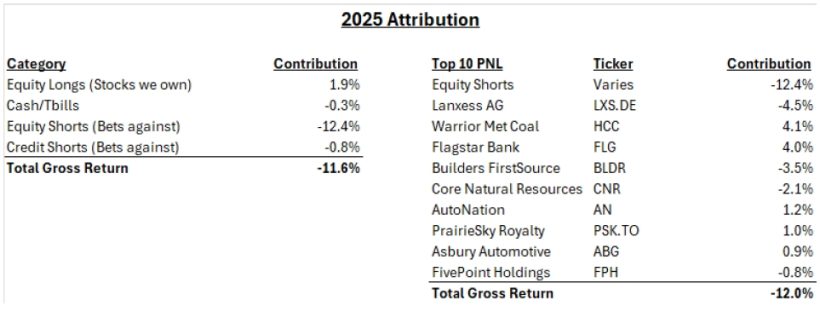
Our short positions more than offset the modest gains we made in our equity longs (businesses we own). Our portfolio discussion follows this section.
Lanxess was our largest equity loser for the year. We exited the position during the year as the thesis seemed in question. As a reminder, Lanxess is a European Specialty Chemicals company. Lanxess’ high debt load was offset by a large equity stake I expected them to monetize in 2026. While it is still possible that could happen, there is also a chance the buyer could delay closing for a few years. The combination of this uncertainty, the debt, and underlying weak business fundamentals made me put this into the “too hard” pile. Sometimes we will have a good process and a bad, random outcome….and then sometimes I’ll just make a mistake. I think Lanxess fits in the latter category.
Credit Shorts/Equity Shorts
We entered the year with a meaningful equity short position (~39%) and a more modest credit short position as compared to years past (~15%). While I do not name shorts specifically, there are some consistent themes represented. Some examples:
- AI wanna-be’s/neo-clouds – While AI will have an impact on our lives, we are still very early in its lifecycle. There are many businesses that are “transforming” to benefit from the investor excitement with questionable business plans but intense stock promotion. While a source of pain to our PNL in 2025, as the weak business fundamentals become more apparent, their stocks should decline.
- Banks/Bridge lending– We are short a bank that rhymes with our Silicon Valley/First Republic short in the sense that I think the bank is technically insolvent. They have assets overmarked on their balance sheet and are playing games recognizing impending losses. Additionally, some of the bank’s customers are getting their own bank charters and could no longer need their services. The bridge lenders (which also includes the bank) are seeing their tenants/borrowers catching colds and through aggressive accounting are pushing off the loss recognition. In time the dividends will be further cut, and the cash simply won’t be there.
- Private credit lenders/private equity – We are short a basket of these businesses. While there are quality private investors, the space has become very popular with lots of LP money chasing returns. Some of these sponsors have paid extremely high prices and/or lent on unfavorable terms. Many have also lent into the AI/data-center space to businesses with questionable futures.
- Buy-now/pay-later lenders – These companies lend to the worst credits via small-dollar/short-duration loans. In a benign credit environment, they do ok, but they have 2 things working against them. One, the health/growth of the lower-end consumer is weakening. Second, it’s a commodity product with a lot of competition. The combination of the above typically ends poorly for the business owners.
- Legacy data centers – These businesses consume capital and produce mediocre levered returns on capital (single digits). The accounting is squishy, and the economics are dreadful. They are massively levered and the general AI- “mania” has been a rising tide lifting all ships. Like real estate, not all data centers are created equal. A corollary would be the bifurcation between Class A office which is doing better (newer build data centers) and struggling Class B office (legacy data centers).
We remain short, longer duration credit instruments. The spread for corporate bonds is near all-time lows with very little in the way of defaults/economic risks priced in. While long-term interest rates have risen, they are in a normal range if one assumes 2-2.5% inflation. Presume 2.5% inflation + 0.50% for a short-term interest rate of 3%. Add 1.50% for a normal yield curve and you get to a 10Y of 4.5%. If inflation is higher and /or we need to borrow significantly (i.e. lack of governmental fiscal discipline) the 10Y and risk spreads could rise.
Top 5 Businesses We Own
Builders FirstSource (BLDR) – 16% of AUM
BLDR declined 28% in 2025 amidst weakness in the housing market and as new home starts pressured sentiment. Fundamentally, the Company performed well despite these headwinds and should generate a significant amount of free cash flow in 2025 ($800MM-$1BB). This translates to a trailing yield of 7-9%. If we owned this business privately, we would be pleased to collect a 7-9% yield in a weak year with the promise of significantly higher cashflows when housing starts pickup. We have previously discussed whether there could be short-term fluctuations with the stock, but so long as the long-term thesis was intact, we would continue to own the business.
BLDR is a manufacturer and supplier of building materials with a focus on residential construction. Historically this business was cyclical with minimal pricing power as the primary products sold were lumber and other non-value-add housing materials. Since the GFC, BLDR has focused on growing their value-add business that is now 40%+ of the topline.
Our long-term thesis remains intact as there is a structural shortage of housing in the USA. Higher mortgage rates reduce the supply of existing home supply as homeowners are locked into low-rate mortgages. As we have seen in recent history, the overall pie of housing activity may shrink, with new homebuilders capturing an increasing share of home sales. Homebuilders can buy-down the mortgage to a lower rate and accept a lower, yet still healthy margin on the home sale.
The company has sustained higher gross margins as they have gained scale. I estimate normalized free-cash-flow per share to be $9-$14 per year implying a free-cash-flow yield of 9-14% with no growth priced in.
Tidewater (TDW) – 14% of AUM
Tidewater is a marine services firm that operates one of the world’s largest fleets of offshore support vessels (OSV’s). They serve the energy industry by transporting crew and supplies, towing and anchoring drillships and supporting offshore construction projects. The long-term outlook for international and offshore markets is strong while the near-term is a little cloudier. As current resource plays (the Permian) slow down, worldwide demand will continue to grow and require more oil. It is expected that offshore capital commitments will rebound in the next 1-2 years.
What’s striking about this industry is the lack of investment in the OSV fleet. Since the GFC, global shipyard capacity has shrunk by nearly 60%. In addition, newbuild investment is lacking as many banks have pulled back from lending. Over the next decade, as fleets age, the global OSV market is expected to shrink by ~40%.
This adds up to a potential for large pricing moves, in our favor, coupled with high utilization. We do not have to bank on that as they are currently generating $300MM+ in FCF vs. a $2.5bb market cap or a 12% yield. In a more normal environment, I’d expect them to generate 500mm-1bb which gets to ~20-40% yields. Importantly their share buybacks were historically limited by debt covenants. That debt has been paid off (they have minimal debt now) and they recently instituted a buyback plan for $500MM.
PrairieSky Royalty (PSK.TO) – 13% of AUM
We have owned PrairieSky Royalty over the last 5+ years. It became a top 5 position for us in the 4th Quarter. As a reminder PSK.TO is a pure-play oil and natural gas royalty company that owns one of Canada’s largest portfolios of subsurface mineral rights and royalty interests across Western Canada. Importantly, the company does not operate or drill oil and gas wells itself; instead, it leases its land to third-party energy producers and collects high-margin royalty revenues based on production without incurring operational costs or capital expenditures. Businesses like this should trade at a meaningful premium to the average company due to the lack of capital intensity and long duration of healthy cash flows. Likely due to both being an energy company and being in Canada we can own the business at a 5-8% yield assuming stable production and steady oil energy prices. Additionally, the business is run by an exceptional CEO and Board that understands capital allocation at a deep level. Given the lack of global investment in energy development and potential for inflation, this investment serves as a positive yielding long-term business investment with a call option on higher energy prices and/or needed production.
Flagstar Financial (FLG)– 10% of AUM
Flagstar Financial is the former New York Community Bank (a mashup of Flagstar Bank, New York Community Bank and assets from Signature Bank). Like our past SHORT investments in Silicon Valley Bank and First Republic, FLG had a hole in their balance sheet (from soured multifamily and office real estate vs. long-duration securities). That is where the similarities end.
FLG raised over $1BB in additional capital, led by former Treasury Secretary Steven Mnuchin. They revamped the management team and brought in a superstar CEO in Joseph Otting who successfully turned around OneWest Bank post GFC (formerly known as IndyMac Bank). Mr. Otting and his team are my kind of managers – they are plain-spoken, hardworking and plan for the worst while hoping for the best.
The turnaround is going well, and they recently reported their first profitable quarter since the new management team took over.
The valuation is extremely compelling. At year-end the bank was trading at ~67% of a conservatively marked balance sheet. This is in contrast with similar banks (who are NOT conservatively marked) trading at 140-160% of their tangible book value. At these prices the downside seems minimal and could see this business up 45-120% over the next 1-3 years as it is more appropriately valued.
Warrior Met Coal (HCC) – 9% of AUM
Warrior Met Coal is a leading metallurgical coal producer (coal used to steel production). There has been minimal worldwide met coal resource development over the last 10 years which could lead to tight supply (higher pricing) when steel production improves. We do not rely on a tight pricing market to do well with this investment. Currently the bulk of HCC’s FCF is being invested in a capital project that will be largely concluded in 2025 and is ahead of schedule. Once the business winds down their investment period they will gush cash.
HCC’s existing mines should generate $100-$350MM in annual free cash flow (assuming lower for longer met coal prices). Blue Creek development is wrapping up by the beginning of 2026 and at mid-cycle should generate $200-$500MM in additional free cash flow. The combined assets should generate $300MM-$850MM in free cashflow with non-heroic pricing and volume assumptions. This equates to ~$6-$16 in annual per share cash generation vs. a price of ~$88 or a 7-18% unlevered annual free-cashflow yield. 2026 should be a sea-change in their free-cash-flow generation.
Fund Updates/Tax Discussion
We recently switched our auditor and tax preparer from EisnerAmper to Cohn Reznick. We were able to achieve meaningful savings for the Fund as well as ensure our audit team remained in the continental United States. It was important from a data security perspective to keep sensitive investor information with a domestic team.
Giving Thanks
As I said in last year’s letter, I know that being patient is easier when there is a “+” in front of our returns but we have a cultivated group of investors that range from individuals to family offices that understand we are making multi-year investments. I appreciate your trust and partnership.
Life has a funny way of offering perspective when you most need it and whether you want it or not. My family received some difficult medical news in December and as we shared, I took a pause on writing the letter/doing calls/meetings to solely focus on my family and portfolio management. Without going into too much detail, I am happy to share that my wife’s prognosis is great, and life should be returning to normal soon. She and the kids have shown incredible bravery and strength. While I have always appreciated being able to run this Fund, my day-to-day appreciation for good health and the little things has grown immensely in these last 10 weeks. An enormous thank you to Lauren and the kids for their strength and resilience. Also a big thank you to the doctors/nurses who have helped us as well as to those who shared notes of encouragement sent over the last weeks.
Thank you to our service providers (BTIG, Opus Fund Services and Kleinberg Kaplan) for helping throughout the year. They are timely and helpful in their work and help the business hum. Thank you to our CFO, Dave Proskin, for helping take a lot of the financial blocking and tackling off my plate allowing me to focus on the portfolio.
Concluding Thoughts
I am going to end this letter in similar fashion to 2024. As a year has passed, our businesses have made fundamental progress even if their stock prices don’t reflect it. Our portfolio is a coiled spring. When it snaps up, I don’t know. We own healthy companies, with the wind at their back, run by excellent management teams at extremely cheap prices. As many of them exit investment cycles, they’ll be able to deploy massive amounts of capital and buy in cheap stock. Our short book has a collection of companies that may be popular today but have fragile economic underpinnings. While our returns can be lumpy we make up ground quickly. I anticipate that to be the case now as well.
Thank you for your trust and support.
Black Bear Value Partners, LP
Read more hedge fund letters here