

Ashva Capital Management's commentary for the year ended December 31, 2025.
Dear Limited Partners,
Before anything else, I want to begin with gratitude.
Ashva Capital Management LLC exists only because a small group of Limited Partners had the faith—and the courage—to back an unproven investor and a young investment partnership. You entrusted me with your capital, your patience, and your confidence long before there was a track record to lean on. That trust is neither assumed nor forgotten. I am equally grateful to my family, whose support made it possible for me to take the personal and professional risk of launching and managing this firm.
I am also deeply grateful for the simple, profound good fortune of being an American. Long-term investing success is inseparable from the system in which it takes place.
“I have been investing for 80 years—more than one-third of our country’s lifetime. Despite our citizens’ penchant—almost enthusiasm—for self-criticism and self-doubt, I have yet to see a time when it made sense to make a long-term bet against America. And I doubt very much that any reader of this letter will have a different experience in the future.” – Warren Buffett
That observation is neither patriotic rhetoric nor hindsight bias. It is a statement of lived experience. The American system—its rule of law, depth of capital markets, tolerance for failure, and relentless capacity for reinvention—has been the single greatest tailwind behind every successful long-term investment career, Buffett’s included.
That humility extends to stewardship.
“We never forget that, though your money is commingled with ours, it does not belong to us.” – Warren Buffett
That principle governs everything we do at Ashva Capital.
The vast majority of market forecasts and financial commentary are largely useless—and often hopelessly outdated—by the time they are published. The purpose of these letters is not to predict the next quarter or the next headline, but to share the judgment and perspective accumulated over an investing career. The most valuable investing insights transcend time and place. They remain relevant across cycles, regimes, and decades. Very few books meet that standard, and it would be presumptuous to assume these letters will. But by aiming for that unreachable bar, I hope to meaningfully improve the quality, depth, and durability of what follows.
If there is a single idea that ties this letter together, it is simple:
Compounding only works if you survive long enough to let it.
Our Investment Philosophy
Jeremy Siegel wrote what I still consider the greatest investing book of all time: Stocks for the Long Run.
His 200-year conclusion is brutally simple:
U.S. equities compound at ~10% annually over the long run.
If you simply own high-quality stocks and avoid blowing yourself up, the math is astonishing.
And there’s a structural reason this works: you want to be long the S&P 500 over the long term because it represents the strongest, best-managed, and most innovative companies of all time. Capital, talent, and innovation continuously flow toward these businesses — and the index relentlessly replaces laggards with leaders.
But here’s the part most investors conveniently forget — and where Warren Buffett’s wisdom hits hardest.
Buffett’s Reality Check: Permanent Loss vs. Temporary Pain
Buffett has repeatedly emphasized a truth that most allocators intellectually know but emotionally resist:
- Permanent capital loss risk for patient owners of great businesses is extraordinarily low.
- Intrinsic value will rise over time, even if reported earnings don’t cooperate every single year.
- But if you overpay, your long-term returns can go sideways fast.
He reminds shareholders that Berkshire — arguably the greatest compounding machine ever built — has fallen by ~50% on three separate occasions.
Not because Berkshire was fragile, but because investor psychology is inherently fragile—and notoriously prone to overreaction in uncertain times.
Though the stock market is massively larger than it was in our early years, today’s active participants are neither more emotionally stable nor better taught than when I was in school. For whatever reasons, markets now exhibit far more casino-like behavior than they did when I was young. The casino now resides in many homes and daily tempts the occupants. – Warren Buffett
Too many investors respond to these drawdowns by selling — they mistake emotion-driven declines in stock prices for permanent impairment in the enduring values of the companies.
Buffett’s takeaway is timeless:
Volatility is not risk. Permanent impairment is risk.
And permanent impairment usually comes from panic, leverage, or failure to adhere to valuation discipline.
That’s the entire ballgame.
Michael Burry: When Brilliant Meets the Wrong Market Regime
To drive the point home, consider Michael Burry — a legitimately brilliant investor who nailed the 2008 housing collapse with surgical precision.
Yet recently, he shut down his hedge fund, citing his inability to understand the current market environment.
This isn’t a knock on Burry.
It’s a reminder that:
- Being right once doesn’t guarantee being right again.
- Timing macro inflection points is exceptionally hard. The market doesn’t care about your model, your conviction, or your prior correct calls.
- Markets evolve faster than any single investor’s mental framework can keep up.
Burry is one of the smartest people in the game, and even he essentially said:
“I don’t get this market right now.” – Michael Burry
That level of humility is rare. It’s also telling.
Investing isn’t about forecasting every twist in the cycle — it’s about compounding through cycles you can’t forecast.
Where Ashva Capital Management LLC Stands
Ashva Capital Management’s framework is the opposite of fad-chasing or macro guesswork:
- Own high-quality U.S. businesses that compound intrinsic value
- Respect valuation discipline
- Use options to enhance returns via disciplined leverage.
- Stay in the game long enough for compounding to express itself.
Buffett survived 50% drawdowns three times because he owned durable businesses.
Burry shut down because even geniuses can feel lost in markets that defy neat narratives.
Ashva Capital Management’s job is not to guess the next market regime. It’s to build a framework that thrives across regimes — without ever risking your family’s capital in a way that jeopardizes long-term compounding.
Warren Buffett’s Track Record: The Original Case Study in Not Blowing Up
You don’t need another hedge fund manager constantly quoting Warren Buffett, so I’ll keep this short.
What makes Buffett the GOAT isn’t a single brilliant trade. It’s:
- Consistency and compounding over decades
- Playing long-term games with long-term people
- A relentless focus on high-quality U.S. businesses bought at rational valuations
He didn’t need to be right about everything. He just needed to avoid permanent mistakes and let time and cash flow do the heavy lifting.
That’s the same game we’re playing at Ashva Capital Management. We apply the same principles, tailored toward high-quality technology businesses.
One detail that often gets overlooked in Buffett’s annual reports is the table he includes at the very end — a simple two-column scoreboard comparing the annual change in Berkshire’s market value versus the S&P 500’s total return. Decades of judgment, temperament, and risk control distilled into something brutally honest.
From 1965 to 2024, Buffett compounded Berkshire at 19.9% annually versus the S&P 500’s 10.4%, almost perfectly echoing Siegel’s long-term equity constant.
The cumulative result is staggering: Berkshire gained 5,502,284%, while the S&P 500 gained 39,054%. Small annual differences, sustained over decades, produce outcomes that feel almost absurd in hindsight.
This underscores an essential truth: Consistent long-term investment in the U.S. market—even through downturns—can generate transformative returns for those who stay the course and avoid panic selling.
This is the ultimate lesson: Surviving market cycles is the key to letting compounding create significant investment gains.
The 2008 Housing Bubble: My Trial by Fire
From Banc of America Securities to Long/Short Financials Analyst
The Big Short makes it seem as if only a handful of savants foresaw the crisis forming.
Great story. Incomplete truth.
Plenty of people saw the rot — they just didn’t get movie deals.
In 2008, I was a newly minted Harvard MBA and Senior Equity Analyst at Avera Global Partners, a long/short hedge fund founded by John Boich in San Francisco.
Before founding Avera, John had built his reputation as a senior equity research analyst and portfolio manager at Montgomery Securities, where he was known for deep fundamental research on financial institutions and balance-sheet risk — experience that proved invaluable as we headed into 2008.
Before joining Avera, I spent eight months in Tech investment banking at Banc of America Securities, trying to live out my dream of following in the footsteps of Frank Quattrone, the most famous tech investment banker of the dot-com era. Quattrone, who worked at Credit Suisse First Boston, was the lead underwriter in some of the biggest IPOs in the late 90s/early 00s.
Including the following:
- Cisco
- Amazon
- Netscape
Unfortunately, I couldn’t handle the 2 am formatting wars over pitch books and proposed deals that had zero chances of becoming live deals. After my experience as a management consultant, I knew all too well the feeling of death by PowerPoint. I simply wasn’t built for it. When John gave me my shot, I took it—even though I had to pay back my stub bonus on the way out. I considered that small payment the price of admission to become a professional investor.
Despite having no direct investment experience beyond the HBS Investment Club, John hired me anyway. I took the job a little poorer, but a lot hungrier.
And then 2008 hit. Perfect timing.
With John and Scott Klimo — one of the sharpest PMs I’ve known — we realized early that when the first subprime lenders blew up in 2007, it was just the opening act.
The lesson was clear and enduring: real risk is rarely hidden in complexity, but in assumptions taken for granted—such as the belief that U.S. single-family home prices never declined on a sustained nationwide basis. We dug through loan books, questioned balance sheets that many investors found too opaque, and acted decisively, including shorting Washington Mutual to zero, without bravado and with discipline.
We weren’t visionaries. We just understood the numbers and could make sense of convoluted balance sheets.
Our U.S. shorts were largely correct. Where we misjudged risk was in the hedge. We paired those positions with long exposure to what appeared to be conservative European and Asian banks—institutions that looked safe, diversified, and prudent on the surface.
They weren’t.
Those balance sheets were carrying the same U.S. subprime exposure, repackaged and marked differently. Geography didn’t change the risk; accounting just obscured it.
One final human note: credit to Washington Mutual’s investor relations team, who remained professional and transparent until the very end.
The Anglo Irish Bank Meeting: Irish Charm Meets Reality
One moment from that period is burned into my brain.
I was on a research trip to Europe with KBW and a group of New York long/short hedge fund analysts.
Everyone had their GMT-Master IIs with the Pepsi bezel synchronized and their Patagonia vests in various shades of gray.
The long-only mutual fund crowd on the trip kept asking why the long/short analysts were so antagonistic. (It’s called “risk management,” lads.)
Then came the meeting with Anglo Irish Bank management.
Every long/short analyst in the room was asking the same question, in different ways:
“How are your non-performing assets this low, given what we’re seeing elsewhere?”
At one point, an analyst — who will mercifully remain anonymous — got so frustrated that he blurted out:
“You guys must be the greatest underwriters of all time.”
Spoiler Alert: They weren’t.
We were reminded that compelling narratives can obscure weak fundamentals—even for experienced investors.
Behind the charm sat hard facts: the infamous “Golden Circle,” in which Anglo quietly extended roughly €451 million to a small group of investors so they could buy Anglo shares and artificially support the stock price. Add to that layers of creative accounting and wishful thinking, all piled on top of an inflated property bubble.
Sitting in that room in Dublin, it became clear that U.S. subprime risk was not confined to the U.S. banking system—it had been exported, repackaged, and embedded into bank balance sheets around the world.
That experience permanently rewired how I think about leverage, complexity, and management storytelling under stress.
Which brings us to today’s favorite cocktail-party question…
Is AI a Bubble?
A private wealth manager I knew in Dubai emailed me not long ago:
He wanted to replicate Michael Burry’s “big short” trade — this time on NVDA and PLTR.
Let’s just say he wasn’t the most sophisticated investor I’ve met. This was a guy who excelled at Saturday brunches, not discounted cash flow analysis.
I’m not convinced he could spell “DCF” without autocorrect. Yet he was absolutely certain: “We’re in an AI bubble.”
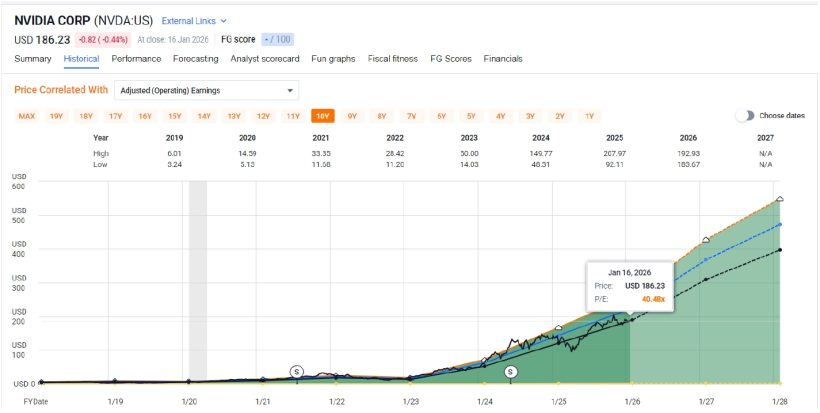
I don’t think we can be in a bubble when COST and WMT trade at a higher forward P/E multiple than NVDA.
Figure 1: COST Blended Forward P/E Multiple
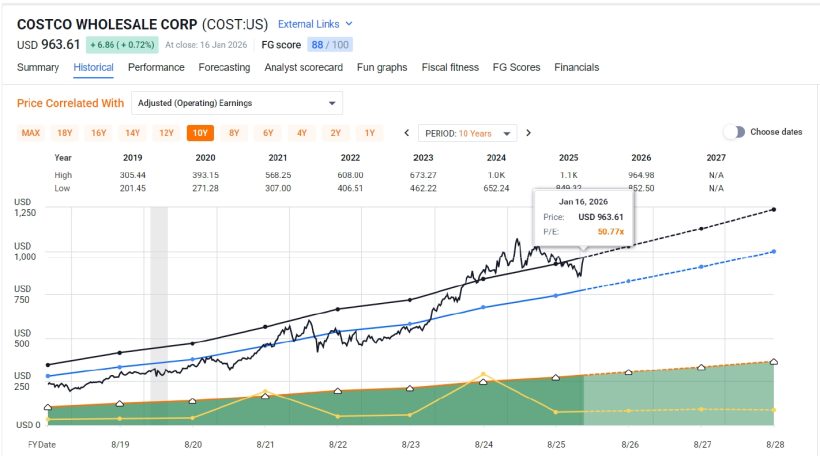
Figure 2: WMT Blended Foward P/E Multiple
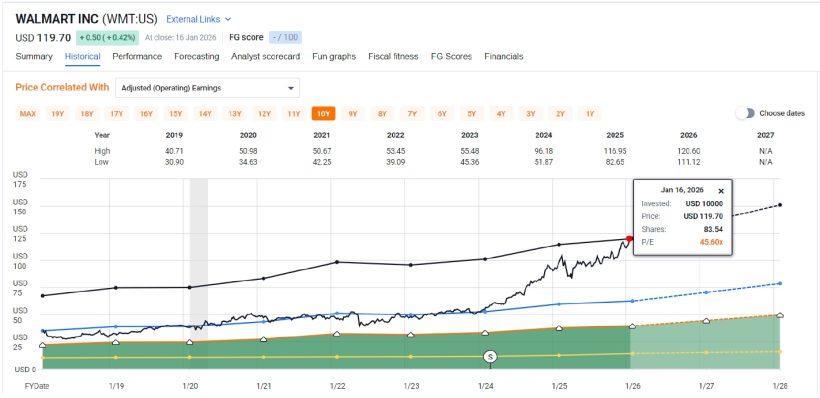
Figure 3: NVDA Blended Forward P/E Multiple
Scar Tissue from 1999 and 2008
The ’99 tech bust and the ’08 financial crisis have scarred an entire generation of investors.
Result:
- Many professionals under-owned U.S. equities in the greatest bull market in history from 2009–2022.
- The pain of volatility outweighed the logic of the long-term equity premium in their heads.
These same investors will, in my view, underperform for the rest of their careers, because they are structurally:
- Late to trends
- Early to panic
- And obsessed with smoothing the ride instead of maximizing long-term outcomes.
The Mirage of Absolute Returns & “Private” Everything
In response, the alternative asset management industry doubled down on:
- Absolute return strategies
- Private equity and private debt
- Mark-to-model portfolios with beautifully smooth lines and beautifully high IRRs
The pitch deck version:
- “Treasuries + 300 bps, with low volatility.”
- “Consistent 20% IRRs with downside protection.”
The reality:
You can’t earn Treasury + meaningful spread in private credit without taking higher risk — whether it’s credit, structure, liquidity, or complexity.
You cannot magically mint 20% IRRs forever by simply choosing to mark your book quarterly and calling it ‘fair value.’
Volatility isn’t eliminated.
It’s hidden — from committees, from dashboards, and sometimes from yourself — until it isn’t.
Volatility: The Price of Equity Returns
Volatility is the price you pay for equity returns.
If you can’t handle that, you don’t deserve equity-like returns.
Charlie Munger said he watched the value of Berkshire Hathaway decline by 50% multiple times over the course of his career.
If you can’t endure that with some degree of equanimity, you might need a different profession — or at least a different asset class.
From personal experience, the vast majority of Wealth Managers in finance are on a treadmill. The following is based on my experience living in Dubai for the past 15 years before relocating back to Los Angeles.
- They have to justify their fees,
- Their kids’ Repton school fees aren’t cheap,
- The Palm Jumeirah beachfront villa rent keeps creeping higher,
- And that five-year-old Huracán lease apparently needs an upgrade.
Those Maldives vacations also don’t pay for themselves.
How, exactly, do you charge 2 and 20 for recommending dollar-cost averaging into the S&P 500?
You can’t. So you:
- Add complexity
- Add illiquidity
- Add jargon
And often end up delivering beta with a marketing story.
If you’re a closet indexer, you deserve the paltry, compressed fees institutional clients keep pushing on you.
Why would any rational allocator pay active fees for simple beta exposure, especially when you couldn’t generate alpha if your life depended on it?
Where the Real Asymmetric Opportunities Actually Come From
One of the biggest misconceptions in investing is that asymmetric opportunities hide in obscure corners of the market.
A recent research note by Travis Hoium, who writes the Asymmetric Opportunities newsletter, captured this perfectly. The stocks delivering 25%+ annualized returns over the past decade weren’t obscure microcaps — they were household names hiding in plain sight: Alphabet, Uber, Zillow, Hims & Hers, Spotify.
The asymmetry wasn’t secrecy.
It was duration.
Markets consistently underestimate how long truly dominant businesses can continue compounding.
This insight aligns directly with how we invest at Ashva Capital Management: focus on dominant companies, massive markets, scalable economics, and the discipline to hold.
Why Ashva Capital Often Owns Big, Obvious Companies
One thing that often surprises investors is that many of Ashva Capital’s holdings are well-known, widely followed companies—not obscure microcaps hidden in the shadows. That is intentional.
As Buffett recently wrote in his annual letter:
Within capitalism, some businesses will flourish for a very long time while others will prove to be sinkholes. It’s harder than you would think to predict which will be the winners and losers. And those who tell you they know the answer are usually either self-delusional or snake-oil salesmen. – Warren Buffett
Owning obvious, high-quality businesses is not a failure of imagination. It is a recognition of reality.
That’s not a bug. It’s the strategy.
The modern internet economy rewards scale. In many industries, value accrues to companies that either control massive user bases or dominate critical niches. Once scale is established, advantages compound — often for far longer than markets expect.
History makes this obvious in hindsight.
Spotify won music.
Facebook and Instagram won social media.
Netflix won streaming.
Apple won smartphones.
None of these companies reinvented themselves every year.
They simply kept winning.
Today, we continue to believe that several already-obvious companies still have the potential to deliver asymmetric returns over long periods, precisely because markets tend to underestimate the duration of dominance. Alphabet, for example, remains one of the most complete AI, data, and cloud platforms in the world.
Within the portfolio, Micron is our largest position, followed by AMD and Disney. These are not speculative bets. They are durable, scalable businesses operating in structurally advantaged positions, where long-term cash flows matter far more than short-term narratives.
Micron Technology (MU) is our largest position because it sits at the intersection of structural demand growth and improving industry discipline. Memory is no longer a commodity business driven solely by boom-bust PC cycles. It has become a strategic input for AI, cloud infrastructure, and data-intensive workloads, particularly through high-bandwidth memory. At the same time, the supply side of the industry has consolidated meaningfully, with fewer rational players, higher capital intensity, and better pricing discipline than in prior cycles. Micron’s manufacturing scale, technology leadership, and expanding exposure to AI-driven demand position it to generate materially higher through-cycle free cash flow than the market has historically assumed.
Advanced Micro Devices (AMD) represents a long-duration share-gain story driven by execution rather than hype. Over the past decade, the company has demonstrated a consistent ability to take share in large, complex markets by delivering competitive performance, strong software ecosystems, and disciplined capital allocation. In data centers and AI infrastructure, AMD has emerged as the most credible alternative supplier to incumbent leaders, benefiting from customers’ desire for diversification, pricing leverage, and architectural flexibility. While near-term margins can fluctuate as the company invests to expand its platform, we believe AMD’s long-term earnings power is substantially greater than implied by a narrow focus on any single product cycle.
Disney (DIS) is a classic example of asset quality being obscured by cyclical and managerial noise. Few companies in the world possess a comparable portfolio of intellectual property, global distribution, and experiential monetization. As Disney rationalizes its streaming strategy, restores profitability in its Direct-to-Consumer segment, and continues to compound value through its parks and experiences segment, the company’s underlying earnings power becomes increasingly visible. Importantly, Disney’s franchises are not merely content libraries — they are multi-decade brands that monetize across film, television, parks, merchandise, and licensing. In our view, the market has focused excessively on near-term disruption while underappreciating the durability of Disney’s long-term cash-flow generation.
Often, the most asymmetric opportunities are not hidden in obscure corners of the market. They are staring us directly in the face.
Performance: Results, Accountability, and Context
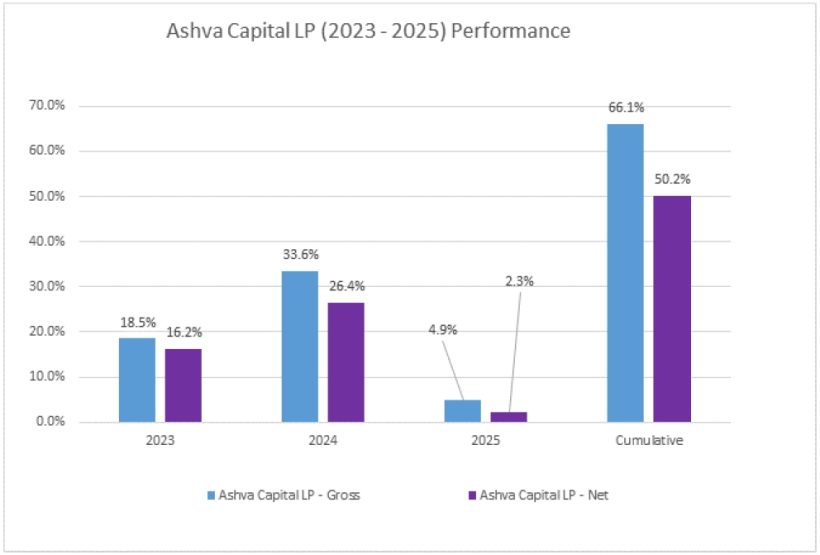
In 2025, Ashva Capital LP generated a net return of 2.26% and a gross return of 4.91%, underperforming broad market indices that were driven by an unusually narrow cohort of mega-cap winners.
The chart below summarizes Ashva Capital LP’s annual gross and net returns from 2023 through 2025, along with cumulative performance over the full period. Over these three years, Ashva compounded capital by 66.1% on a gross basis and 50.2% on a net basis, equivalent to annualized returns of approximately 18.7% gross and 14.5% net. Performance is presented in the same spirit as Warren Buffett’s long-standing approach to reporting: simple, unadjusted, and free of narrative smoothing.
Figure 4: Ashva Capital LP (2023 - 2025) Gross and Net Performance
To place these results in proper perspective, Capital Group examined a hypothetical investor with perfect market timing—someone who, with impossible precision, invested only on the single best day of each year, consistently buying at or near the market low. Over a 20-year period, that investor achieved an annual return of approximately 12.25% annually.
Figure 5: Source: Capital Group and S&P500
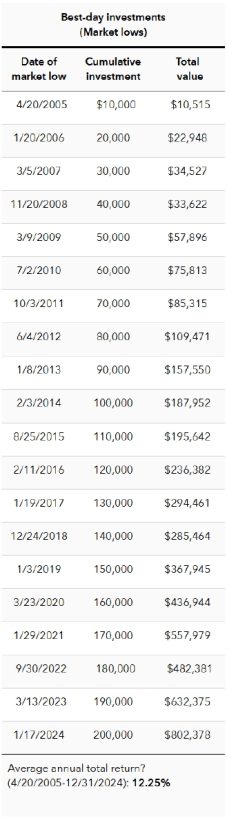
That figure is not a realistic benchmark. It is a mathematical fantasy.
Yet even against this impossible standard, Ashva Capital’s results compare favorably. Over the 2023–2025 period, Ashva’s annualized returns exceeded those of the hypothetical “perfect” market timer—despite remaining fully invested, avoiding leverage, and making no attempt to time market bottoms. The implication is straightforward: disciplined, long-term compounding can outperform even idealized versions of market timing—not by guessing lows, but by staying invested and letting time do the work.
The underperformance in 2025 was neither accidental nor the result of deteriorating fundamentals. It was the predictable outcome of a market defined by extreme concentration, aggressive multiple expansion, and widening dispersion between perceived winners and the rest of the equity universe.
As in prior late-cycle periods—most notably 1999—a disproportionate share of market returns accrued to a small cluster of index-dominating companies tied to a single dominant narrative. In such environments, disciplined portfolios that emphasize valuation, durability, and risk control often lag—not because the underlying businesses are weakening, but because capital flows temporarily reward narrative dominance over underlying economics.
This dynamic produces two well-documented effects. First, multiple expansion accrues to perceived category leaders, often irrespective of starting valuation. Second, high-quality businesses outside the narrow leadership cohort experience valuation compression even as their intrinsic value continues to compound. Ashva’s portfolio sat squarely in the latter category.
Throughout 2025, several holdings experienced drawdowns driven by multiple compression and factor rotation rather than by declining earnings power, balance-sheet stress, or competitive erosion. Importantly, expected long-term cash flows and intrinsic value across the portfolio remained intact.
Ashva also deliberately avoided chasing the narrow leadership that dominated index returns. History suggests that purchasing already-extended leaders at elevated valuations late in a concentration cycle may improve short-term optics, but often does so at the expense of long-term, risk-adjusted outcomes. Our mandate is not to maximize returns in any single year, but to compound capital across full cycles without exposing investors to permanent impairment.
The year also highlighted an unavoidable trade-off: risk discipline carries an opportunity cost in momentum-driven markets. Ashva’s use of options and explicit downside management is designed to preserve capital during adverse regimes and to maintain the ability to remain invested through volatility. In years where markets reward aggression and concentration, that discipline can mute upside. Over full cycles, however, it meaningfully improves survivability and compounding.
Crucially, when viewed over the full period rather than a single year, results remain strong. The cumulative returns achieved from 2023 through 2025 spanned markedly different market environments and were delivered without excessive leverage, permanent capital impairment, or forced exits, while remaining fully invested through volatility.
At the end of every annual letter, Warren Buffett does something remarkably simple—and remarkably rare in professional investing. He includes a single table.
That table compares the annual percentage change in Berkshire Hathaway’s market value with the total return of the S&P 500, side by side, year by year. No smoothing. No excuses. No “adjusted” anything. In effect, a 60-year investing career is summarized in a single table.
It is the ultimate act of accountability.
All the analysis, judgment, and decision-making are laid bare—along with the ability, or inability, to withstand corrections, drawdowns, and long stretches of being out of favor. There is nowhere to hide.
That table teaches several uncomfortable but essential truths: outperformance does not appear every year; extended periods of underperformance are inevitable; small differences in annual returns compound into staggering differences in wealth over time; and most importantly, no professional investor can be fairly judged by a single year—or even a handful of years.
Buffett never asked to be judged on quarterly results. He asked to be judged over decades.
I suspect this is why most people could never be successful professional investors. It is not a lack of intelligence, access to information, or analytical tools. It is the accountability. Being a professional investor means willingly submitting one’s thinking to public judgment year after year—knowing that markets will periodically make you look wrong, impatient capital will test conviction, and short-term results will often misrepresent long-term skill.
Most people cannot tolerate that level of scrutiny. They prefer smoother narratives, softer benchmarks, and explanations that shift with the cycle. They want the upside of being a professional investor without accepting the reputational risk, persistent criticism, and self-doubt that honest measurement entails.
A simple table removes all of that. It enforces discipline. It demands humility. And over time, it separates durable investment processes from well-marketed stories.
That is why I have always respected Buffett’s approach—not because he avoided mistakes, but because he never tried to hide from them. And ultimately, long-term compounding does not care about narratives. It cares only about survival, discipline, and math.
That remains the sole objective at Ashva Capital Management.
Where Ashva Capital Management Fits In
Ashva Capital Management isn’t trying to be everything to everyone.
We do one thing — and we do it with discipline:
Own high-quality U.S. equities and use options to manage downside volatility without sacrificing the long-term equity premium.
If that sounds boring, good.
Compounding usually is.
Call to Action
If this philosophy resonates, accredited investors are welcome to contact my assistant, Jan Dominic, to schedule a meeting with me and to continue the conversation.
Thank you for your trust.
We will continue to avoid permanent mistakes, embrace necessary volatility, and let disciplined compounding do its work.
With appreciation,
Ankur Shah
Managing Member
Ashva Capital Management LLC
Read more hedge fund letters here