


set  of optimal outcomes is not empty then the optimal fraction
  to bet on k-th outcome may be calculated from this formula:
  .
.
One may prove[13] that
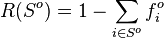
where the right hand-side is the reserve rate[clarification needed]. Therefore the requirement 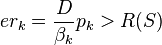 may be interpreted[13] as follows: k-th outcome is included in the set of optimal outcomes if and only if its expected revenue rate is greater than the reserve rate. The formula for the optimal fraction may be interpreted as the excess of the expected revenue rate of k-th horse over the reserve rate divided by the revenue after deduction of the track take when k-th horse wins or as the excess of the probability of k-th horse winning over the reserve rate divided by revenue after deduction of the track take when k-th horse wins. The binary growth exponent is

and the doubling time is

This method of selection of optimal bets may be applied also when probabilities  are known only for several most promising outcomes, while the remaining outcomes have no chance to win. In this case it must be that
  and
and  .
.
Application to the stock market
Consider a market with  correlated stocks
  with stochastic returns
  ,
,  and a riskless bond with return
  . An investor puts a fraction
  of his capital in and the rest is invested in bond. Without loss of generality assume that investor’s starting capital is equal to 1. According to Kelly criterion one should maximize
 ![mathbb{E}left[ lnleft((1 + r) + sumlimits_{k=1}^n u_k(r_k -r) right) right]](http://upload.wikimedia.org/math/6/d/e/6de30ae99c1da27e27e4ab92c95f7f79.png "Kelly Formula and Weighting Investments [ANALYSIS] 20")
Expanding it to the Taylor series around  we obtain
![mathbb{E} left[ ln(1+r) + sumlimits_{k=1}^{n} frac{u_k(r_k - r)}{1+r} -<br /><br /><br /><br /><br /><br /><br /><br /><br />frac{1}{2}sumlimits_{k=1}^{n}sumlimits_{j=1}^{n} u_k u_j frac{(r_k<br /><br /><br /><br /><br /><br /><br /><br /><br />-r)(r_j - r)}{(1+r)^2} right]](http://upload.wikimedia.org/math/b/1/c/b1c2b08db45957bd88b0bdc60a5cb56c.png "Kelly Formula and Weighting Investments [ANALYSIS] 22")
Thus we reduce the optimization problem to the Quadratic programming and the unconstrained solution is 
where  and
and  are the vector of means and the matrix of second mixed noncentral moments of the excess returns.[14] There are also numerical algorithms for the fractional Kelly strategies and for the optimal solution under no leverage and no short selling constraints.
Via: csinvesting.org