

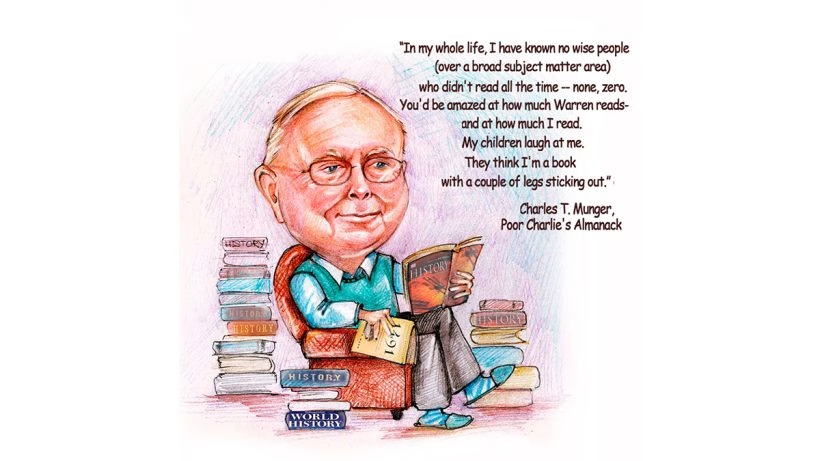
Name the Three Wise Men of Investment:
Charlie Munger, Warren Buffett and Jack Bogle
They teach every key concept: diversification, compound interest, debt avoidance, honesty, diligence, charity, staying the course, regression to the mean, return on investment…
But could those same great investing principles lie in humanity’s most ancient and precious text?
Behold the investment wisdom of The Bible:
I Thou Shalt Invest Little By Little
“Wealth gained hastily will dwindle, but whoever gathers little by little will increase it.”---Proverbs 13:11
Long-term investment, building wealth slowly, engaging the principles of continuing growth and compound interest, promoting humility, simplicity and faithfulness, is the surest and safest road to prosperity.
As the Bible teaches, those greedy to acquire wealth are punished, whether by nature, failed “get-rich-quick” schemes, con artists and crooks, or the wreckage of morality and decency.
II Thou Shalt Diversify Thine Investments
“Invest in seven ventures, and also to eight, for thou knowest not what disability may come upon the land.”---Ecclesiastes 11:2
Brought forth by the late, great Jack Bogle, index funds were decried not only by Wall Street, but initially by Warren Buffett and Charlie Munger, whose Berkshire Hathaway long outshone the indexes through focused investment.
More recently Warren Buffett, though practicing focused investment at Berkshire, consistently recommended index funds to the general public, lest innocent investors suffer in a market unforgiving of “those who know not what they do.”
Likewise, the late Charlie Munger, who long decried diversification as “deworsification,” for dashing any hope of outperforming the indexes, mandated index investing for all employees of his Daily Journal, recognizing, at long last, that few investors beat the indexes and most, tragically, never even come close.
III Thou Shalt Dread Debt
“Just as the rich rule the poor, so the borrower is servant to the lender.”---Proverbs 22:7
Warren Buffett has always shunned debt, calling leverage “the only way a smart person can go broke.”
Charlie Munger, famously indifferent to political correctness, opined that “smart people go broke three ways: liquor, ladies and leverage.”
Jack Bogle referred to “bad debt” not as accounting’s uncollectable debt, but high interest debt that prevents investors from amassing wealth.
IV Thou Shalt Practice Thrift
“The wise have wealth and luxury, but fools spend whatever they get.”---Proverbs 21:20
Warren Buffett still lives in the same modest house he bought in 1958. He famously said, “Do not save what is left after spending, but spend what is left after saving.”
“If you know how to spend less than you get, you have the philosopher’s stone.”---Benjamin Franklin
V All Thee Possess Shall Regress to the Mean
“So the last shall be first, and the first last.”---Matthew 20:16
Jack Bogle taught that strong performance by a managed fund or a stock is often followed by underperformance, sometimes ever after. Trying to catch every wave of outperformance and escape every wave of underperformance, to buy and sell and time the market, is a fool’s errand.
“Take advantage of compound interest and don’t be captivated by the siren song of the market.”---Warren E. Buffett
VI Jesus’ Parable of the Talents
“It is easier for a camel to go through the eye of a needle than for a rich person to enter the Kingdom of God.”---Matthew 19:24
This timeless pronouncement proclaims danger in the idolatry of wealth.
Yet Jesus taught the Parable of the Talents, espousing the wisdom of investment, reproving hiding and hoarding:
A wealthy man leaving upon a journey entrusts three servants with varying “talents,” sums of gold to put to good use during his long absence. Upon his return he learns that two of his servants have wisely invested and gained a goodly return and they are duly rewarded. The third servant, fearful and trepidatious, has hidden the talents granted him. Though faithfully returning the talents intact, he is punished for not having invested.
Though the Parable of the Talents has been variously interpreted, the plain message is that, in stable times, it is blessed to invest and foolish to hide or hoard.
VII Thou Shalt Be Generous Unto the Poor
“The generous will themselves be blessed, for they share their food with the poor.”---Proverbs 22:9
Jack Bogle, founder of Vanguard Funds, not only eschewed the grand fees and salaries of money managers but famously gave half his annual income to charity. Warren Buffett and the late Charlie Munger earned but $100,000 per annum in salary and have been fabulously charitable with their wealth, moreover, in spreading their candid wisdom across the globe at the annual Berkshire Hathaway meeting.
VIII Thou Shalt Be Diligent and Thereby Blessed
“A slack hand causes poverty, but the hand of the diligent makes rich.”---Proverbs 10:4
As Charlie Munger has taught, “If you want to guarantee a life of misery, be unreliable. Do not faithfully do what you have been engaged to do. This one habit will counterbalance all of your virtues combined, however great.”
And, even more directly, “If you’re unreliable it doesn’t matter what your virtues are, you’re going to crater immediately.”
IX Thou Shalt Be Honest and Thereby Blessed
“A false balance is an abomination to the Lord, but a just weight is his delight.”---Proverbs 11:1
As Charlie Munger taught, “Remember that reputation and integrity are your most valuable assets and can be lost in a heartbeat.”
As Warren Buffett advises, “It takes 20 years to build a reputation and five minutes to ruin it.”
X Thou Shalt Serve But One Master
“No one can serve two masters.”---Matthew 6:24
Stockbrokers and money managers earn their daily bread from commissions and fees on trades and are thus incentivized to encourage active trading over sober, long-term investment.
“Show me the incentive and I will show you the outcome.”---Charlie Munger
As Warren Buffett has said, “If you bought Berkshire Hathaway in ’65, you made money. But your broker probably starved to death. Wall Street doesn’t make money unless people are doing things.”
In the 1980s I approached my then-broker, now long passed, about Berkshire Hathaway.
He advised, “Warren Buffett can’t live forever and then where will you be?”
Well, Warren Buffett is still here and, invested in Berkshire Hathaway, I’m far better off.
“We have an unusual group of shareholders. We have a business that’s owned by people where the turnover on our stock may be 20% a year, where virtually every stock in the S&P 500 turns over 100% a year.”---Warren E. Buffett
Full disclosure: long time shareholder of Berkshire Hathaway and VOO.