


Last updated: July 2026
George Soros, the 95-year-old living founder of Soros Fund Management, stands as one of the most influential figures in hedge fund history. His multi-billion-dollar capital is now managed through his family office under the leadership of Chief Executive and Investment Officer Dawn Fitzpatrick. Even so, the firm’s regulatory disclosures continue to draw intense Wall Street scrutiny. This analysis breaks down the firm’s current 13F portfolio holdings, its core investment strategy, and the enduring market legacy of its founder.
The Soros Fund Management Portfolio Today
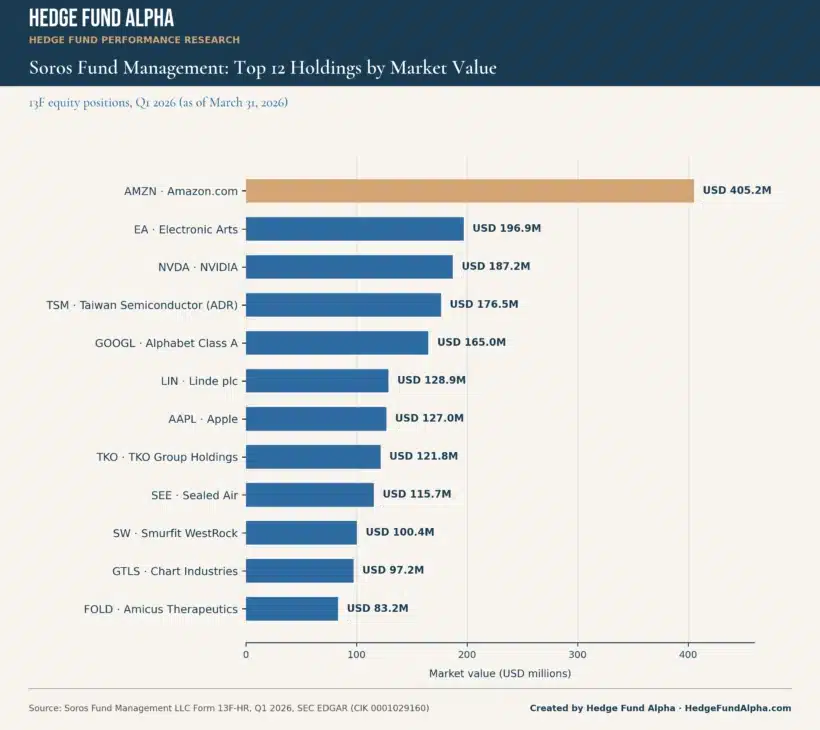
| Rank | Ticker | Company | ~% portfolio | Value | Shares |
|---|---|---|---|---|---|
| 1 | AMZN | Amazon.com | ~4.4% | ~$405.2M | 1,945,789 |
| 2 | EA | Electronic Arts | ~2.2% | ~$196.9M | 965,793 |
| 3 | NVDA | NVIDIA | ~2.1% | ~$187.2M | 1,073,206 |
| 4 | TSM | Taiwan Semiconductor (ADR) | ~1.9% | ~$176.5M | 522,318 |
| 5 | GOOGL | Alphabet Class A | ~1.8% | ~$165.0M | 573,929 |
| 6 | LIN | Linde plc | ~1.4% | ~$128.9M | 259,926 |
| 7 | AAPL | Apple | ~1.4% | ~$127.0M | 500,534 |
| 8 | TKO | TKO Group Holdings (Cl A) | ~1.3% | ~$121.8M | 604,242 |
| 9 | SEE | Sealed Air | ~1.3% | ~$115.7M | 2,751,799 |
| 10 | SW | Smurfit WestRock | ~1.1% | ~$100.4M | 2,520,236 |
| 11 | GTLS | Chart Industries | ~1.1% | ~$97.2M | 470,095 |
| 12 | FOLD | Amicus Therapeutics | ~0.9% | ~$83.2M | 5,753,186 |
Source: Soros Fund Management LLC Form 13F-HR for Q1 2026 (as of March 31, 2026), filed with the SEC (EDGAR, CIK 0001029160).
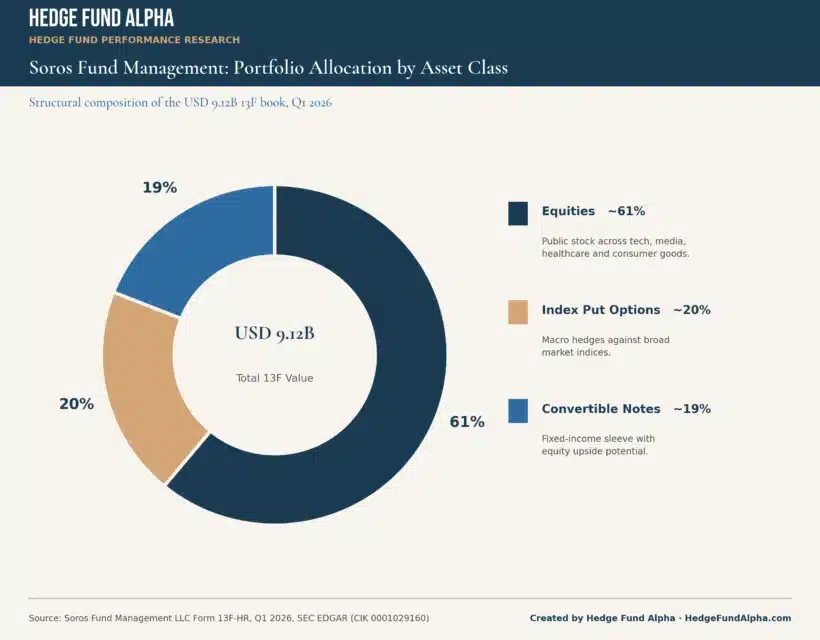
Soros Fund Management’s regulatory filings reveal a highly institutionalized multi-asset strategy. The disclosed 13F U.S. portfolio is valued at $9.12 billion across 263 distinct positions.
What stands out most in the current book is its structural asset mix, which highlights a strict approach to downside protection. The portfolio allocation breaks down into three core components:
- Equities (~61%): The primary engine of the portfolio, comprised of public stock allocations across tech, media, healthcare, and consumer goods.
- Index Put Options (~20%): A defensive overlay consisting of large macro hedges against the broader market indices, protecting the permanent capital base from structural shocks.
- Convertible Notes (~19%): A fixed-income sleeve that secures baseline yields while retaining the option to capture equity upside if the underlying stocks rally.
This allocation marks a major evolution from the Quantum Fund era. The founder’s original strategy focused on a concentrated portfolio built around big bets on selected currencies and commodities. Today, under Chief Investment Officer Dawn Fitzpatrick, the portfolio is deeply diversified.
While Amazon holds the firm’s largest direct equity position at approximately 4.4% of the book, no single long stock dominates the capital structure. Instead, the firm utilizes a highly institutional strategy that spreads risk broadly across more than 260 holdings.
It maintains flexibility to trade short-term market inefficiencies while shielding the fund from severe downside exposure.
Soros Fund Management’s Top Stock Holdings in Detail
Amazon (AMZN)
The fund initiated its first position in Amazon two decades ago, back in Q3 2003. Over the years, the portfolio managers have aggressively traded the stock, rapidly scaling into and out of the position to capture momentum. In the first quarter of 2026, Soros Fund Management opted to take some profits off the table. It trimmed the position by 17.5%, selling approximately 414,000 shares. Even after this reduction, Amazon remains a cornerstone of the equity book. Here is the current snapshot:
- Shares Held: ~1.95 million
- Market Value: ~$405.2 million
- Portfolio Weight: 4.44% of the disclosed 13F portfolio
NVIDIA (NVDA)
The fund initiated its very first position in NVIDIA over two decades ago, in Q1 2003. Since then, the portfolio managers have dynamically scaled in and out of the stock across dozens of transactions to capitalize on market cycles. Unlike Amazon, where the fund took profits in the first quarter of 2026, Soros Fund Management actively doubled down on its semiconductor exposure. In Q1 2026, the firm increased its NVIDIA stake by an additional 61.2%, acquiring approximately 408,000 more shares. This is the current NVIDIA holding:
- Shares Held: ~1.07 million
- Market Value: ~$187.2 million
- Portfolio Weight: ~2.1% of the disclosed 13F portfolio
Taiwan Semiconductor (TSM) and Alphabet (GOOGL)
While still maintaining a significant allocation to digital advertising and cloud infrastructure, the fund opted to take profits on its Alphabet position. In Q1 2026, the firm reduced its GOOGL stake by 10.2%, selling roughly 65,000 shares.
- Shares Held: ~574,000
- Market Value: ~$165 million
- Portfolio Weight: ~1.8% of the disclosed portfolio
Conversely, the fund deepened its conviction in the hardware backbone of the AI boom. Viewing TSM as central to the global chip supply chain, Soros increased its long position by an aggressive 49.3%, adding over 172,000 shares.
- Shares Held (Long): ~522,000
- Market Value (Long): ~$176.5 million
- Portfolio Weight: ~1.9% of the equity book
However, staying true to Dawn Fitzpatrick’s cautious macro outlook and heavy use of defensive overlays, the firm simultaneously initiated a new put option position against TSM. Holding puts on 375,000 shares valued at roughly $126.7 million, this position acts as a structural hedge.
It allows the fund to maintain long-term equity upside in semiconductor manufacturing while protecting against short-term geopolitical shocks or a sudden cyclical downturn in the chip sector.
The Convertible-Bond and Options Overlay
A defining characteristic of Soros Fund Management’s current portfolio is its sophisticated use of derivatives and hybrid fixed-income instruments to navigate a highly volatile market. Together, the convertible-note sleeve (~19%) and the options overlay (~20%) account for nearly 40% of the firm’s $9.12 billion U.S. book. This defensive structure reflects CEO Dawn Fitzpatrick’s cautious 2026 market outlook. It combines equity upside potential with aggressive index-level hedging.
The Convertible-Note Sleeve (~19% of the Book)
The fund maintains a robust convertible debt portfolio as a credit-oriented equity strategy. By investing in corporate convertible notes, the firm secures steady downside yield protection. At the same time, it retains the ability to benefit if the underlying stocks rally.
The core of this fixed-income strategy consists of six key institutional allocations:
- Global Payments (1.500% note): ~$218.2M (~2.4% of the entire portfolio)
- Bill Holdings note: ~$186.6M (~2.0%)
- PG&E (4.250% note): ~$181.6M (~2.0%)
- Jazz Investments (2.000% note): ~$158.4M (~1.7%)
- Rivian Automotive (4.625% note): ~$153.7M (~1.7%)
- JD.com (0.250% note): ~$149.9M (~1.6%)
The Options Overlay (~20% of the Book)
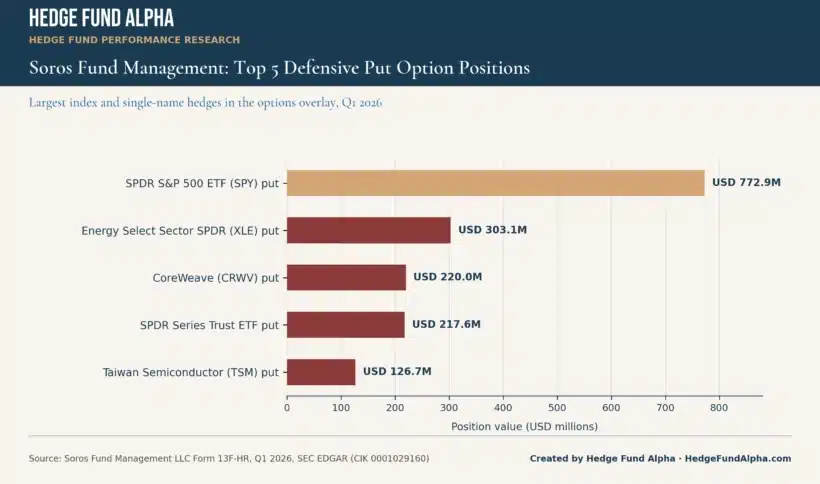
Complementing the convertible sleeve is a $1.83 billion options book spread across just 13 lines. This segment is not a collection of speculative stock picks. Instead, it serves primarily as a macro hedge and short overlay, helping protect the firm’s permanent capital from major market shocks.
The largest put options serve as the portfolio’s primary defensive firewalls:
- SPDR S&P 500 ETF (SPY) put: ~$772.9M
- Energy Select Sector SPDR (XLE) put: ~$303.1M
- CoreWeave (CRWV) put: ~$220.0M
- SPDR Series Trust ETF put: ~$217.6M
- Taiwan Semiconductor (TSM) put: ~$126.7M
In contrast, the fund holds very few call options. These leveraged positions are designed to benefit from rising markets. The largest call positions (including Elastic, Iron Mountain, Itron, Pony AI, and Huntsman) are all valued at under $40 million each.
George Soros’s Investment Philosophy
George Soros is a pioneer of global macro investing, using geopolitical insight to anticipate major economic shifts. Operating through the famed Quantum Fund alongside legendary portfolio managers like Stanley Druckenmiller, Soros built one of history’s most successful investment partnerships. He employed highly leveraged, short-term speculation across all asset classes. This approach yielded historic windfalls, most notably their iconic 1992 short against the British pound.
His strategy is built on the theory of reflexivity, which holds that market participants’ perceptions can shape economic fundamentals. Rather than reacting to data, Soros relies on market feedback. This allows him to anticipate self-reinforcing boom-and-bust cycles and capitalize on structural bubbles.
His risk management framework is rigorous yet highly unconventional. Soros typically tests the waters with small initial investments, sizing up heavily only when the market validates his thesis, and cutting losses when it fails. To avoid confirmation bias, he consistently surrounded himself with dissenting advisors to stress-test his arguments. He was known for acting on instinct, including selling large positions when sudden back pain appeared.
Take A Look At George Soros Philosophy of Trading:

Who Runs Soros Fund Management Now
Today, Soros Fund Management operates fundamentally differently than it did during its Quantum Fund heyday. Having returned all outside capital to investors in 2011, the firm now functions exclusively as a family office. Its primary mandate is to serve as the permanent capital base for the Open Society Foundations, managing an estimated $25 billion to $28 billion in assets.
The daily operational and portfolio leadership is held by Dawn Fitzpatrick, who serves as both Chief Executive Officer and Chief Investment Officer. Under her leadership, the firm has evolved into a highly institutionalized, multi-asset allocator. Meanwhile, the 95-year-old George Soros has completely stepped back from trading operations to focus on his philanthropic legacy. This structural succession was finalized in 2023 when he formally handed control to his son and designated heir, Alexander Soros, who now chairs the Open Society Foundations and oversees the fund’s investment committee.
Frequently Asked Questions
What stocks does George Soros own?
While George Soros does not personally dictate daily trades, his wealth is invested through Soros Fund Management. As of the firm’s Q1 2026 13F regulatory filing, it maintains a $9.12 billion U.S. portfolio spread across 263 positions. The fund’s top direct equity holdings currently include Amazon, Electronic Arts (EA), Nvidia, TSMC, Alphabet, and Apple.
What is Soros Fund Management?
Soros Fund Management is a private family office managing an estimated $25 billion to $28 billion in assets. After returning all outside investors’ capital in 2011, the firm now functions primarily as the permanent capital base for the Open Society Foundations. It is currently run by Chief Executive Officer and Chief Investment Officer Dawn Fitzpatrick.
What is George Soros’s investment strategy?
Soros is a pioneer of global macro investing and short-term speculation, with a core philosophy rooted in his theory of “reflexivity.” This theory suggests that market participants’ biases can actively influence underlying economic fundamentals. Rather than relying purely on intrinsic valuation, Soros exploits this market feedback to anticipate self-reinforcing boom-and-bust cycles.
How did George Soros make his money?
Soros generated the vast majority of his wealth operating the legendary Quantum Fund. His most famous windfall came in 1992 when he recognized a structural weakness in the European Exchange Rate Mechanism. By aggressively shorting the British pound, he forced the UK to withdraw from the system, earning him over $1 billion and the moniker “the man who broke the Bank of England.”
Is George Soros a value investor?
No. While value investors typically look for fundamentally underpriced companies to hold for the long term, Soros is a speculator. He utilizes heavy leverage, tracks broad geopolitical and macroeconomic trends, and actively trades momentum and currency fluctuations to capitalize on market inefficiencies.
Related Content
- David Tepper Portfolio: How This Billionaire Crushes the Market
- Ron Baron Portfolio Magic: Building Your Financial Future
- Tom Russo Portfolio Performance Analysis & Current Holdings
- Chris Hohn Portfolio: Strategies to Model for Your Own Portfolio
- Howard Marks Portfolio: Analyzing His Risk Management Strategies
- Charlie Munger Portfolio Performance: Analyzing the Strategies His Success