


Apis Flagship Fund commentary for the first quarter ended March 31, 2025.
Dear Partners,
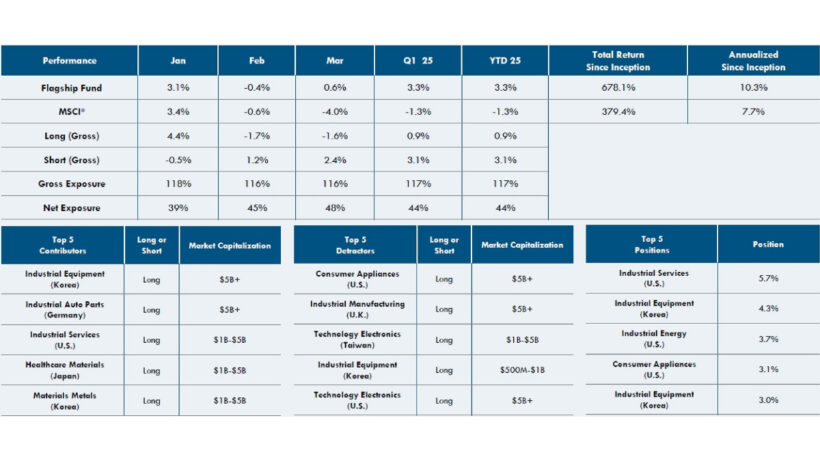
The Apis Flagship Fund was up 3.3% net in Q1 2025. During the past quarter, our longs contributed 0.9% (gross) and our shorts also contributed 3.1% (gross). At the end of March, the Fund was approximately 48% net long with the portfolio 82% long and 34% short.
Read more hedge fund letters here
Performance Overview (Gross Returns)
2025 is off to a good start for our Flagship Fund, with positive returns during Q1 across both longs and shorts. Regionally, the story for the quarter was strong outperformance in Europe, which saw impressive market performance (up over 10.0%), and stocks there are still trading at a significant discount to U.S. peers. This contrasted starkly with declines in major global benchmarks, particularly in the U.S. and Japan. Asia ex-Japan also performed well, gaining over 5.0%.


The Fund benefited from exposures tilted away from the U.S., with greater focus toward Europe but especially Asia ex-Japan, which contributed 4.8% to returns, with Europe adding about 2.0%. The biggest contributors to returns came from the defense sector, with names in South Korea and Europe outperforming. Defense stocks, especially those linked to European initiatives aimed at bolstering defense spending, were key drivers of this success – a secular trend we’ll touch on more below. On the flip side, our exposure to Japan (down 1.8%) and U.S. (down 0.6%) detracted from returns. Strong short positioning in the U.S. helped offset much of the downside. Our exposure to small-caps continues to be a headwind, but not as stark as its been, with the MSCI-SMID underperforming the larger cap benchmark by about 0.5%.
The Technology and Healthcare sectors were the biggest detractors from performance, while all other sectors showed positive results. Industrials stood out as a top performer, contributing more than 7.0% to returns. This was driven by defense-related Industrials, which reacted positively to European initiatives to shore up defense. Short performance was positive across all sectors, with the best results coming from Technology sector.
Our leading long positions were all defense names, with strong performances from two companies in South Korea and one in Europe. While several larger defense names attract attention, we continue to uncover new opportunities in defense supply chains, focusing on names that are less well understood and have potential for discovery. On the downside, Technology and Healthcare names underperformed, with the top detractor being Lotes (Taiwan), which detracted about 1.0% as AI stocks saw a pullback. On the short side, Moderna was the top contributor, just as it was for much of last year. Detractors were modest, with SMA Solar among the losers, as the stock staged a technical bounce after a poor 2024.
Portfolio Outlook And Positioning
As we initially began drafting this letter, our thought was to focus on Europe, which we believe is at a turning point. The region’s stimulus measures are set to have important long-term implications. The scope for turning on the spigot in Europe is far greater than in the U.S., considering Europe’s substantially lower debt burden.

We will continue to focus on this theme, although as we write, the markets have turned sharply down on President Trump’s “Liberation Day” tariff surprise.
The current plan is not (yet) worth commenting on. Its specifics remain unclear – it’s uncertain what the plan actually entails, how it will be implemented, or what success would even look like. From our perspective, targeting trade deficits, especially with poorer countries that produce essential goods, seems misguided. Even if there was a coherent strategy, history has shown us that it could all change overnight. No company is likely to put time and money into new manufacturing capabilities without a clear, stable, long-term framework in place. Therefore, we believe that one of two outcomes will emerge: either a more sensible policy will be introduced soon, or the current plan will cause enough disruption that it forces revisions. In either case, we expect the current strategy to fail – and the sooner the better.
As for portfolio positioning, we remain committed to our historical approach. We will continue to use market volatility to “upgrade” the portfolio while not radically changing gross/net positioning. The combination of volatility and reduced liquidity in smaller companies can create outsized technical moves. Already this month, we have seen a number of high-quality “franchise” companies or those with solid backlogs fall by 20 or 30%. We view these sharp declines as opportunities to prudently “buy the dip,” all the while ensuring that the overall portfolio remains well-positioned to weather what could remain a challenging environment.

Investment Highlights
The Opportunity in E.U. Building Materials
A new theme in the portfolio is the building materials sector in Europe, which has experienced significant volatility over the past two decades, marked by the housing crisis and the COVID-19 pandemic. More recently, construction activity surged to a post-financial crisis high in 2021 in Europe, only to collapse by 60% in 2023 due to over-investment and rising interest rates. Current data, however, shows signs of stabilization, particularly in building permits, suggesting the market may be finding its footing.

E.U. Residential Building Permits and the Outlook for Recovery

There are several key points worth highlighting about this cycle. First, current construction volumes are well below historical averages, which could lead to structural shortages if these levels persist. As a classic cyclical market, it is not a matter of if these volumes recover, but when. We believe that recovery could come sooner rather than later, especially with the current interest rate cycle appearing to turn in favor of growth. The recent cuts by the ECB are expected to continue at least through June, and increasing tariff uncertainties may spur additional rate cuts.
Another significant factor at work here is related to fiscal stimulus. Germany recently announced a €500 billion infrastructure investment plan. While this was surprising, what was equally, if not more so, was the loosening of its constitutional debt brake. This shift in policy, considered sacrosanct, signals the government’s commitment to stimulating growth. While it is largely speculation, it’s plausible that other E.U. countries may follow suit. Additionally, the potential end to the war in Ukraine presents a long-term rebuilding opportunity; everything from concrete and doorknobs to utility services will be required. While investment in Ukraine is currently minimal, post-war recoveries often lead to a surge in construction, sometimes doubling pre-war levels and lasting for a decade. Given the size of Ukraine’s population (nearly 10.0% of the E.U.), a post-war rebuilding effort could tighten the building supply markets, driving up manufacturing volumes and pricing.
Additionally, tariffs present a new wildcard, particularly for the U.S., which will most likely lead to higher prices as it is a net importer of cement. This should benefit European producers, who have significant exposure to this market.
The Cyclical Nature of the Building Materials Industry and Cement Market Focus
The building materials industry is inherently cyclical, which is often seen as a disadvantage for investment. However, we believe the cycle is at a turning point, creating an attractive opportunity. We have specifically focused our attention on the cement market for several compelling reasons.
Cement is a highly localized market wherein a single plant will only serve a radius of customers within 200-400 kilometers due to the weight and bulk of the product. Similar to many other industries like memory chips, airlines, and railroads, the cement industry is now run by MBAs who have figured out that consolidation is critical to maintaining pricing power. Over the past two decades, we have witnessed a flurry of M&A activity, reshaping the industry and resulting in a highly profitable landscape even at the bottom of their cycle. Margins are currently near all-time highs across the industry, which is highly unusual for a cyclical commodity. While we have been unable to get plant-by-plant market share figures, it is widely accepted across the industry that within each region, there are typically no more than two or three dominant operators. This concentration has enabled cement companies to hold or even raise prices despite operating at just 60% utilization in their European plants.
The Impact of Carbon Emissions and Regulatory Pressures
The last important driver of our thesis relates to carbon emissions and the growing pressure to reduce them. Cement production, which involves plants essentially baking limestone, inherently releases CO2. The process itself and the fuel used to generate the necessary heat both contribute to CO2 emissions. As a result, cement companies face increasing regulatory scrutiny and regulatory pressures to reduce their carbon footprint. The cement companies have been given credits for free, but those grants are being reduced annually, forcing companies to either purchase additional credits in the marketplace or bury their CO2 through carbon capture. For perspective, the current price of cement is about €120 per ton and the cost to offset the carbon for each ton is another €30-40 today. These credits trade on an exchange and analysts anticipate a growing shortage that could increase this cost by multiples. Companies are experimenting with carbon capture (and the first plant should go live next month), but the technology is costly, and pricing for cement processed this way is expected to reach €300-500 per ton.
It remains to be seen if the powers that be will have the stomach to continue down this path. What is certain, however, is that no one is going to build a new plant, and the 20-30% of the market that is still “mom & pop” operators will most likely sell to the handful of companies remaining. While carbon charges seem like a bad thing for the industry, the opposite is the case as they drive further consolidation, more pricing power, and less competition. Starting next year, a carbon border adjustment will be imposed, meaning foreign manufacturers shipping cement into the E.U. will also have to purchase these credits, further tightening the market.
Attractive Valuations in a Cycle Turnaround
Given the top-down dynamics described above, we were surprised that many of these companies are still trading at very low valuations. We have holdings in Buzzi (Italy), Cementir (Italy), Titan (Greece), and Wienerberger (Germany). Wienerberger is slightly different from the other names as they control about one-third of the European brick market and are even more cyclically exposed than the cement names. The average P/E ratio for these is around 8x, with the highest at 9x. Free cash flow yields are around 10% and all pay 2-3% dividends. We believe these stocks have significant upside potential, driven by a volume recovery that could substantially boost earnings and a potential rerating of valuation multiples. Cyclical stocks that can deliver record margins at the bottom of a cycle typically trade at much higher multiples. We expect investors will begin to recognize this opportunity as the current downturn fades and growth resumes.
As always, we encourage your questions and comments, so please do not hesitate to call our team here at Apis or Will Dombrowski at +1.203.409.6301.
Sincerely,
Daniel Barker
Portfolio Manager & Managing Member
Eric Almeraz
Director of Research & Managing Member
- See Apis Global Discovery Fund Q1 2025 Commentary here.
- See Apis Deep Value Fund Q1 2025 Commentary here.