



When quant investors encounter a new dataset, one of the first questions they ask is whether the data is “point-in-time” – a make-or-break factor.
Why Point-in-Time Matters
To evaluate a dataset’s value, quants backtest how its trading signals would have performed historically. To be meaningful, this backtest must recreate the past exactly as it was – a process that’s often more complicated than it sounds.
Over time, data definitions change; defunct, delisted or merged companies may disappear from feeds; scoring methodologies are updated; and old records get overwritten. As a result, look-ahead bias and survivorship bias infect a huge fraction of financial data.
For example, if a data provider retroactively fills gaps in its historical shipping transit data using newer algorithms for interpreting satellite imagery, it introduces look-ahead bias by using information that wasn’t actually available at the time.
Backtesting and training models on biased data is a futile exercise in alternative history. Worse, since these biases typically inflate backtested performance, the result is trading strategies that almost always fail in live trading.
The Value of Getting PIT Data Right
Data that’s verifiably point-in-time is worth more to investors. We explored why PIT data drives pricing power and builds buyer trust in Whose Data Is Worth More?.
When investors can’t be certain their data is free from bias, they either over-invest in strategies that backtest well but fail in live trading, or hesitate to scale profitable strategies while waiting for live validation. Both outcomes can be exceptionally costly.
In one anonymous hedge-fund case study, simply making their news feed point-in-time led to a 15% increase in alpha generation across strategies.
A deep reservoir of PIT historical data is one of the hidden advantages of the world’s most successful quant firms, including Renaissance and DE Shaw. After decades of meticulous data gathering, these firms know their internal datasets are fully point-in-time, enabling their research groups to run backtests and develop strategies with confidence.
Data providers who deliver PIT data give their clients the same level of assurance, without requiring years of proprietary data archiving.
How PIT Data Wins Deals
A trusted point-in-time history makes it easier for investors to evaluate a dataset, integrate it into research pipelines, and deploy capital with conviction. (Providers like TEJ illustrate how audited, time-stamped financial histories help establish credibility.)
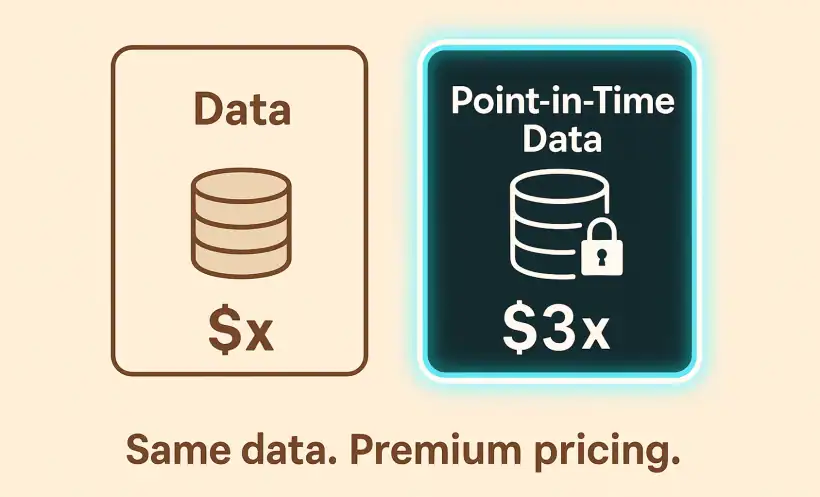
That’s why PIT data frequently serves as an initial filter. If a dataset isn’t point-in-time, many investors won’t request a trial. And even when they do, in our experience investors are often willing to pay two to three times more for a point-in-time version of the product (example).
The value of a point-in-time data history compounds over time. Within months, every prospective client experiences a built-in live trial the moment they pull your historical data. And because PIT data can’t be recreated after the fact, that growing history becomes a lasting competitive moat.
Why Some Providers Hesitate
So why doesn’t everyone offer PIT data?
- Fear: Providers worry that showing revisions makes them look sloppy. In reality, investors expect data to be messy, and want to know when and how data has changed. Hidden flaws surface during trials anyway, eroding a provider’s credibility far more than openness ever could.
- Complexity: Version control, timestamping, and documentation can feel daunting for lean engineering teams.
- Cheap Talk: Because point-in-time status has long been easy to claim but difficult to verify, the term itself has lost credibility — reducing the reward for those who deliver it authentically.
Making PIT Simple and Verifiable
validityBase makes datasets verifiably point-in-time without changing your existing pipeline. Each update receives an independent, blockchain-backed timestamp, and clients can verify point-in-time status of a dataset in seconds.
By proving data is point-in-time instantly, data providers turn a common source of lost deals into a competitive advantage — building credibility, improving the likelihood of trials, increasing trial conversions, and commanding premium pricing.
Want to make your data dramatically more valuable to quant investors? Get in touch — we’ll show you how easy it is to turn your data into a product quants prioritize.
The article "Why Quants Pay More for Point-in-Time Data" first appeared on validityBase.