

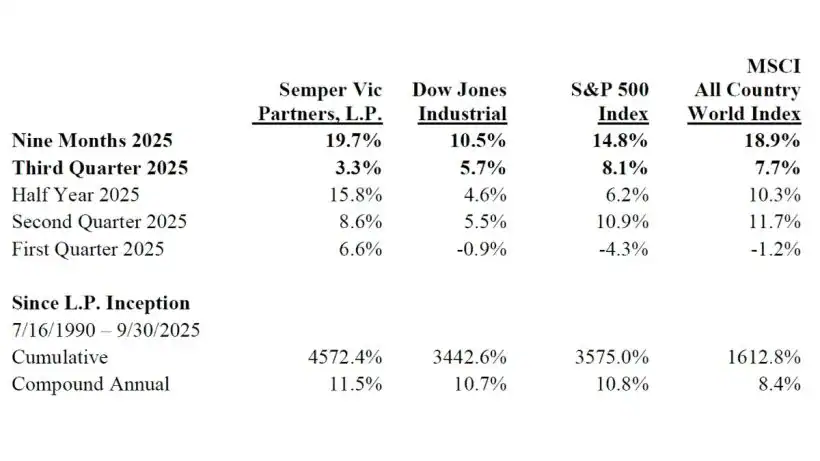
Tom Russo’s Semper Vic Partners returned 3.3% for the third quarter, bringing its year-to-date return to 19.7%. The Dow Jones Industrial Average is up 10.5% for the year, while the S&P 500 has gained 14.8%. The MSCI All Country World Index has returned 18.9% year to date.
Read more hedge fund letters here
Semper Vic’s compound annual return since inception is 11.5%, outperforming the compound annual returns of the Dow, at 10.7%, the S&P 500, at 10.8%, and the MSCI, at 8.4%.
Boosted by the dollar
In his Q3 letter to investors, which was obtained by Hedge Fund Alpha, Russo recalled his previous letter, in which he talked about “collective buying of AI exposure baskets of shares that promise access to AI riches.” Looking back into history, he recalled the FAANG era, which was also marked with a similar fear of missing out.
During that period, the U.S. dollar was another factor that drove the FAANG names and other widely sought-after investments. Russo noted that the U.S. dollar has been skyrocketing in valuation for most of the last 10 years.
Global investors who wanted to take part in this trend had to convert their local currencies into U.S. dollars, pressuring the dollar and providing Semper Vic clients with a tailwind of over 10% in 2025. Russo pointed out that the reversal in the dollar left global investors who chased after what investors had grown to expect, namely, the soaring pace of the U.S. dollar, flatfooted.
Also see: Arquitos Capital Up 67% YTD, 14% CAGR Since Inception; Bullish On These Biotech Stocks
High portfolio concentration
Semper Vic’s top six holdings now account for a little over 61% of the fund’s assets, while the top eight positions account for about 75%.
According to Russo, “Skilled investors make their money in the protection they give themselves by investigating deeply those factors which might cause declines and then avoiding the effect of such losses.”
He was reminded of the late Charlie Munger, who once said that what he would like to know was where he was going to die so that he would never go there.
Meanwhile, Warren Buffett made his fortune by investing in great businesses with the ability to redeploy and advance. For example, he paid $25 million for See’s Candies in 1972, an investment that has returned $2 billion in dividends to Berkshire Hathaway alongside expectations of significant growth in profits.
Protecting down
Explaining his philosophy of “protecting down,” Russo said investors must ensure they have plenty of capital available to allow for the inevitable downturns like those that have sometimes plagued the semiconductor business from its earliest days. For a better understanding of this type of investing, he added that it’s necessary to understand the nature of potential returns from companies that currently soar.
Russo recommended Stephen Witt’s book The Thinking Machine: Jensen Huang, NVIDIA, and the World’s Most Coveted Microchip as a way for investors to gain an understanding of downside protection. Russo explained that this book shines a light on the discipline needed to protect down and have the resources needed to stay the course when challenges can force less financially secure investors out.
According to him, The Thinking Machine “does a great service” by emphasizing that the semiconductor business isn’t a steady performer. Over the last two decades, NVIDIA stock has tanked more than 90% at least twice during the chip wars that crop up every so often, “which can drive away profits in lightning speed.”
“For investors who believe that the search for enduring value through AI can be manageable, the number one variable that they will face is to show that survivability will be their own resolve not to panic when the likely prospects of a 90% decline over the course of a product cycle rears its ugly head,” Russo warned.
Also see: David Einhorn’s Greenlight Makes New Hires; Says DOGE Was Last Chance To Avert Crisis [Q2 Letter]