


Most stocks that pay dividends, do so on a quarterly basis. Some companies pay dividends on a semi-annual or annual schedule.
But for investors looking for more frequent payouts, monthly dividend stocks may be appealing.
Even better, some monthly dividend stocks have high dividend yields above 8%. This article will analyze 3 high-yield monthly dividend stocks in greater detail.
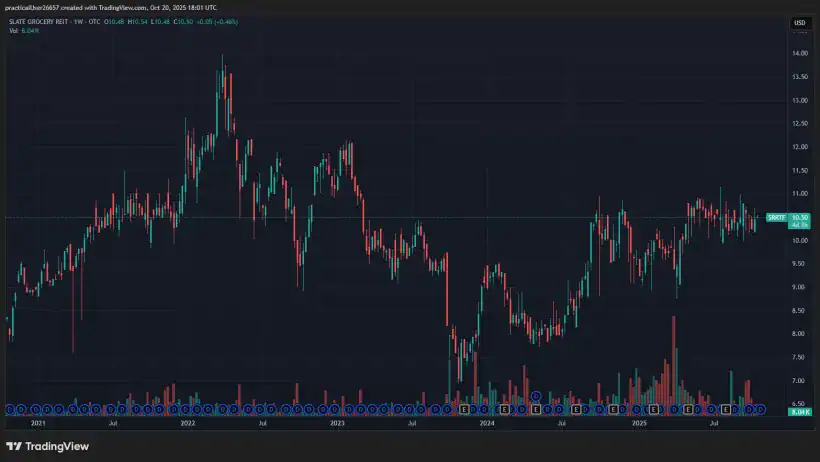
Slate Grocery REIT (OTCMKTS:SRRTF)
Slate Grocery REIT is a Toronto-based, yet U.S.-focused real estate investment trust focused on grocery-anchored retail centers. It owns 116 properties, totaling 15.3 million square feet and valued at about $2.4 billion. Its portfolio is deeply rooted in necessity-based retail. Some of its top tenants including Kroger, Walmart, and Ahold Delhaize, while it boasts anchor occupancy rate of 98.8%.
On August 6th, 2025, Slate Grocery REIT posted its Q2 results for the period ending June 30th, 2025. Total revenue grew 2.1% year-over-year to $53.4 million. The growth was primarily driven by rental rate increases, strong leasing spreads, and contractual rent escalations, particularly on renewed leases that continue to reflect resilient demand for grocery anchored retail.
Despite the revenue uplift, profitability was modestly pressured by higher general and administrative expenses as well as interest and finance costs. FFO totaled $15.0 million, or $0.25 per unit, unchanged from a year ago. Leasing activity remained healthy, supporting a stable occupancy rate and reinforcing the REIT’s position in necessity-based retail.
Slate Grocery REIT’s FFO per share has exhibited notable consistency over the past decade, ranging narrowly between $1.03 and $1.32 despite changes in market conditions and the broader economic cycle. This reflects the strength of its strategy, which basically revolves around owning and operating a portfolio of grocery-anchored retail properties, leased predominantly to essential-service tenants like national grocers and pharmacies.
SRRTF currently yields 8.3%.
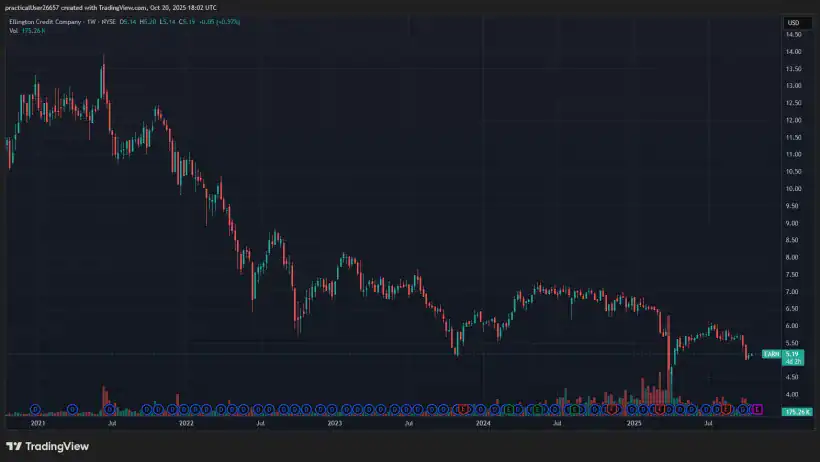
Ellington Residential Mortgage REIT (EARN)
Ellington Credit Co (NYSE:EARN) acquires, invests in, and manages residential mortgage and real estate related assets. Ellington focuses primarily on residential mortgage-backed securities, specifically those backed by a U.S. Government agency or U.S. government–sponsored enterprise.
Agency MBS are created and backed by government agencies or enterprises, while non-agency MBS are not guaranteed by the government.
On August 19th, 2025, Ellington Credit reported its first fiscal quarter results for the period ending June 30, 2025. The company generated net income of $10.2 million, or $0.27 per share.
Ellington achieved adjusted net investment income of $6.6 million in the quarter, or $0.18 per share. At quarter end, Ellington had $36.6 million in cash and cash equivalents.
Ellington Residential has a few avenues of growth, which all revolve around optimizing their MBS portfolio. Capitalizing on opportunities driven by market volatility, particularly around the rate hiking cycle and quantitative tightening, could also bring growth. Additionally, Ellington will protect their book value and manage volatility through interest rate hedges and liquidity management.
Generating growth will be important for the company’s ability to maintain its high dividend payout. Shares yield over 18% right now. While there is a high level of risk to EARN’s dividend payout, the very high yield could be attractive for income investors.
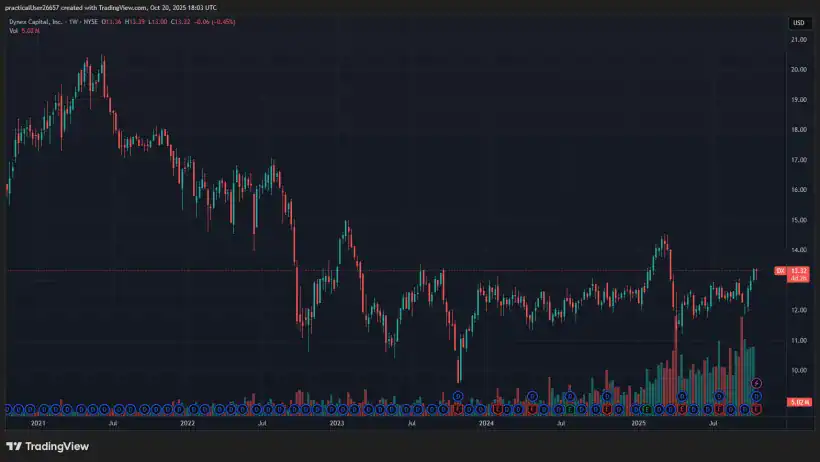
Dynex Capital Inc (NYSE:DX)
Dynex Capital invests in mortgage–backed securities (MBS) on a leveraged basis in the United States. It invests in agency and non–agency MBS consisting of residential MBS, commercial MBS (CMBS), and CMBS interest–only securities.
On July 21, 2025, Dynex Capital, Inc. reported its financial results for the second quarter of 2025. Dynex Capital, Inc. reported a total economic loss of $(0.10) per common share for Q2 2025, representing a 0.8% decline in beginning book value, with book value per common share at $11.95 as of June 30, 2025, down from $12.56 in the prior quarter.
The company recorded a comprehensive loss of $(0.11) per common share and a net loss of $(0.14) per common share, despite declaring dividends of $0.51 per common share. Dynex raised $282 million in equity capital through at-the-market common stock issuances and invested in $1.9 billion in Agency RMBS, $364 million in Agency CMBS, and increased TBA investments by $953 million, maintaining liquidity at $891 million.
Leverage, including TBA securities at cost, was 8.3 times shareholders’ equity. Compared to the previous quarter, net interest income rose to $23.1 million from $17.1 million, with economic net interest income at $35.5 million, reflecting a 0.96% spread.
Dynex brings to the table some competitive advantages, which could enable it to generate strong returns for investors throughout business cycles. These include the trust’s experienced management team with expertise in managing securitized real estate assets through multiple economic cycles, as well as its emphasis on maintaining a diversified pool of highly liquid mortgage investments with minimal credit risk.
DX stock yields 15%.
Disclosure: No positions in any stocks mentioned