



Key takeaways:
- The U.S. Federal Reserve continues to hold a “higher for longer” monetary policy as inflation remains at an elevated level.
- Gold prices have climbed to new heights, reaching a record $2,437.30/oz in May before sliding down to $2,319.90/oz halfway through June.
- Gold prices and interest rates tend to have an inverse relationship, whereby gold prices soften during periods of high interest rates.
- Economic factors such as high inflation and growing demand have seen prices rising faster over recent years as interest rates remain at record levels.
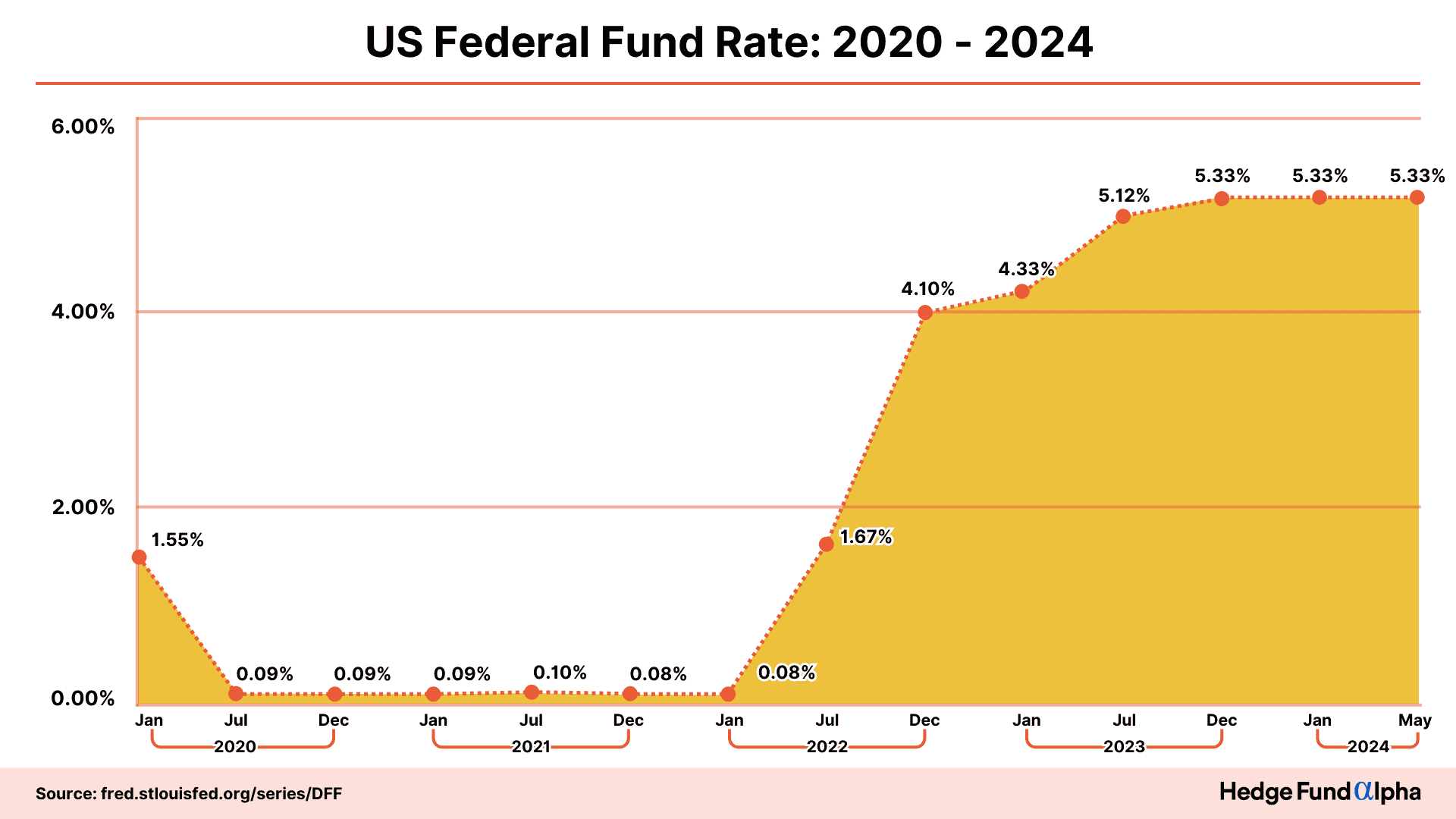
Following an aggressive monetary tightening policy that started back in March 2022, the U.S. Federal Reserve Bank continues to reinforce caution on cutting interest rates in the coming months following recent inflation data that indicates prices remain stubbornly high.
After months of seeing interest rates nearing a two-decade high, with the Federal Reserve’s overnight rate sitting high at 5.25% – 5.5%, current market expectations remain that the central bank will announce a possible rate decrease around the end of summer.
Policymakers remain apprehensive about cutting rates too soon and risking sending the economy back into overdrive. For many on Wall Street, this continues to be a moment of uncertainty, as volatile market conditions, coupled with geopolitical tension and sticky inflation have left some puzzled over the outcomes of recent gold rallies.
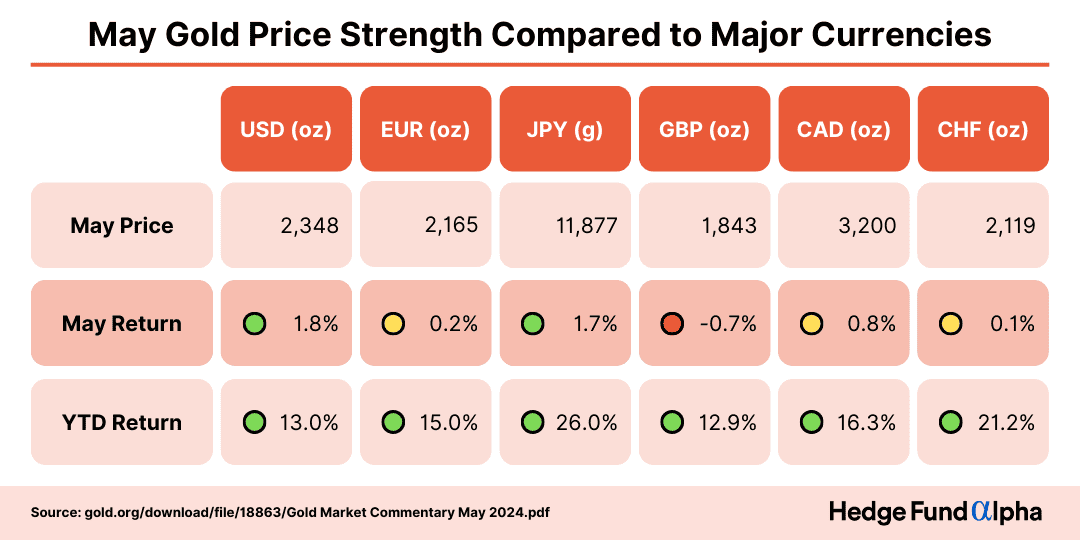
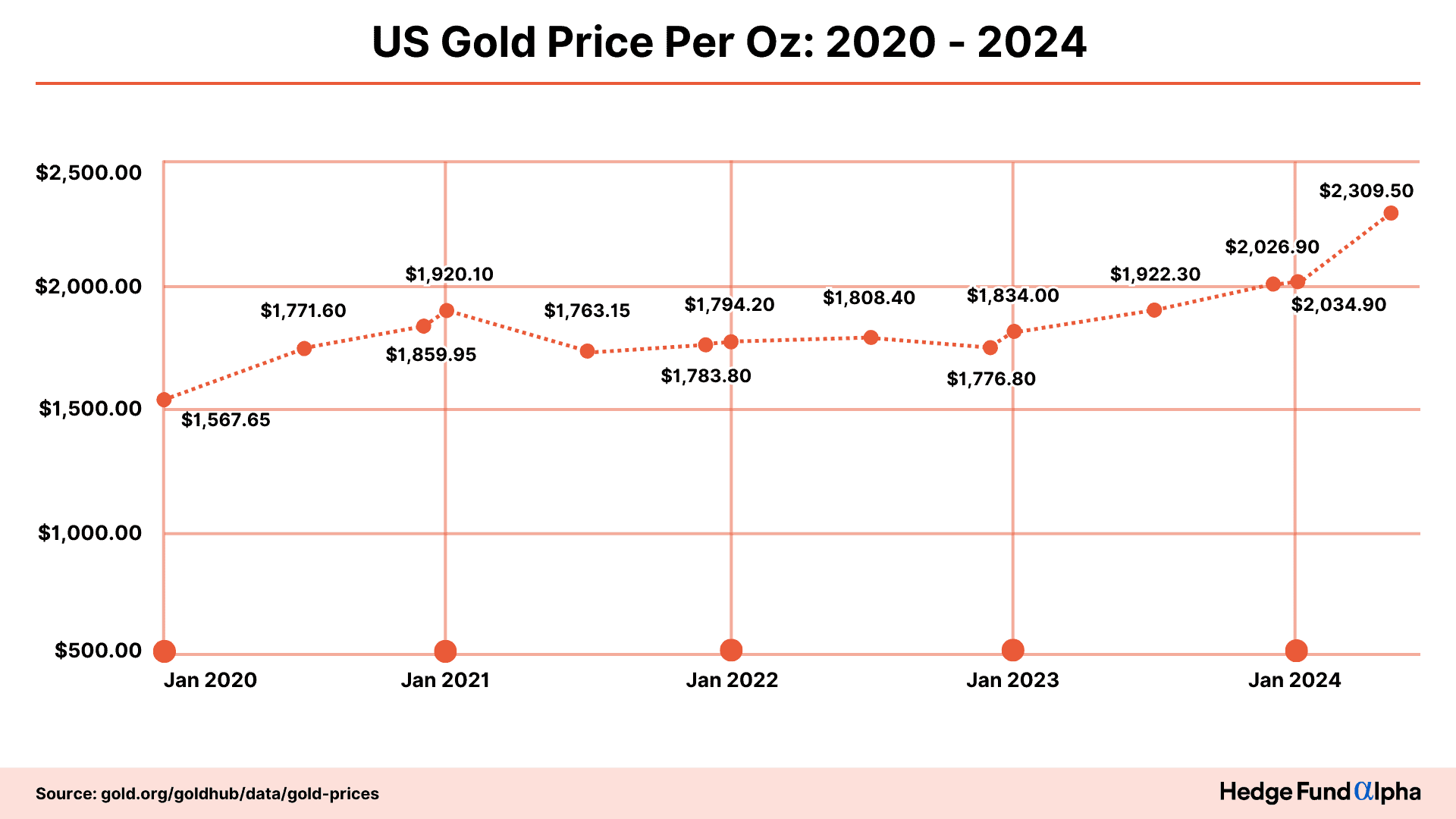
During recent months gold prices soared to new heights. The second quarter of the year opened with spot gold prices peaking at $2,307/oz in April, following strong performance of $2,214/oz in March. May witnessed moderate gains of 2%, with prices rising to $2,348/oz, while prices hit a fresh record of $2,449.89 p/oz halfway through the month, rising 11% since the turn of the year.
June has seen similar price performance after the month started with prices headlining at $2,337.70/oz and nearing $2,299.65/oz around the close of the month. Current estimates suggest that prices leading into the second half of the year could start at $2,308.11/oz with possible maximum breakout of $2,654.32/oz by the end of July.
As gold prices continue to witness appreciation against the backdrop of a higher interest rate environment and unruly market conditions, investors are left wondering whether prices will manage to keep the current pace, or will declining rates help deflate prices as compared to previous years.
Do Interest Rates Affect Gold’s Price?
There are seemingly multiple possible outcomes over whether gold prices are affected by interest rates. However, the short of the long answer is that gold often holds an inverse relationship with interest rates.
Historically, investors tend to look more at bonds, stocks, and savings accounts during times of higher interest rates as demand for physical assets trends downwards. For investors, a higher interest rate environment often translates into higher yields on cash-backed securities.
Although, the case is often more complicated, and leaves a lot of room for more unanswered questions. Multiple factors help drive the price of gold.
For instance, supply and demand tend to be a main contributor to whether gold prices are increasing or falling. Similarly, the impact of currencies could be another driver of price influence, whereas the case with a depreciation in the dollar could see gold prices trending downwards.
Yet, this is where investors often believe that the price graph would rather be inverse. As currencies begin to lose value over time due to inflationary pressures, many would expect investors to look at diversifying their portfolios with less volatile security vehicles.
The reality is that while interest may dampen gold prices and other precious metals, economic factors often may lead to a steady increase in demand over time, or potentially the opposite.
Even looking at historical data will tell a completely different story. During the last 50 years, interest rates had a 25% correlation to gold prices. The data suggests that a mild inverse relationship of weaker prices typically takes place before monetary changes.
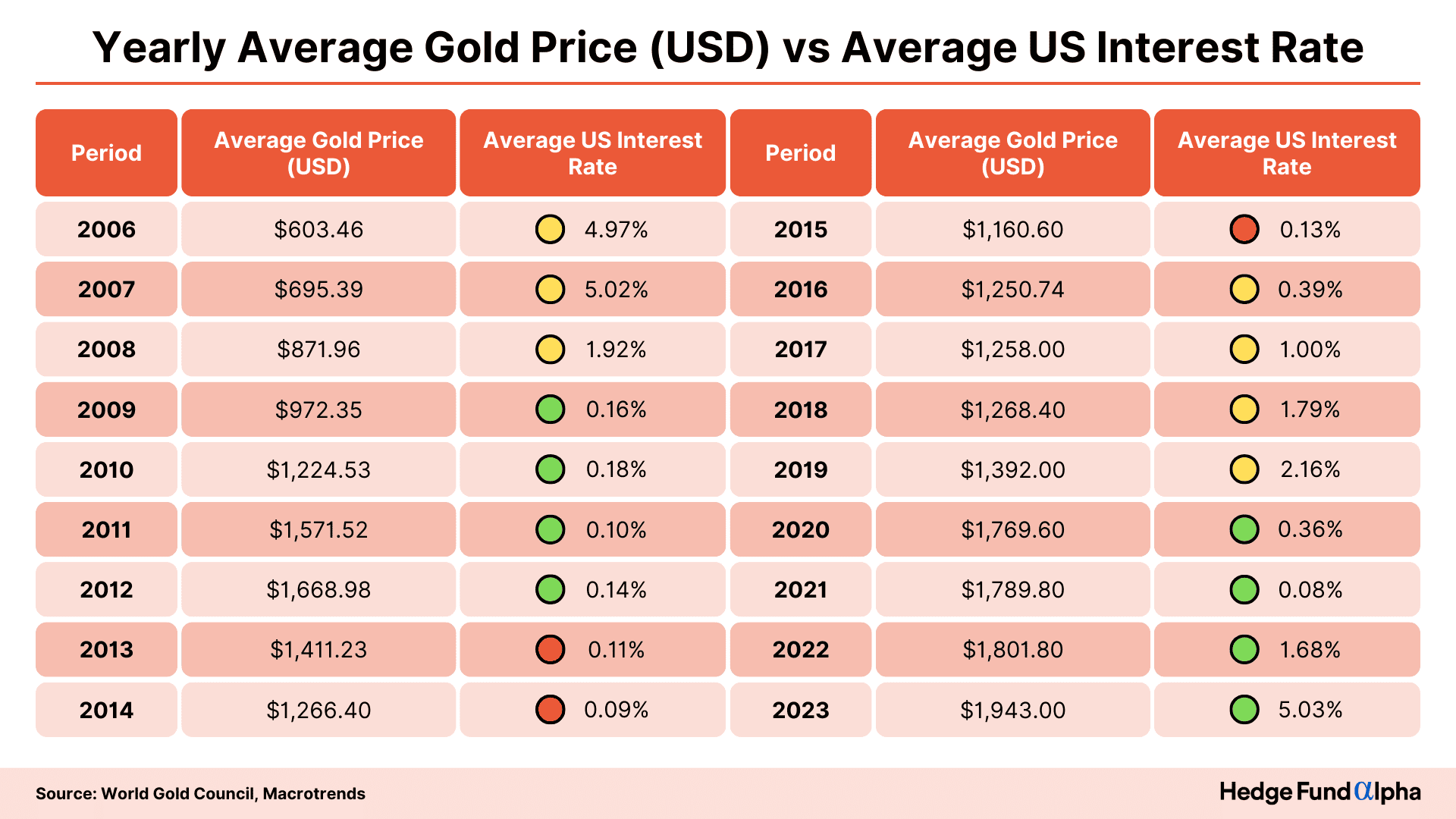
Federal fund rates have a knock-on effect on the market, influencing the performance of assets such as stocks, bonds, and cash deposits. These changes can be attributed to lower valuations and rising expenses investors will have to carry once rates begin to increase.
However, in another scenario, we could see that investors are rather focusing on holding more liquid assets as cash and lending become a more profitable form of income. This might lead investors to look at de-risking their portfolios, holding and selling bonds or stocks.
Seeing as gold can have an inverse relationship with interest rates the opposite could be true in current market conditions. During a higher interest rate environment, investors may begin looking at uncorrelated assets, usually commodities and precious metals.
Holding a unique basket of uncorrelated assets could mean that investors will have their portfolios connected to the macroeconomic changes, but ensure that their investments can outperform the market, and outlive tightening cycles.
What Happens To Gold Prices When Interest Rates Rise
The correlation between gold prices and interest rates often presents complicated outcomes for investors. There is a scenario where gold prices tend to decline during a higher interest rate environment, as fixed-income securities such as bonds tend to influence the appeal of commodities.
However, this isn’t always the case, and in situations where inflation expectations may be shuffling market sentiment, investors often seek to diversify their portfolios with gold or precious metals as a way to shelter their performance from currency devaluation.
Investors tend to be in favor of higher yields, which in return could dampen prices, and further extend price recovery.
However, gold price performance is far from being a nuanced situation. Previous performance data reveals that gold prices typically remained steady before a rate hike. During the transition period, gold prices bottomed before appreciating.
During a previous monetary cycle, data shows that gold prices were down 7% six months before a rate hike was announced by the central bank. However, prices nearly doubled six months after the rate hike, adding 11% performance and an additional 7.5% roughly one year later.
Rate hikes can create headwinds for gold prices, although experts stand to believe that these effects may be limited. The importance of understanding key instruments – inflation, geopolitics, supply and demand, and investor sentiment – only further highlights the various analytical metrics that influence gold prices and how the reaction is often linked to the macroeconomic context.
What Happens To Gold Prices When Interest Rates Decline
Another likely scenario to consider is when interest rates begin to decline, as the central bank introduces more quantitative easing, and seeks an approach for a possible soft landing.
Declining interest rates could impact yield-focused fixed-income assets, once again enticing investors to apply consideration for non-yielding securities that can provide a capital return.
Data-supported reasoning for initiating a decline in interest rates could be an improving benefit for gold prices, with investors seeking potential in gold and other precious metals to mitigate a weakening economy and slower market performance.
This inverse scenario would mean that as investors look for a hedge against an economic downturn, gold prices might begin appreciating due to an increase in demand. As interest rates fall on the back of declining economic performance, investors could flood gold markets and drive the gold price reaction.
These reactions tend to feel more psychologically driven in instances where gold witnesses improving gains in periods before an anticipated rate cut. However, this trajectory isn’t long-lived and often falls over time as rate cuts have been implemented.
The complexity of the scenario tends to leave a larger room for error. As investors turn to non-yielding assets during a declining interest rate environment, prices could begin rising as demand outpaces supply. Similarly, slower economic indicators could leave investors to seek an inflation-hedge or an economic buffer against the backdrop of slower market performance.
The importance of a nuanced analysis remains an important factor that could further determine the impact on gold prices driven by rate cuts, economic slowdown, currency devaluation, or a sudden increase in demand, both from investors and sector-specific players.
Alternative Factors Influencing Gold Prices
Gold prices can be influenced by additional factors such as:
Inflation: Gold often holds a financial shelter for investors during periods when interest rates are unable to keep pace with inflation. Gold’s ability to hedge inflationary pressures often sees an increased demand during periods where interest rates remain artificially low, and prices rapidly increase. This market reaction could lead to a stronger demand for gold, with investors buying up surplus stocks and driving prices higher.
Changes in currency values: Interest rates move depending on domestic economic circumstances, meaning that as interest rates may be rising in the U.S., in other countries the opposite could be taking place. With that said, gold prices are closely related to the value of the U.S. dollar, meaning that when interest rates in the U.S. rise faster than in another country, the dollar will typically appreciate against the native currency.
The reaction to the price of gold is determined by the value of the U.S. dollar converted to the native currency. The weaker a currency, the higher the price of gold, and vice versa. Seeing as central banks across the world can raise or drop interest rates at any time, price performance remains a complex process, seeing as rates are not raised or lowered simultaneously.
Market demand: Gold is a commodity that is traded, bought, and sold in both financial and consumer-related markets. While having higher interest rates may reduce the overall investment potential of gold, slower demand could see prices fall even further.
The narrow combination of gold prices and the relationship between supply and demand often creates an oversimplified situation that investors largely tend to overlook. Additionally, changes in monetary policies could mean that many investors may start investing more in gold or increasing their portfolio diversification, which in return could drive up demand for gold, leaving prices elevated and supplies limited.
Geopolitical risks: Investors continuously monitor geopolitical developments to determine the development of market opportunities or predict future challenges within a market or with a specific asset. A change in political agenda could mean the sudden rise or fall of gold prices.
For example, investors might start noticing market irregularities leading up to a new election. This could prompt many to return to gold as a possible way to hedge any uncertainty and potential market volatility. This sentiment could leave the price of gold trending upwards, as demand begins to pick up.
While there is a connection between gold prices and interest rates, it’s important to remember that outside of these macroeconomic conditions, the political landscape tends to play an important role in the direction of gold’s price performance.
Strategic Opportunities And Investment Considerations
Gold has historically had an inverse relationship with interest rates. In some instances, we notice gold prices appreciate as interest rates rise and investors begin seeking uncorrelated assets to diversify their portfolios.
The link between gold prices and interest rates is multifaceted and requires careful analysis of forward-looking guidance regarding broader economic indicators such as inflation, monetary policies, and geopolitics.
While it’s true that there may be a correlation between gold prices and interest rates, the impact thereof is often limited and provides somewhat restrictive growth for gold performance. The upside is that gold can provide some buoyancy during uncertain economic periods, however, gold provides minimal yields and often exhibits immense price volatility.
Investors need to observe the wider performance indicators of gold prices before making a final call. Investing in gold can provide upside potential for improved portfolio diversification, however, gold’s close correlation with market influences, such as interest rates, inflation, and politics can create further complexities for investors in the near term.
Methodologies
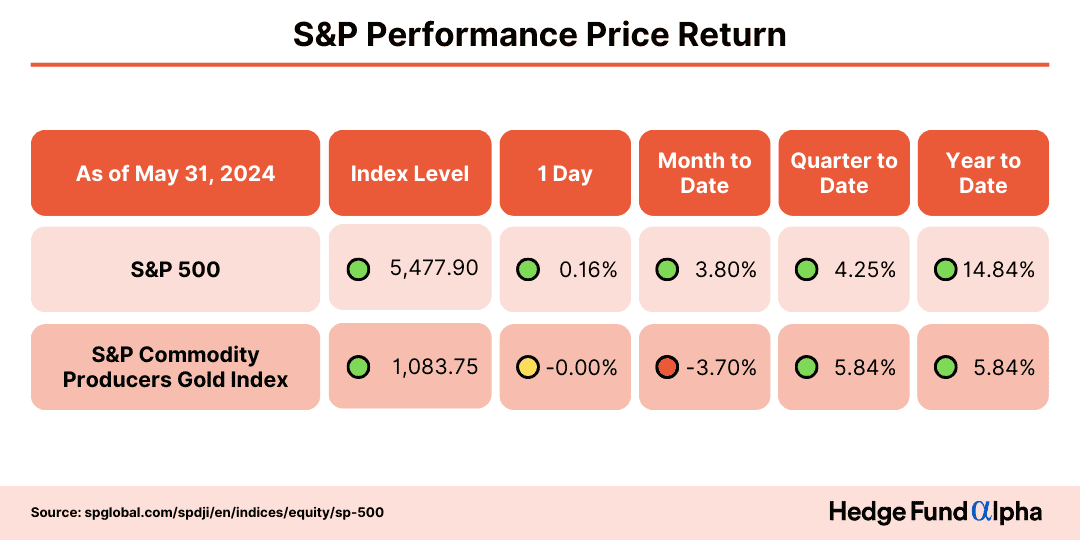
This article was created using data sourced from the internet including The World Gold Council, Macrotrends, Trading Economics, and the S&P Dow Jones Indices. Price data relating to the performance of spot gold (per troy ounce) were tracked throughout March 2024, April 2024, May 2024, and June 2024 to determine the highest-performing gold prices for the first half of the year. Additionally, data relating to the U.S. Federal Fund Rate (interest rate) was collected and analyzed to determine whether gold prices fluctuated during periods of both high and low interest rates.
Furthermore, a collection of research was analyzed to determine whether there are any changes in the performance of gold’s spot price during certain economic cycles, including recessions, contractions, and periods of expansion. By conducting this comparison, we were able to further determine whether there is any possible relationship between gold prices and interest rates and whether increasing interest rates or lowering rates will change the price performance of gold. By applying this methodology we were able to further analyze additional factors that play a significant role in the price performance of gold, including inflation, changes in currency values, supply and demand, and geopolitical changes.
