



Last updated June 2026 – Investors around the globe have been following Ray Dalio’s portfolio for decades. Even now, after Dalio has stepped down from the firm and sold his entire stake, exiting the board entirely, investors want to know what Bridgewater Associates owns, and for good reason. The firm has generated net gains of $79.1 billion since inception, including net gains of $15.6 billion in 2025, according to estimates from Edmond de Rothschild. Bridgewater’s total assets under management is about $92 billion.
Dalio stepped down from the firm as co-CIO in 2022, handing his voting rights over to the Bridgewater board. In 2025, he sold his final remaining stake in the firm and left the board – a complete exit after about five tremendous decades of performance.
Today, co-CIOs Karen Karniol-Tambour, Bob Prince and Greg Jensen make investment decisions for Bridgewater Associates. Dalio runs his own money through the Dalio Family Office, where he serves as acting de-facto CIO.
Bridgewater Associates has about $92 billion in assets under management with an equity 13F value of $22.4 billion. The firm has around 1,000 holdings, displaying a highly diversified portfolio. Here are Bridgewater’s top five holdings from its Q1 2026 13F:
| Stock | Ticker | % of the portfolio | Recent activity | Current price | Market Cap | 52 week low | 52 week high |
| SPDR S&P 500 ETF | NYSEARCA:SPY | 12.67 | Reduced 2.03% | $758.08 | $684.06 Billion | $591.06 | $760.28 |
| iShares Core S&P 500 ETF | NYSEARCA:IVV | 7.81 | Reduced 35.99% | $761.88 | $476.4 Billion | $593.95 | $763.93 |
| Amazon | NASDAQ:AMZN | 4.08 | Added 125.26% | $258.32 | $2.76 Trillion | $196 | $278.56 |
| NVIDIA | NASDAQ:NVDA | 3.65 | Added 21.42% | $228.54 | $5.56 Trillion | $137.96 | $236.54 |
| Alphabet | NASDAQ:GOOGL | 2.56 | Added 25.57% | $371.14 | $4.45 Trillion | $162.07 | $408.61 |
*Source: Bridgewater Associates 13F filing for Q1 2026, as of March 31, 2026.
**Stock prices as of late morning on June 2, 2026
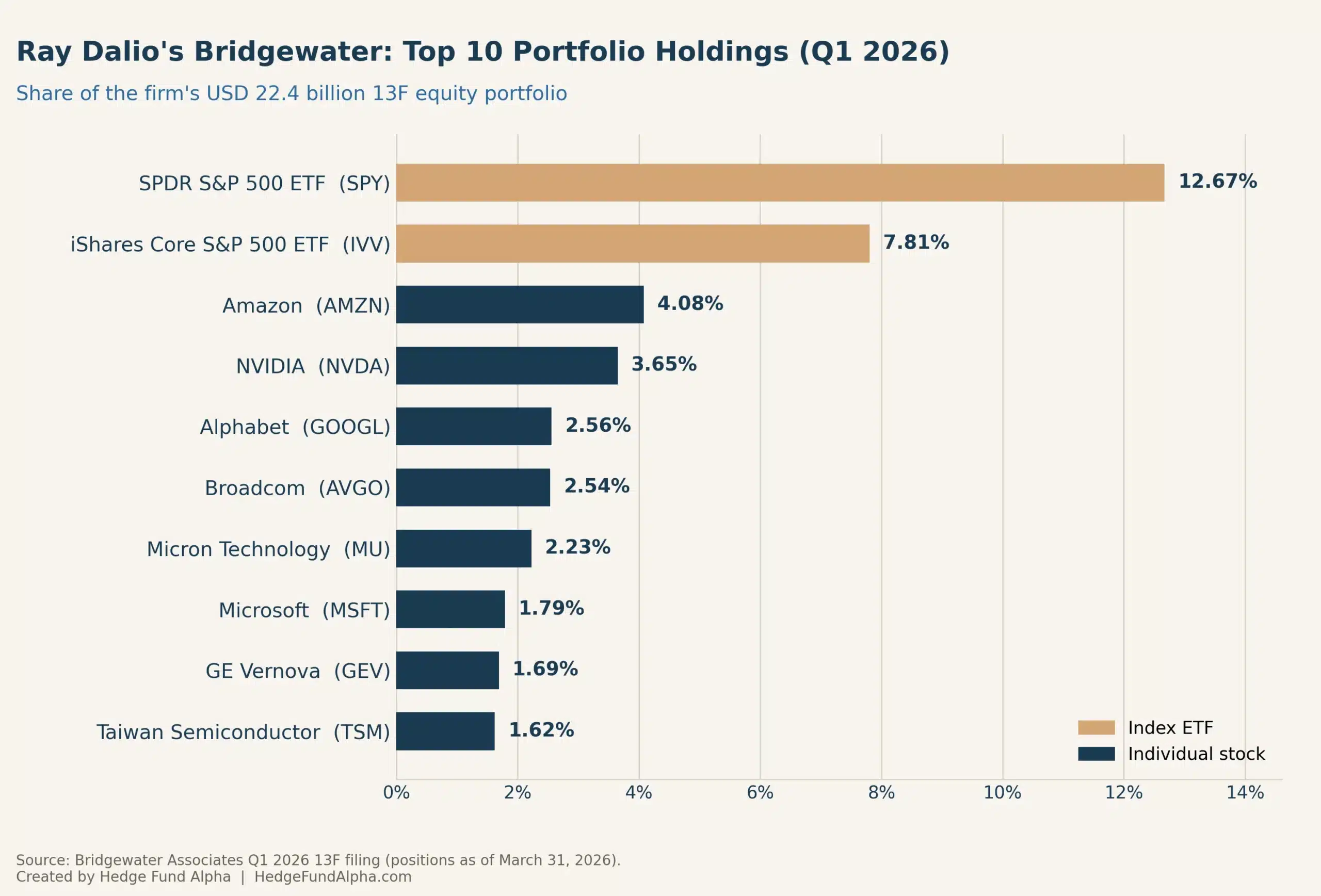
Bridgewater Associates Portfolio as of Q1 2026
SPDR S&P 500 ETF (NYSEARCA:SPY)
As the name suggests, this exchange-traded fund tracks the S&P 500. Although Bridgewater sold more than 90,000 shares of the SPDR S&P 500 ETF during Q1, it grew as its share of the portfolio, rising from 11.08% to 12.67% to take the top spot from number 2, the iShares Core S&P 500 ETF.
This has been a long-term holding for the firm, as it has owned shares since 2010. Bridgewater currently owns about 4.4 million shares of SPY and has held quite a lot of shares of this ETF in each quarter over the past year.
iShares Core S&P 500 ETF (NYSEARCA:IVV)
Bridgewater unloaded more than 1.5 million shares of the iShares Core S&P 500 ETF during Q1 2026, making it a 7.81% position. That large sale reduced the firm’s holdings in the ETF by more than a third. Bridgewater now owns about 2.7 million shares of the iShares Core S&P 500, which is similar to SPY in its holdings. The firm first bought IVV in 2010.
Amazon (NASDAQ:AMZN)
Bridgewater’s third-largest position is e-commerce and cloud giant Amazon. The firm owns 4.4 million shares of the company, and it accounts for 4.08% of the portfolio. Bridgewater purchased more than 2.4 million shares of Amazon during Q1 2026, more than doubling its position and causing it to jump from its previous size as a 1.64% position.
Under Ray Dalio’s leadership in as early as 2014, the firm reportedly did pick up a minuscule position in Amazon, although it didn’t hold it for more than three to six months. It wasn’t until early 2024 that Bridgewater established a sizable, long-term position in the company, which it has continued to build.
NVIDIA (NASDAQ:NVDA)
Bridgewater also added to its position in juggernaut NVIDIA in Q1 2026, snapping up more than 800,000 shares. The size of the position rose from 2.63% in Q4 2025 to 3.65% in Q1 2026. Bridgewater now owns 4.7 million shares of the chipmaker.
Like Amazon, Dalio initially tested the waters with NVIDIA early when he helmed Bridgewater, reportedly establishing a relatively small position of 1.1 million shares as early as 2007, when the price ranged from 47 cents to 60 cents a share. The most recent position was established in Q3 2023, and Bridgewater has been cutting and increasing the size of that position quarter by quarter since then.
Alphabet (NASDAQ:GOOGL)
Bridgewater boosted its position in Alphabet by 26% during Q1 2026, adding about 400,000 shares to bring its stake close to 2 million shares. The position rose from a 1.82% share of the portfolio to 2.56%.
Again under Dalio, Bridgewater stuck its proverbial toe into the water with Alphabet as early as Q1 2016, picking up just 219,000 shares. The more recent position was established in Q4 2020, and the firm has been buying and selling since then. Bridgewater actually sold Alphabet in the two previous quarters before rotating and then increasing its position in Q1 2026.
Broadcom (NASDAQ:AVGO)
Bridgewater added another 670,000 shares to its holdings in chipmaker Broadcom during Q1 2026, boosting the position from 1.47% of the portfolio to 2.54%. The firm now holds 1.8 million shares of Broadcom.
Bridgewater initially picked up some shares of Broadcom in Q4 2021, but it dumped those shares a couple of quarters later. The most recent position was established in Q3 2023. While Bridgewater has reduced its stake in Broadcom a few times since then, it’s mostly been loading up on shares of the chipmaker.
Micron Technology (NASDAQ:MU)
Bridgewater boosted its position in Micron by more than 50% in Q1 2026, adding about 586,000 shares to bring its stake to 1.5 million shares. The position now accounts for 2.23% of the portfolio, up from 0.93%.
The firm Dalio founded has a long history with Micron, originally buying a small position of about 150,000 shares as early as Q1 2009. The current position was just initiated in Q3 2025, after dumping the stock back in Q4 2024.
Microsoft (NASDAQ:MSFT)
Bridgewater added about 100,000 shares to its Microsoft position in Q1 2026, bringing its share count to about 1.1 million. The size of the position within the portfolio is roughly flat, up from 1.74% in Q4 2025 to 1.79% in Q1 2026.
Bridgewater has an exceptionally long history with Microsoft, having owned it off and on since Q4 2005, when it picked up a relatively small number of shares. The firm’s been buying and selling steadily since then.
GE Vernova (NYSE:GEV)
The firm cut its stake in GE Vernova during the quarter, selling more than 200,000 shares to reduce its position to more than 400,000 shares. The stock now accounts for 1.69% of the portfolio, up from 1.59% in Q4 2025 despite the reduction in shares, indicating that the Bridgewater team sold into strength during Q1 2026. The firm has owned shares of GE Vernova since the split in Q2 2024.
Taiwan Semiconductor (NYSE:TSM)
Bridgewater initiated a new position in Taiwan Semiconductor during Q1 2026, weighing in big time to make the stock its 10th-largest position at about 1.1 million shares, or 1.62% of the portfolio. The firm hasn’t owned Taiwan Semiconductor since Q3 2023. That position was originally established in Q3 2022.
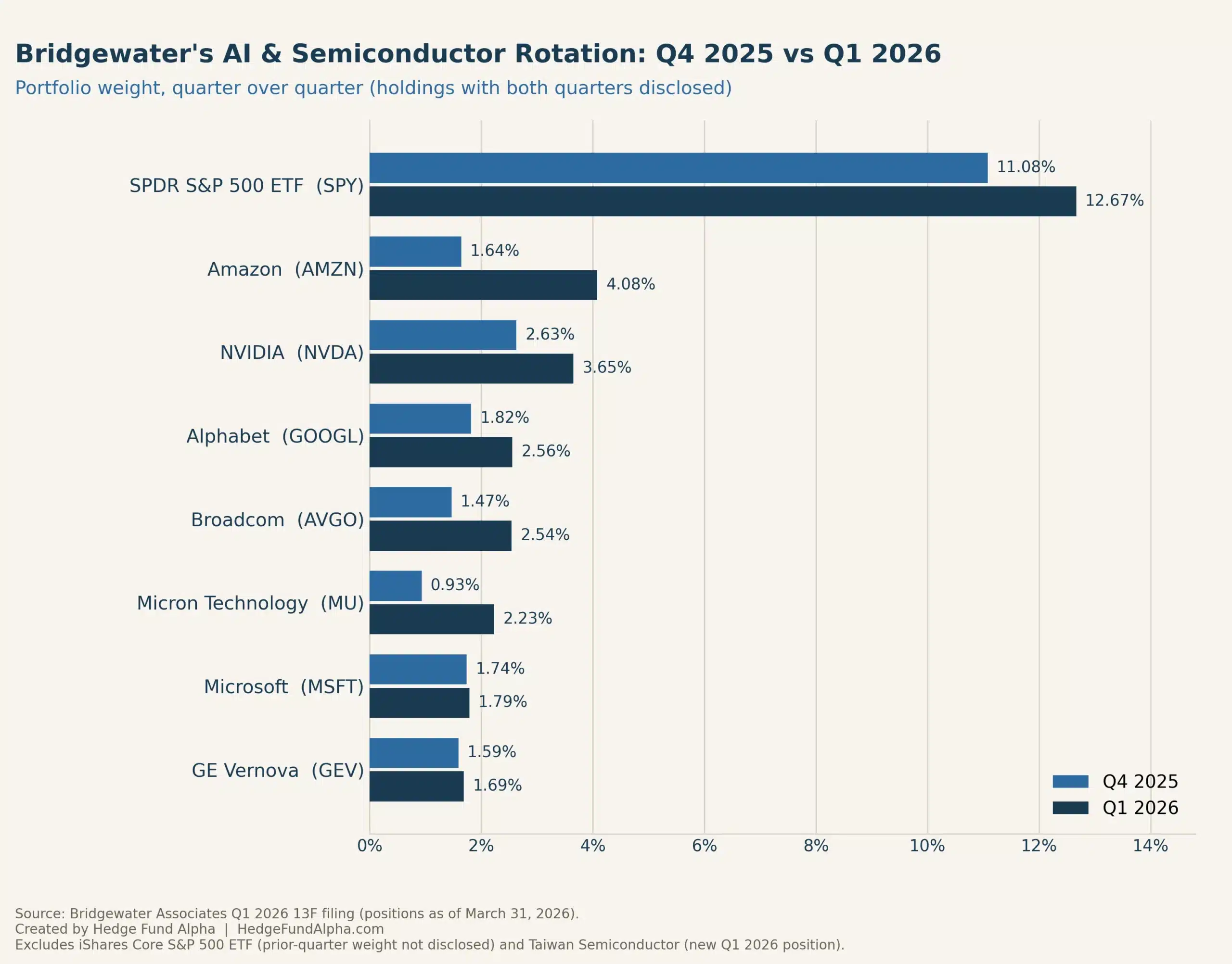
Bridgewater Portfolio Analysis for Q1 2026
While Bridgewater trimmed the ETFs that account for its top two holdings, they continue to dominate, although a clear tilt toward artificial intelligence and semiconductors has emerged. Clearly, the firm has rotated into the AI infrastructure theme.
In addition to Broadcom, Micron Technology and Taiwan Semiconductor, which are all among Bridgewater’s top 10 holdings, Lam Research (NASDAQ: LRCX), Advanced Micro Devices (NASDAQ: AMD) and Oracle (NYSE: ORCL) are among the top 15. Lam, AMD and Oracle were all reduced during Q1 2026, but they remain among the top 15 positions.
The top 15 positions demonstrate a solid bet on the next leg of the AI boom, which started with AI infrastructure and hardware and now is moving to cloud providers. Meanwhile, Bridgewater Associates has been aggressively dumping enterprise software companies, buying heavily into the software-is-dead narrative.
Here are the software companies the firm exited during Q1 2026:
- Salesforce (NYSE:CRM) – Notably, Salesforce was previously a major position within the technology sector for Bridgewater.
- ServiceNow (NYSE:NOW)
- Workday (NASDAQ:WDAY)
The firm also slashed its position in Adobe (NASDAQ:ADBE), cutting it back to a nominal holding.
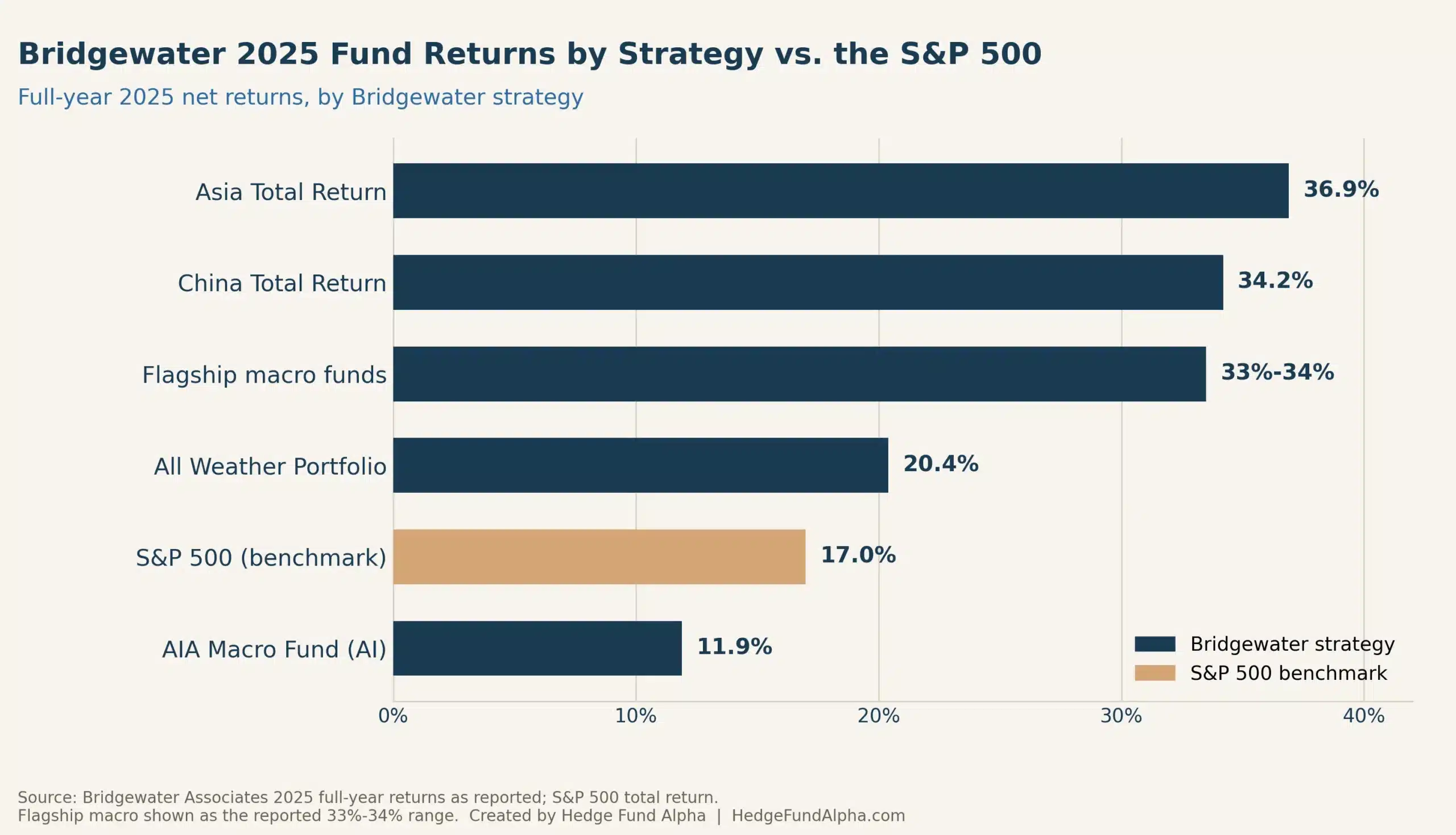
Bridgewater’s performance in Q1 2026 and 2025
During Q1 2026, Bridgewater Associates saw a drawdown of 6.44%.
For all of 2025, the firm generated all-time high returns, raking in the highest profits in its 50 years of existence, at $15.6 billion net. Bridgewater’s flagship macro funds returned an impressive 33% to 34% for the year, smashing the S&P 500’s 17% return.
The All Weather Portfolio returned 20.4%, while the Asia/ China Total Return book surged 36.9% and 34.2%, respectively. The AIA Macro Fund, which focuses on AI, returned a less-impressive 11.9%.
Ray Dalio’s Real Portfolio: The Dalio Family Office
Given that Dalio is no longer involved in Bridgewater Associates’ investment decisions, his real investment portfolio is that of the Dalio Family Office. Dalio told Bloomberg in late 2025 that he had taken over the CIO role for his family office. According to the Bloomberg Billionaires Index, his net worth is over $21 billion. About $15 billion of that is estimated to be tied up in the Dalio Family Office.
Of the family office’s portfolio, just about $503 million is in U.S. public equities, a minuscule bet for a multi-billion-dollar family office. Over 75% of the Dalio Family Office’s allocation to U.S. stocks was to an exchange-traded fund that tracks gold prices. The entity also holds smaller positions in similar vehicles for U.S. Treasuries and the S&P 500. Other holdings include ETFs for developed and emerging markets.
According to one breakdown of the Dalio Family Offices’ holdings, 20% to 25% of the portfolio is allocated to publicly traded stocks spanning the globe, with a heavy focus on emerging markets. Here’s the full breakdown:
- 20% to 25% public equities, a diversified portfolio with a focus on emerging markets
- 20% to 25% fixed income and TIPS, covering inflation-linked bonds, U.S. Treasuries and global sovereign debt
- 10% to 15% in commodities and gold, with a sizable gold position and Dalio’s own public statements that gold is a major portfolio hedge
- 10% to 15% in venture capital, with a focus on artificial intelligence, fintech, data analytics and decision science
- 5% to 10% in public equity, spanning certain direct and fund investments
- 5% to 10% in real assets and OceanX, which covers marine research, media and conservation
- 5% to 10% in cash and short-term holdings, providing liquidity
The All Weather Portfolio
Dalio and Bridgewater are widely known for their All Weather Portfolio, but investors should know that this isn’t the same as the firm’s 13F. The All Weather Portfolio is a separate strategy that leans heavily on global bonds, commodities and derivatives. The 13F only discloses long positions in U.S.-listed stocks, options and convertible debt.
The All Weather Portfolio was originally created in 1996, but Bridgewater revealed an ETF that operates on this strategy in April 2025, the State Street Bridgewater All Weather ETF (NASDAQ:ALLW). This portfolio is designed to protect investors from volatility in the markets using the approach Dalio developed decades ago. The typical allocation for the All Weather portfolio is:
- 40% long-term bonds and 15% intermediate bonds, which provide stability and helps cushion against deflation or economic turmoil.
- 30% stocks, which supports growth but is kept low to reduce volatility
- 7.5% gold, serving as a hedge for inflation and safe haven when volatility strikes
- 7.5% commodities, a diversifying move aimed at protecting against spikes in inflation.
The All Weather Portfolio takes a risk parity approach that balances the risk associated with every type of asset in it. Bonds tend to be less volatile than stocks, which is why they are a major overweight in the portfolio. The aim of the All Weather Portfolio is to limit drawdowns while targeting reliable performance instead of attempting to time or forecast the economy.
Take A Look At Ray Dalio: There’s One Thing Every Portfolio Should Have:

FAQs
Does Ray Dalio still run Bridgewater?
No, Ray Dalio doesn’t still run Bridgewater Associates. He stepped down as co-CIO in 2022 and handed his voting rights to the board. Then in 2025, he sold his final stake in Bridgewater and left the board entirely. Today, co-CIOs Karen Karniol-Tambour, Bob Prince and Greg Jensen make Bridgewater’s investment decisions.
What is Bridgewater’s biggest holding now?
As of March 31, 2026, Bridgewater’s biggest holding is the SPDR S&P 500 ETF (NYSEARCA:SPY).
What is the Dalio Family Office?
Ray Dalio invests his billions via the Dalio Family Office, which is his true portfolio today, as he is no longer involved with Bridgewater.
Is the All Weather portfolio the same as Bridgewater’s 13F?
No, the All Weather portfolio is not the same as Bridgewater’s 13F. The 13F discloses only long U.S.-listed equity positions, and the All Weather portfolio leans heavily on bonds, with a 55% allocation to bonds and just 30% toward equities.
What is Ray Dalio’s net worth?
According to the Bloomberg Billionaires Index, Ray Dalio’s net worth is over $21 billion.
What Commodities Does Ray Dalio Invest In?
A significant part of AWP’s portfolio is reserved for investing in commodities that combined with gold make about 15%. Dalio prefers investing in gold which usually takes around 7.5% of his portfolio. His investment in commodities is based on investing in ETFs that focus on commodities investing. Those can be oil, gas, or land, depending on his current preference.
Currently, Dalio owns at least 556 thousand acres of arable land in Australia, while other potential locations are unknown. He started seeing the need and the potential in agricultural land back in 1992.
How Much of Bridgewater Does Ray Dalio Own?
What is the size of the exact ownership share of Dalio is not known. Since Bridgewater is a private company, they do not need to publicly reveal the exact ownership share. From interviews and news snippets, we can take a guess.
In the past, he held a major stake in the company, but with time passing he transferred voting rights to the board. He transitioned his position to the co-CEO and founder role. In one interview in 2018, he hinted that he owns less than half a share of Bridgewater.
In a second, more recent interview in 2022, Dalio mentioned that he has transferred all voting rights to the board, from which we can deduce that he doesn’t hold the controlling stake.