


Last updated: June 2026 – Founded in 1979 by Ken Fisher, Fisher Investments is a global asset management firm utilizing a value-driven and systematic investment methodology. The firm oversees more than $387 billion in total assets under management (AUM) under the leadership of CEO Damian Ornani. Founder Ken Fisher maintains an active role in shaping the firm’s market strategy, serving as Executive Chairman and Co-Chief Investment Officer (Co-CIO).
A substantial portion of this capital is deployed in American public markets, with a U.S. equity book valued at approximately $295 billion across roughly 1,016 positions according to its 13F filings. While the portfolio is broadly diversified to manage risk, it features a pronounced tilt toward the technology sector, with Nvidia anchoring the book as its top holding.
Ken Fisher’s Q1 2026 Portfolio at a Glance
| Rank | Ticker | Company | ~% port | Value | Shares | Note |
|---|---|---|---|---|---|---|
| 1 | NVDA | NVIDIA Corp. | 5.2% | $15.4B | 88.6M | Held, increased – now #1 |
| 2 | AAPL | Apple Inc | 4.9% | $14.3B | 56.4M | Held |
| 3 | IEF | iShares 7-10 Yr Treasury Bond ETF | 4.8% | $14B | 147M | Bond ETF – top of book |
| 4 | GOOGL | Alphabet Inc – Class A | 3.8% | $11.2B | 39.1M | Held, increased |
| 5 | MSFT | Microsoft Corp | 3.3% | $9.6B | 26M | Held – slipped from #1 |
| 6 | VCIT | Vanguard Interm-Term Corp Bond ETF | 2.5% | $7.4B | 89M | Bond ETF |
| 7 | AMZN | Amazon.com Inc | 2.4% | $7.1B | 34.2M | Held |
| 8 | CAT | Caterpillar Inc | 2.3% | $6.9B | 9.8M | Industrials |
| 9 | TSM | Taiwan Semiconductor – ADR | 2.1% | $6.3B | 18.6M | Held, increased (intl) |
| 10 | ASML | ASML Holding NV | 2.1% | $6.1B | 4.6M | Held, increased (intl) |
| 11 | GS | Goldman Sachs Group Inc | 2% | $5.8B | 6.8M | Financials |
| 12 | XOM | Exxon Mobil | 1.9% | $5.4B | 32.2M | Held, increased |
| 13 | WMT | Walmart | 1.7% | $5.1B | 41M | Consumer Staples |
| 14 | JPM | JPMorgan Chase & Co | 1.7% | $5B | 17M | Financials |
| 15 | AVGO | Broadcom Inc | 1.5% | $4.5B | 14.7M | Semis |
Source: Fisher Asset Management, LLC Form 13F-HR for Q1 2026 (as of March 31, 2026)
What’s in the Ken Fisher Portfolio Now
Fisher Investments operates as a massive, systematically diversified registered investment advisor. It holds roughly 1,016 positions rather than operating as a concentrated conviction fund. Total firm assets under management have grown to more than $387 billion. This includes $331 billion in the Private Client Group and $56 billion in institutional accounts.
The firm’s 13F U.S. equity portfolio alone accounts for roughly $295 billion. While the portfolio remains globally diversified and maintains a strong technology tilt, recent filings reveal a significant realignment among its largest holdings. This shift moves the fund away from a purely domestic big-tech narrative.
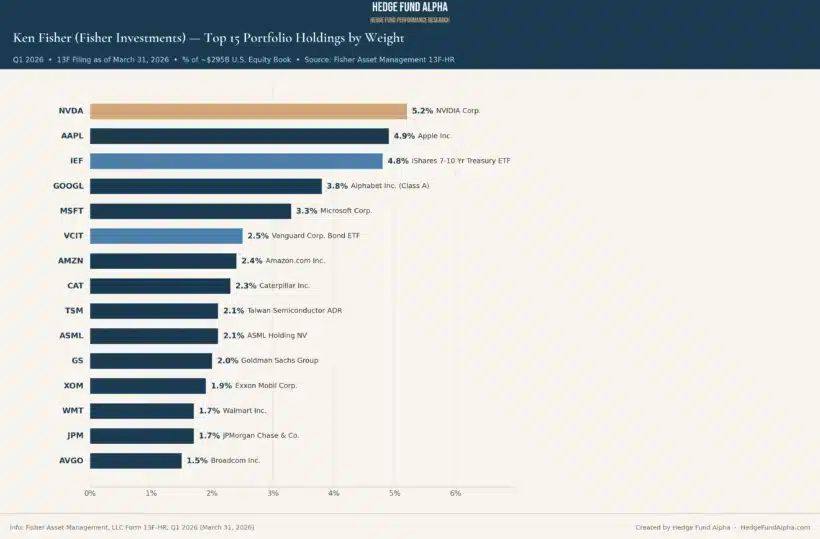
NVIDIA has officially overtaken Microsoft as the number-one holding at a 5.2% weight, followed by Apple at approximately 4.9%. Breaking from traditional “Magnificent Seven” equity leadership, the iShares 7–10 Year Treasury Bond ETF now ranks as the portfolio’s third-largest holding at 4.8%. Alphabet occupies the fourth position at 3.8%, while Microsoft has slipped from its historic top spot down to fifth place at 3.3%. The Vanguard Intermediate-Term Corporate Bond ETF claims the sixth spot at 2.5%, while Amazon has settled into seventh place at 2.4%. The remainder of the top 15 reflects a highly diversified international, cyclical, and defensive balance. It includes industrial and semiconductor anchors such as Caterpillar, Taiwan Semiconductor, ASML, and Broadcom, alongside a notable retail and energy footprint via Walmart and Exxon Mobil. Large-scale financials also round out this upper tier, driven by institutional allocations in Goldman Sachs and JPMorgan Chase.
High bond allocations are used to directly offset the portfolio’s heavy stock tilt. In addition to the iShares Treasury ETF, it includes the Vanguard Intermediate-Term Corporate Bond ETF, which represents roughly 2.5% of the book within the top 15. Together, these holdings indicate a meaningful bond allocation consistent with Fisher’s typical 70/20/10 balanced asset model.
Recent trading activity reinforces this dual focus on secular tech infrastructure and global value. The firm actively increased its exposure to high-conviction technology and international market leaders, adding to its stakes in NVIDIA, Alphabet, Taiwan Semiconductor, and ASML, while simultaneously reinforcing its cyclical defensive exposure with an expanded position in Exxon Mobil. Despite holding more than a thousand individual stocks across its entire book, the portfolio remains heavily concentrated at the very top in global mega-cap names. While this extensive long tail provides wide asset coverage, the sheer mathematical weight of the top holdings ensures that overall portfolio performance remains closely tied to broader macroeconomic shifts and technology sector trends.
Ken Fisher’s Top Holdings in Detail
NVIDIA (NVDA)
Nvidia’s ascent to the top of the Fisher Investments portfolio highlights how the firm’s systematic approach capitalized on the expansion of artificial intelligence infrastructure. Rather than treating the semiconductor designer as a short-term momentum trade, Fisher Asset Management built its position gradually over several years. As a result, it holds a low, split-adjusted average purchase price of about $27.76 per share.
Between 2021 and 2024, the firm nearly doubled its position from approximately 48.6 million to over 93.4 million split-adjusted shares. While many large institutional asset managers sold or reduced their positions during the sharp rise in hardware-driven valuations, Fisher’s investment committee held its position. They continued to believe in the company’s long-term growth and pricing power.
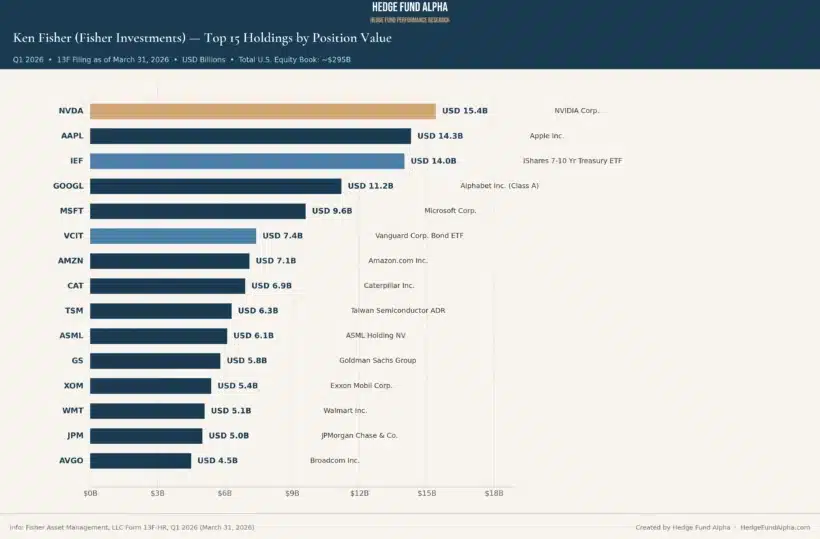
As of the Q1 2026 regulatory filings, the position sits at 88,559,570 shares, commanding a market value of approximately $15.4 billion. Accounting for 5.2% of the firm’s $295 billion U.S. equity portfolio, the rapid rise in Nvidia’s valuation pushed it ahead of traditional core holdings like Microsoft and Apple to become the largest position.
Apple (AAPL)
Apple’s position as the second-largest holding in the Fisher Investments book underscores the firm’s approach to using mega-cap tech as a foundational, long-term compounder. Rather than frequently trading based on product cycles or short-term weakness in consumer hardware, Fisher has held the stock consistently over time. This has resulted in a low, split-adjusted average purchase price of about $66.55 per share.
While other Wall Street heavyweights actively backed away from the stock to trim tech sector concentration, Fisher’s investment policy committee chose to steadily accumulate. In the Q1 2026 reporting cycle, the firm increased its Apple exposure, bringing its total stake to approximately 56.4 million shares. Valued at over $14.3 billion, the position commands 4.9% of Fisher’s $295 billion U.S. equity book, trailing only Nvidia.
Alphabet (GOOGL)
Alphabet (GOOGL) is the fourth-largest holding in the Fisher Investments portfolio. Its position reflects the firm’s long-term strategy of building large investments in companies that provide essential global infrastructure.
Instead of adjusting its position based on short-term news or shifts in market sentiment, Fisher Investments has held Google as a long-term investment. The firm has steadily added shares through different market cycles and major events, including the company’s 2014 restructuring and its 2022 20-for-1 stock split.
Consistent with this long-term strategy, Fisher’s investment policy committee increased its Alphabet position during the Q1 2026 reporting cycle. The firm took advantage of recent market fluctuations to add more shares. The firm added 944,529 shares, which represents a 2.48% increase in its allocation. This brings the firm’s total holding to 39,050,562 Class A shares. The position is valued at approximately $11.2 billion. It represents 3.8% of Fisher Investments’ $295 billion U.S. equity book. This underscores a long-term commitment to mega-cap technology as a key portfolio driver.
Microsoft (MSFT)
Microsoft Corp. (MSFT) serves as a core foundational anchor within the Fisher Investments portfolio, currently holding the number five position in the firm’s U.S. equity book. For years, Microsoft was one of the crown jewels of Fisher’s equity portfolio. It frequently held the top spot until NVIDIA’s massive gains in market value surpassed it.
Instead of selling its Microsoft position, Fisher’s investment policy committee has continued to treat the company as a stable long-term investment. Its confidence is supported by Microsoft’s leadership in enterprise software and the recurring profits generated by its cloud business.
According to the Q1 2026 regulatory disclosures, Fisher Asset Management holds 25,941,594 shares of Microsoft, commanding a total market value of approximately $9.60 billion. The position represents 3.26% of the firm’s 13F portfolio. It reflects Fisher’s long-term strategy of maintaining significant exposure to resilient global infrastructure companies while adjusting the position as growth cycles change.
ASML & Taiwan Semiconductor
Fisher Investments systematically deploys capital into premier non-U.S. megacaps to capture global tech exposure. It also reinforces its core semiconductor and infrastructure thesis. Rather than restricting its technological allocations to domestic borders, the firm relies on heavyweight American Depositary Receipts (ADRs). It uses them to tap directly into foundational global supply chains.
- Taiwan Semiconductor Manufacturing Co. (TSM): Accounting for 2.13% of the portfolio (about $6.29 billion), TSMC holds roughly 18.6 million shares. It functions as a critical hub in the advanced technology ecosystem. Fisher’s angle treats the Taiwanese foundry not as a cyclical chip play. It instead views it as an indispensable monopoly that physically manufactures cutting-edge silicon for partners like NVIDIA and Apple.
- ASML Holding N.V. (ASML): Commanding a 2.06% portfolio allocation (~$6.08 billion), the Dutch lithography pioneer provides structural alpha to the portfolio. Fisher’s investment policy committee increased its stake by 2.6% during the Q1 2026 reporting cycle, bringing it to 4.60 million shares. It capitalized on ASML’s dominant control over Extreme Ultraviolet (EUV) systems, which are required to produce next-generation AI hardware.
The Bond-ETF Sleeve (IEF, VCIT)
Fixed-income investments rank among the largest holdings in Fisher Investments’ 13F portfolio. This reflects the firm’s deliberate asset-allocation strategy, which follows its signature 70/20/10 model of stocks, bonds, and cash.
Instead of managing thousands of individual bond ladders across separate client accounts, Fisher Investments uses large, highly liquid exchange-traded funds. This approach allows the firm to scale its fixed-income exposure with institutional efficiency.
This strategy is anchored by the iShares 7–10 Year Treasury Bond ETF (IEF), which is the portfolio’s third-largest holding at 4.76%. It is further supported by the Vanguard Intermediate-Term Corporate Bond ETF (VCIT), which accounts for 2.50%.
By utilizing these multi-billion-dollar liquid vehicles, the firm can seamlessly manage macro-level defensive ballast and capture broad yield shifts across its $295 billion book, providing an immediate counterweight to temper the volatility of its heavy technology tilt.
Financials
According to the Q1 2026 regulatory filings, this financial allocation is led by The Goldman Sachs Group, which commands a market value of roughly $5.78 billion, representing nearly 2.3% of the overall 13F U.S. equity book.
JPMorgan Chase maintains a similarly massive footprint at approximately $5.01 billion, making up around 1.70% of the book, followed by Morgan Stanley at a market value of $4.21 billion, which accounts for 1.43%. Collectively, these three banking giants sit comfortably within Fisher’s top 15 allocations.
This heavy positioning underscores the reality that while global tech expansion remains a headline theme, the portfolio relies significantly on the steady operational compounding and capital-return programs of dominant Wall Street institutions to anchor its diversified asset model.
Caterpillar, Amazon, Broadcom & the long tail
While mega-cap stocks like NVIDIA and Apple dominate headlines, the middle of Ken Fisher’s portfolio combines cyclical industrial leaders and core technology holdings with a freshly fortified energy strategy.
- Caterpillar Inc. (CAT): At 2.35% (~$6.93 billion), CAT acts as a cyclical hedge. Fisher expanded this position by roughly 3% to capitalize on global industrial demand and a resilient macro economy.
- Amazon (AMZN) & Broadcom (AVGO): Representing 2.41% ($7.12 billion) and 1.54% ($4.55 billion), respectively. These positions give the portfolio exposure to cloud computing through Amazon and AI networking hardware through Broadcom.
- Exxon Mobil (XOM) & Chevron (CVX): Resolving a previous gap in energy coverage, the firm made aggressive moves in the oil and gas sector. Exxon Mobil ranks #12 in the portfolio with a position worth approximately $5.48 billion after Fisher increased the stake by 2.5%. Chevron, meanwhile, was introduced as a brand-new position, debuting at #16 just outside the top 15.
- The “Long Tail”: Fisher manages a staggering 1,016 unique positions. While the top 10 holdings represent 33.4% of assets, the portfolio remains highly diversified. Nearly two-thirds of the $295 billion equity book is allocated across a wide range of holdings to capture global market breadth and limit stock-specific volatility.
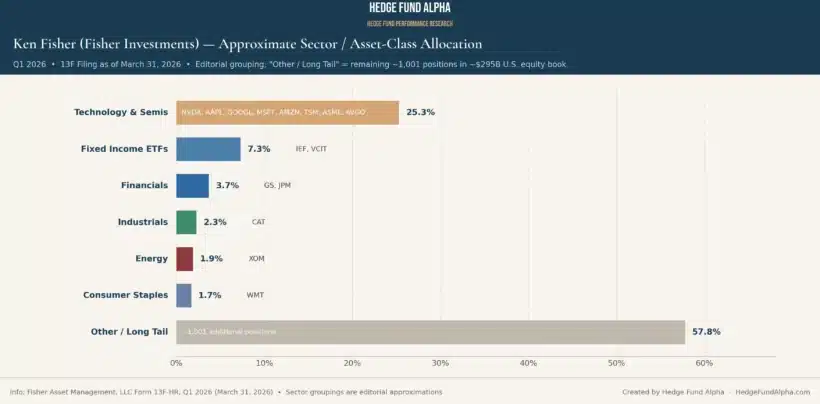
Sector Allocation & Diversification
An editorial and approximate grouping of the Q1 2026 filing provides insight into the firm’s portfolio construction. It shows how Fisher implements its classic 70/20/10 target asset allocation model across stocks, bonds, and cash on a multi-billion-dollar scale. While technology remains the portfolio’s largest sector exposure, it is anchored by core holdings such as Nvidia and Apple. However, it no longer completely dominates the rest of the portfolio or crowds out other industries.
Financials have assumed a much more prominent role in the portfolio. Goldman Sachs and JPMorgan Chase both sit inside the top 15, with Morgan Stanley close behind, giving the book a sizable Wall Street banking sleeve.
Similarly, the fixed-income sleeve has become highly visible near the top of the book via major Treasury and corporate bond exchange-traded funds.
Geographically, the portfolio remains overwhelmingly U.S.-heavy, but it achieves intentional diversification by embedding international market leaders directly into its top allocations. International exposure is concentrated in a handful of key markets. Major positions include ASML in the Netherlands and Taiwan Semiconductor in Taiwan. This geographic mix reinforces the portfolio’s top-down global diversification strategy.
Ken Fisher’s Investment Philosophy & Strategy
Ken Fisher’s investment philosophy is anchored in a fundamental belief in capitalism and free-market efficiency. He views security prices as a direct reflection of supply and demand. Rather than relying on common data, his approach centers on information arbitrage. He seeks to uncover insights or market dynamics that are not widely understood or reflected in a security’s price.
To execute this strategy, Fisher popularized the Price-to-Sales (P/S) ratio in his book Super Stocks as a key tool for identifying structurally undervalued companies with long-term growth potential. He often invests in quality businesses experiencing temporary operational setbacks before their revenue fundamentals recover.
This strategy requires a strict contrarian mindset that intentionally filters out popular sentiment and media noise. Furthermore, Fisher is highly skeptical of conventional macroeconomic narratives.
He argues that widely discussed concerns about inflation, national debt, and GDP fluctuations are already fully priced into the market and therefore have far less influence on equity returns than most investors assume. Supported by an extensive analyst team, his methodology focuses on identifying behavioral blind spots. This approach uncovers investment opportunities overlooked by the broader market.
Is Fisher Investments Worth It? (Fees, Minimum, Criticisms)
Investing through Fisher Investments involves specific financial and operational trade-offs compared to alternative wealth management options. The firm utilizes a tiered fee structure based on total assets under management (AUM). Annual fees generally range between 1% and 1.5%, depending on portfolio size.
While this fee-only structure removes traditional commission-based conflicts, these costs are higher than passive robo-advisory services. Furthermore, accessing the firm’s services requires a substantial capital commitment. The advisory entry point typically requires a minimum investment of around $1 million for specific account types. This structurally limits the platform to mass-affluent and high-net-worth clients.
Beyond its baseline costs, Fisher Investments is characterized by a heavy marketing spend. It allocates a significantly larger portion of its operational resources toward aggressive client-acquisition campaigns than typical industry peers.
The firm has also been subject to reported transparency criticisms from financial commentators and consumer advocates. Such critics point to limited public data regarding comprehensive, long-term historical performance composites often compared directly against standard market benchmarks. Because the firm relies on an active, top-down investment strategy rather than a passive index model, its portfolio returns experience cyclical fluctuations.
As a result, performance can shift between periods of outperformance and underperformance relative to major market indices, depending on changing macroeconomic conditions.
Take A Look At Fisher Investments’ Founder, Ken Fisher, Provides Investing Tips for New Investors:

Frequently Asked Questions
What are Ken Fisher’s / Fisher Investments’ top holdings?
Based on the latest filings, the top five positions in exact order are Nvidia, Apple, the iShares 7-10 Year Treasury Bond ETF, Alphabet, and Microsoft.
How much does Fisher Investments manage?
As of Q1 2026, total firm assets under management have grown to over $387 billion, which includes roughly $331 billion in the Private Client Group and $56 billion in institutional accounts. The firm’s 13F U.S. equity book alone represents about $295 billion of this total, diversified across approximately 1,016 distinct positions.
What is Ken Fisher’s biggest holding?
NVIDIA is the single largest holding in the portfolio, representing a weight of 5.2% of the total 13F equity book. It officially claimed the number-one spot after overtaking Microsoft.
Does Fisher Investments hold bonds?
Yes. Fixed-income exchange-traded funds carry significant weight at the top of the portfolio. The iShares 7-10 Year Treasury Bond ETF is the third-largest overall holding at 4.8%, and the Vanguard Intermediate-Term Corporate Bond ETF sits in the top 15 at 2.5% of the book. These multibillion-dollar fixed-income exposures align with Fisher’s standard 70/20/10 asset allocation strategy for balanced accounts.
What is the minimum to invest with Fisher Investments / what are the fees?
Fisher Investments typically requires a minimum of $1 million in investable assets for its standard private wealth management service. However, the firm may accept smaller accounts at its discretion. One example is its specialized WealthBuilder offering, which starts at around $200,000.
The firm operates on a fee-only model based entirely on assets under management. It uses a tiered pricing structure that generally ranges between 1% and 1.5% annually. For a standard equity or blended account, the management fee is 1.25% on the first $1 million in assets. The rate then declines to 1.125% on the next $4 million.
Related Content
- Glenn Greenberg Portfolio Uncovered: Top Holdings and Strategies
- Guy Spier Portfolio Revealed: What’s Hot and What’s Not in His Fund
- Seth Klarman Portfolio Analysis: Achieving Long-Term Success in Investing
- Terry Smith Portfolio: Stocks This Investing Genius is Betting On
- Chris Davis Portfolio: Key Investment & Portfolio Performance Analysis
- Chuck Akre Portfolio: 3 Stocks This Investing Great is Buying Up