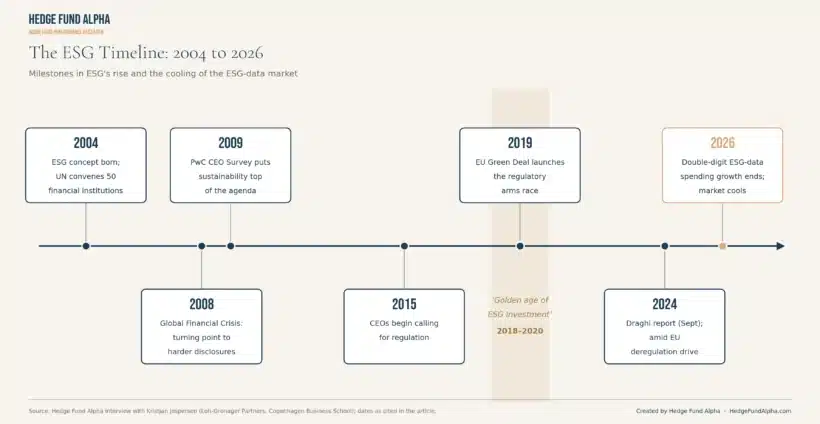


Global spending on ESG data has grown in the double digits for years, but that ends in 2026. A recent Opimas survey (via Responsible Investor) points to U.S. legal pushback and an EU deregulation drive, which sparked Mario Draghi’s September 2024 report, as the reason the market is finally cooling.
In an interview with Hedge Fund Alpha, Kristjan Jespersen, ESG advisor and chief engagement officer at Loh-Gronager Partners and associate professor at Copenhagen Business School, explained that a cooling market is not a broken thesis. He said the data is patchy, inconsistent and frequently wrong, and he argued that this is precisely why it still offers an edge — providing that investors know what they are looking for.
A history of ESG
The concept of ESG was born in 2004, when then-UN Secretary-General Kofi Annan brought together 50 of the top financial institutions to examine how environmental, social and governance risks were quietly costing the industry money. The Global Financial Crisis four years later became the real turning point. Public anger forced companies past the era of self-selected CSR reports and into harder disclosures: Scope 1 and emissions, water use, and the rest.
By 2009, PwC’s Global CEO Survey had sustainability at the top of the agenda. By 2015, the same CEOs were asking for regulation to guide them. In part, the CEOs wanted to take the decision off of their own desks. Europe obliged.
“The thesis was that Europe was going to be this big green champion with regulation,” Jespersen said.
Ursula von der Leyen’s 2019 Green Deal kicked off a regulatory arms race, and the data providers, Bloomberg, MSCI, LSEG and Sustainalytics, moved in to resolve and monetize the gap.
“This starts this incredible regulatory arms race when it comes to sustainability,” Jespersen added. “And what became part and parcel about this process is we needed to collect the data, but we needed to force firms to actually report on this data. So you had this sort of bifurcated system.”