



“The best thing a human being can do is help another human being know more.” – Charlie Munger
“Income inequality” is the trending socioeconomic complaint.
The rich grow richer as the poor grow poorer and the middle class is squeezed.
Reformers promote “income redistribution.”
Latter day Robin Hoods.
But – truth be told – Robin Hood never really existed!
And income redistribution, as practiced, never really works.
“Socialism is great until you run out of other people’s money.” – Margaret Thatcher
Reformers ignore how entrepreneurship, enterprise, innovation and prosperity increase the common good.
Reformers mock the names of wealthy donors emblazoned on our universities, hospitals, medical centers, museums, parks and foundations.
Reformers forget many of today’s wealthy were born poor, worked relentlessly, took risks, suffered privations and achieved through innovation, determination, sacrifice and hard work.
Reformers dismiss the frequent disintegration of concentrated wealth after but a few generations, back into the public domain.
“Shirtsleeves to shirtsleeves in three generations.” – Scottish proverb
Battle Cry: Tax the Rich!
Rather tax the rich! Tax their wealth, their assets, not merely their income!
Turn their “ill-gotten gains” into government largess:
Supplemental income! Guaranteed income! Free transportation! Free housing!
Freeze the rents! Build government-run groceries!
Have such policies ever worked? Anywhere? Anytime?
The Soviet Union? North Korea? Cuba?
Or is this just ever-failing communism rebranded for a new generation?
Redistributing Your Own Income
Are there workable solutions for reducing income inequality as our collective wealth increases, without envy and jealousy, blaming and demonizing the most daring and accomplished among us and disincentivizing their drive for success?
Yes! Redistribute your own income!
Lee Kuan Yew, founder and first prime minister of Singapore, who created a wealthy modern nation from a malarial swamp, taught a simple rule:
“Find what works and repeat it!” – Lee Kuan Yew
Charlie Munger distilled that instruction to its essence.
“Repeat what works!” – Charlie Munger
At a 2010 Berkshire Hathaway meeting Charlie dubbed it “The Fundamental Algorithm of Life:”:

What Works For “Income Inequality”?
The Rambam, Moses Maimonides, great physician and rabbi of the Thirteenth Century, taught this essential principle of raising the estate of the poor:
“Give a man a fish and you feed him for a day; teach a man to fish and feed him for a lifetime.” – Moses Maimonides
Benjamin Franklin reasoned similarly, finding that government handouts only incentivize dependency:
“I am for doing good to the poor, but…I think the best way of doing good to the poor, is not making them easy in poverty, but leading or driving them out of it. I observed…that the more public provisions were made for the poor, the less they provided for themselves, and of course became poorer. And, on the contrary, the less was done for them, the more they did for themselves and became richer.” – Benjamin Franklin
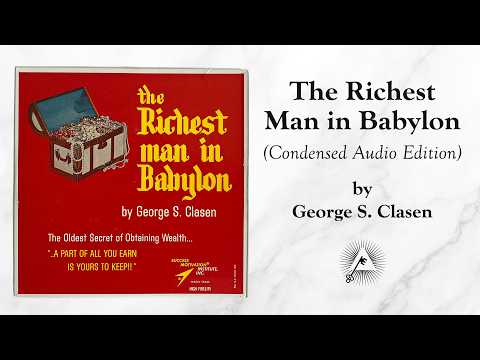
“The Richest Man in Babylon” by George S. Clason (1926)
Charlie Munger often recalled a venerable book, a hundred-year-old million-seller that pretends to be even older, “The Richest Man in Babylon” by George S. Clason.
The lessons of this fictional book, set in ancient Babylon, six thousand years ago, are as essential today as they were in antiquity, for they are timeless and enduring.
“The Richest Man in Babylon” teaches that anyone can build wealth, regardless of income, if they simply learn how and do it.
And the lesson bears repeating because, as the Fundamental Algorithm demands, it has always worked and always will.
“The Richest Man in Babylon” is available free online in YouTube videos and summaries, in books on Amazon and at any local library.
Long story short: Bansir the chariot maker is old and tired and has begun to resist his very difficult work. He is visited by his old friend, Kobbi, the musician. Both are highly competent in their respective fields but they are both broke. They squabble over a small loan and then recall their childhood friend, Arkad, said now to be the richest man in Babylon. They resolve to visit Arkad and learn his secret, if he will tell them.
Arkad receives his old friends warmly and is happy to share his secret. Arkad is neither cheap nor greedy and is not smarter or harder working than his old friends. He learned his secret from a wealthy old man for whom he worked and then applied it.
The secret is this: “A part of all I earn is mine to keep.” Or, simply said, “Pay yourself first.”
The Ten Percent Solution
Set aside ten percent or more of your earnings, put them in a safe investment at a reasonable return, and you will surely grow rich over your lifetime.
“Wealth, like a tree, grows from a tiny seed.” The earlier you plant it, the bigger it will grow in your lifetime. Then you shall bask beneath the tree, enjoy the shade, eat the fruit and no longer labor for your money!
Simple!
So simple that most people, even very intelligent people, foolishly miss it.
Here is a YouTube video of an audio performance of “The Richest Man in Babylon”:
The Age-Old Objection to Arkad’s Prescription: “But I Can’t Make Ends Meet Now!”
“If you know how to spend less than you get, you have the philosopher’s stone.” – Benjamin Franklin
To be sure, there is a well-worn objection to Arkad’s prescription for wealth. “I can barely get by on what I make now!”
Arkad has a simple answer: “Now I will tell a strange truth, the reason for which I know not. When I ceased to pay out more than nine tenths of my earnings, I managed to get along just as well.”
How? Step off the hedonic treadmill. Be frugal but not stingy. Buy appliances built to last and keep them. Cars especially. Shun luxury. Prepare your own meals. Brew your own coffee. Drink tap water. Risk the mockery of the crowd. You’ll be rewarded in the end. The simple wisdom of Arkad.
As Charlie Munger says, “It’s simple but not easy!”
Ten Percent of Your Income Compounded at Ten Percent Per Annum: Financial Judo
“Money makes money. And the money that money makes makes money.” – Benjamin Franklin
“The greatest shortcoming of the human race is our inability to understand the exponential function.” – Albert Allen Bartlett
“Compound interest is the eighth wonder of the world. He who understands it, earns it; he who doesn’t, pays it.” – attributed to Albert Einstein
Compound interest is financial judo. Size does not matter. Persistence matters. Constancy and consistency matter. Small sums compound hugely over time. For example:
A mere one hundred dollars per month compounded quarterly at the 10% historical rate of the S&P 500 over fifty years comes to $1,662,766.73.
As my Organic Chemistry professor taught, if the outcome is not intuitive, try it yourself and prove it to yourself.
Visit: Compound Interest Calculator
Compounding is why most wealthy investors are old, but began young. Warren Buffett made his first investment at age 11, yet his first billion arrived after age 55.
We Learn Best Through Stories and Simple Numbers
People love stories and simple numbers. Goldilocks and the Three Bears.
Adding is easy: baby wants more.
Multiplying is a stretch but the yield is so much greater.
The Holy Bible is a book of stories and simple numbers: Ten Commandments, Three Kings.
Yet Genesis, the first book of the Bible, propounds a fundamental exponential commandment of God: “Be fruitful and multiply.”
The full text unveils the extraordinary power of exponential growth:
“Be fruitful, and multiply, and replenish the earth and subdue it; and have dominion over the fish of the sea, and over the fowl of the air, and over every living thing that moveth upon the earth.” – Genesis 1:28
The multiplicative fruit of compound interest is not intuitive and must be learned, remembered and applied.
Income Doesn’t Matter
Compound interest smiles upon small and large incomes alike.
You hardly need a large salary to engage the staggering power of compound interest.
The mass media occasionally carry stories of lonely, underpaid assistants and working people who die in old age, leaving millions to charity, money no one imagines they might have amassed, no matter how frugal they might have been.
Indeed, they could not have built their fortunes by merely saving: they invested and compounded. Readers are surprised but few emulate their model.
On the other hand, many well paid people do not invest, do not compound and die poor.
Those big earners stepped onto the “hedonic treadmill” and spent all they earned, living larger and larger, paycheck to paycheck, and ended up broke even though the paycheck was huge. Especially if the paycheck is huge.
“As they elephants say, I’m livin’ in a great, big way.” – Dorothy Fields and Jimmy McHugh, “I’m Living in a Great Big Way”
“Now you are broke, though you earned a lot.” – Richard Rodgers and Lorenz Hart, “Bewitched, Bothered and Bewildered”
High earners can end life poor while work-a-day investors can end up rich – if work-a-day’s compound their income into wealth instead of spending it as they go.
Time Matters
“Getting wealthy is like rolling a snowball. It helps to start on top of a long hill – start early and try to roll that snowball for a very long time. It helps to live a long life. – Charlie Munger
“The real action from compounding takes place in the final 20 years of a lifetime. – Warren Buffett
“The big money is not in the buying and the selling but in the waiting.” – Charlie Munger
We are evolved creatures. Our minds were not designed by Apple or Google. Our brains are more akin to our primate relatives than bloodless calculators and computers.
Like a baby playing peek-a-boo, we are forever surprised by the explosive growth of compound interest over time.
No matter how many times we follow a doubling penny over a month we remain shocked when, on day 31, it reaches the staggering sum of $10,737,418.24.
So we are more delighted by small casino windfalls than the compounded wealth of time and maturity. Because we hate to wait.
“Waiting helps you as an investor and a lot of people just can’t stand to wait.” – Charlie Munger
The secret sauce of comedy is timing.
The secret sauce of wealth is timing – long-timing.
See also: Ten Great Secrets of Compound Interest
Beware Latter-Day Robin Hoods
It is oft said of politicians: ignore what they say and watch what they do.
“Watch what we do, not what we say.” – John Mitchell, Attorney General of the United States, 1969-1972
Mel Brooks and Carl Reiner had a long-running skit in which Mel portrayed the 2,000-Year-Old Man and Carl an eager reporter. Reiner asks, ever so innocently, what Brooks recalls of folk hero of legend, Robin Hood.
Reiner: “Did he really steal from the rich and give to the poor?”
Brooks: “Stole from everybody, kept everything.”
For the original bit, go to: