

The market is focused on current free cash flow and debt. The investment case rests on whether Comstock Resources Inc (NYSE:CRK)’s countercyclical investment in Western Haynesville and Pinnacle is about to meet a structural increase in LNG and power demand.
Comstock is not the safest or cleanest natural gas producer. It may, however, be the most asymmetric listed equity expression of a tightening Gulf Coast gas market.
Key Takeaways
- At around $13.80 per share at time of writing, I view Comstock Resources as a Buy. My base value is approximately $22 per share and the bull case reaches approximately $38+.
- The market is underwriting CRK on the 2026 and 2027 gas balance. The investment opportunity depends on the balance that may exist from 2028 through 2032, when LNG capacity, data center power demand, and Western Haynesville development are expected to reach a much larger scale.
- Under the Chronometer Partners high scenario, production increases from approximately 112 Bcf per day to 132 Bcf per day while LNG exports increase from approximately 15 Bcf per day to 35 Bcf per day. The entire modeled production increase is absorbed by LNG before fully accounting for additional power, industrial, and pipeline demand.
- CRK should be viewed as one connected asset system: Legacy Haynesville production, a large Western Haynesville development option, and Pinnacle infrastructure that can convert the resource into marketable Gulf Coast supply.
- Debt is the principal risk and part of the upside mechanism. If the gas thesis is wrong, leverage can of course impair the equity. If the thesis is right, operating leverage and debt reduction can transfer substantial value to common shareholders.
Investment Thesis
CRK is not the lowest leverage or highest free cash flow natural gas producer. It is an asymmetric investment in the possibility that the United States is approaching a structural tightening in natural gas as LNG exports, data center power demand, industrial consumption, and ordinary electricity growth begin competing for supply.
The market is primarily valuing CRK on what it is today: a leveraged Haynesville producer spending more than it generates, carrying approximately $3 billion of debt, and approaching a November 2027 revolver refinancing. I think that view is incomplete. It does not give enough weight to what the company has been building during the weak part of the gas cycle.
Over the past five years, CRK has assembled more than 540,000 net acres in the Western Haynesville, identified approximately 2,550 net drilling locations, and built Pinnacle into an integrated gathering and treating system with externally validated value. Those assets are located close to the Gulf Coast, where LNG export capacity and power demand are expected to grow materially through the end of the decade.
The natural gas thesis does not require AI demand alone to overwhelm the market. Under the structural deficit scenario, the expected increase in LNG exports could absorb nearly all plausible production growth before fully accounting for data centers, ordinary electricity demand, industrial consumption, pipeline exports, weather, and the constant replacement of declining wells.
To me, CRK is attractive because it invested ahead of that potential demand rather than waiting for the shortage to become obvious. While several peers prioritized current free cash flow and debt reduction, CRK accumulated acreage, drilled technically demanding Western wells, and financed the infrastructure needed to deliver future gas into premium markets.
That strategy created the current balance sheet risk. It also created the potential asymmetric upside.
If natural gas remains near $3, Western well economics disappoint, or management continues outspending cash flow into the refinancing window, the equity can decline materially. If Gulf Coast demand tightens the market, realized prices settle closer to $4 to $5, Western production becomes repeatable, and cash flow is directed toward debt reduction, the value transferred to common shareholders could be substantial.
The way I see it, one can argue the debt is the reason CRK cannot be considered a hand over fist buy. It is also one of the reasons the stock offers greater upside than several cleaner peers if the natural gas thesis is correct.
The Market Is Underwriting the Wrong Time Horizon
The current market debate is dominated by natural gas prices in 2026 and 2027, storage above the five year average, record production, CRK’s negative trailing free cash flow, and the November 2027 revolver maturity. Those issues should be monitored and do matter. They are not, however, the same time horizon as the structural demand thesis.
The investment thesis is focused on LNG capacity reaching fuller utilization from 2027 through 2030, data center and power demand accelerating during the same period, the cost and time required to add production, Western Haynesville development reaching scale, and Pinnacle connecting that gas to the markets where the new demand is being built.
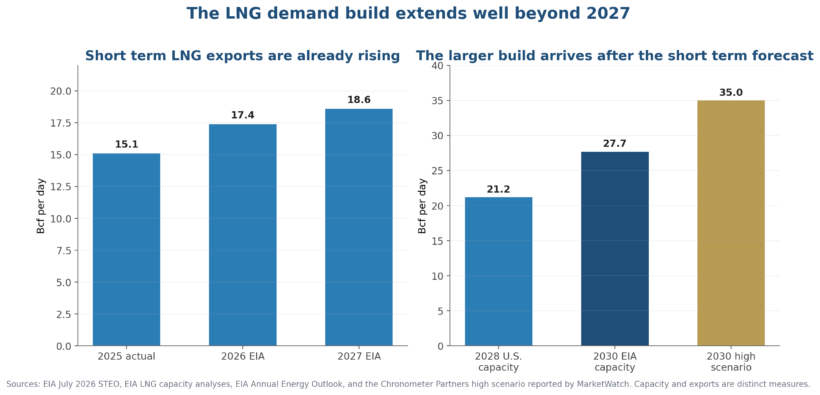
The July 2026 Energy Information Administration outlook expects Henry Hub to average approximately $3.67 in 2026 and $3.49 in 2027. It also expects U.S. LNG exports to rise from 15.1 Bcf per day in 2025 to 17.4 in 2026 and 18.6 in 2027. Those numbers explain why the current curve is not pricing an immediate shortage.
They do not answer what the market may look like after the next wave of liquefaction capacity reaches service. The EIA separately estimates U.S. LNG nominal capacity can reach approximately 21.2 Bcf per day by 2028 and approximately 27.7 Bcf per day by 2030. North American capacity is expected to increase even further when Canadian and Mexican projects are included.
The exact 32 to 35 Bcf per day estimates presented by CRK, Bank of America, and Chronometer Partners can be viewed as aggressive. So, I do not use them as the consensus base case. What they demonstrate is that the short term forecast and the structural buildout are different questions.
The market is underwriting CRK on the current gas balance. The investment opportunity depends on the balance that may exist when the assets CRK has spent years building are ready to produce at scale.
Figure 1. The LNG demand build extends well beyond 2027
The Natural Gas Supply and Demand Bridge
The most important arithmetic in the natural gas thesis comes from the Chronometer Partners scenario described by Matthew Smith. In that framework, U.S. production increases from approximately 112 Bcf per day to approximately 132 Bcf per day by the end of 2030. Over the same period, LNG exports increase from approximately 15 Bcf per day to approximately 35 Bcf per day.
The entire 20 Bcf per day increase in modeled production is therefore absorbed by the 20 Bcf per day increase in LNG exports alone.
That is before fully accounting for data center power demand, ordinary electricity load growth, industrial demand, pipeline exports to Mexico, coal retirements, weather variability, and the constant need to replace natural declines from existing wells.
That is the real gas thesis. It is not simply that AI uses electricity and natural gas should therefore rise. It is that the United States may be committing nearly all plausible incremental production to infrastructure driven and contract backed LNG demand before fully accounting for the next layer of domestic power demand.
The EIA does not currently forecast a shortage of that magnitude. It does, however, expect LNG exports and power generation to remain major sources of demand growth. Natural gas is expected to provide approximately 40 percent of U.S. electricity generation through 2027, and power sector gas consumption is forecast to reach a record 38.1 Bcf per day in 2027.
To me, that is enough to take the structural case seriously even while treating the Chronometer outcome as a higher scenario rather than a certainty.
Why LNG Demand Is Different From Ordinary Cyclical Demand
Not every unit of natural gas demand has the same durability. Weather demand can disappear within weeks, industrial demand can weaken with the economy, power generators can switch dispatch when relative fuel prices change. LNG facilities are different because the demand is supported by billions of dollars of fixed infrastructure, project financing, long term sales contracts, and global buyers that have made their own supply commitments.
The EIA reported that U.S. LNG developers signed approximately 5.2 Bcf per day of new sale and purchase agreements during 2025, the highest annual volume since 2022. These agreements do not guarantee that every proposed terminal will be completed, but they demonstrate that much of the demand is being commercialized before the facilities begin operating.
Once an LNG terminal is constructed, the marginal incentive is to keep it utilized whenever the spread between U.S. feed gas and overseas LNG prices covers the variable cost. Cutting exports is not a simple market response because contracts, financing, international relationships, and terminal economics all stand behind the volume.
This creates a different type of demand pressure. New supply has to offset existing well declines, satisfy rising domestic consumption, and feed export facilities whose economics depend on throughput. If supply arrives late, the adjustment occurs through storage and price rather than through an immediate cancellation of the demand.
I do not think this means LNG demand is completely inelastic. Projects can be delayed, global spreads can compress, and policy can change. What it does mean is that the next wave of LNG demand is more durable than a temporary weather spike and should not be treated as just another ordinary seasonal variable.
Why CRK Is Positioned Where the Demand Is Being Built
The natural gas thesis is not only about owning reserves. It is about owning reserves close to the marginal source of demand.
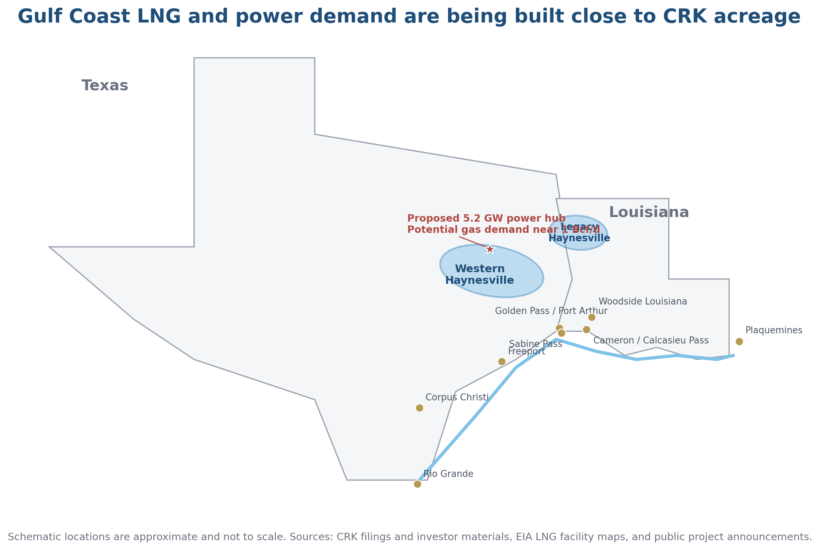
CRK’s Legacy and Western Haynesville acreage is located near a growing network of Gulf Coast LNG facilities, including Golden Pass, Port Arthur, Sabine Pass, Plaquemines, Corpus Christi, Rio Grande, Cameron, Freeport, Calcasieu Pass, and Woodside Louisiana LNG. Several are operating, ramping, or under construction.
Comstock states that its proximity to Gulf Coast LNG exports, Mexican exports, and petrochemical demand allows it to access stronger markets and receive higher net realized prices than producers in several other regions. They also highlight extensive infrastructure, natural gas storage access, and flexible marketing arrangements.
That positioning matters because a national Henry Hub forecast does not fully capture regional basis, transportation constraints, firm capacity, access to premium markets, proximity to liquefaction plants, and the value of integrated gathering and treating.
A molecule in the Western Haynesville located near Gulf Coast LNG and Texas power demand is not economically identical to a molecule that is stranded behind a transportation bottleneck in another basin.
The proposed Anderson County power hub adds another potential source of local demand. The announced project contemplates up to 5.2 gigawatts of natural gas generation and gas requirements that could approach 1 Bcf per day by 2031. I assign no base case value to that project because the final commercial structure, timeline, and economics remain incomplete. It still demonstrates why the location of the Western acreage will become strategically important.
Figure 2. Gulf Coast LNG and power demand are being built close to CRK acreage
CRK Invested Before the Demand Arrived
This is the point I think the current market underweights the most.
Comstock did not wait for natural gas to trade at $5 and then begin acquiring acreage at peak prices. It invested while gas prices were weak and while the industry was being rewarded for reducing activity and returning current cash flow.
The first step was scale. In 2019, CRK acquired Covey Park in a transaction valued at approximately $2.2 billion. The company assumed $625 million of senior notes, repaid approximately $380 million of Covey Park bank borrowings, and used additional debt and equity to create one of the largest Haynesville positions.
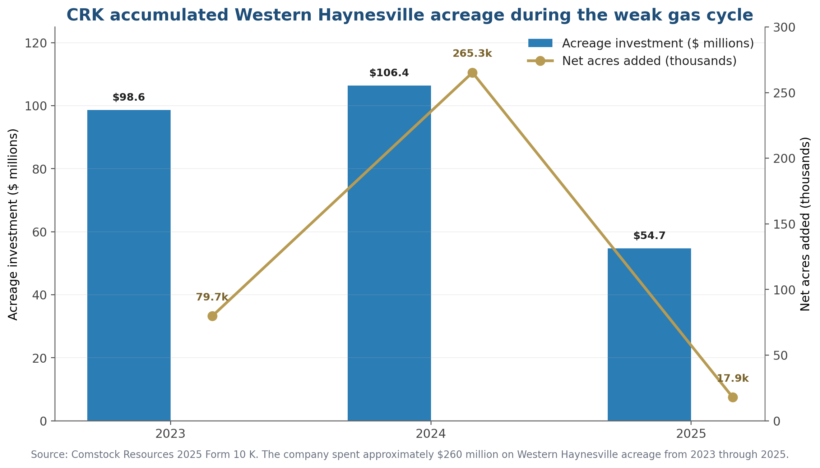
The next step was Western Haynesville. Comstock spent approximately $98.6 million adding Western acreage in 2023, $106.4 million in 2024, and $54.7 million in 2025. It now controls more than 540,000 net acres in the play and has disclosed approximately 2,550 net drilling locations.
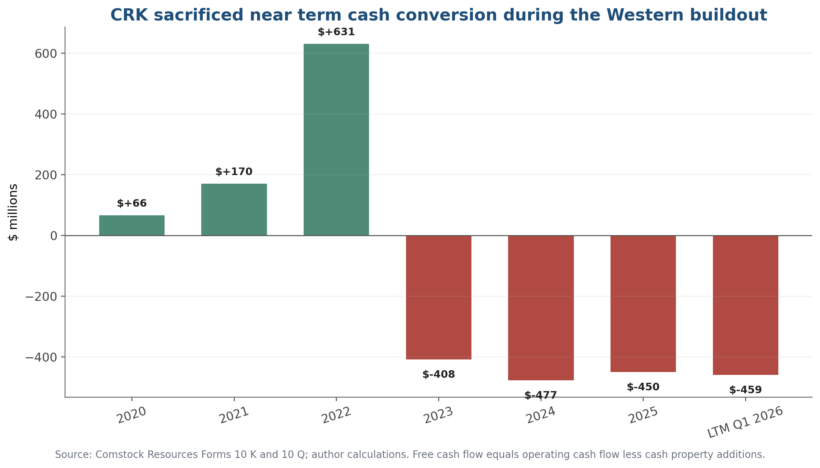
While much of the industry responded to weak gas prices by prioritizing current free cash flow, CRK used the downturn to assemble a long duration Western position and build the infrastructure required to develop it. The company sacrificed near term cash conversion in exchange for greater future exposure to the part of the gas market where LNG and power demand are most likely to emerge.
That is very different from simply saying CRK has weak free cash flow and too much debt compared with peers. Both statements are true. The first explains why the second exists, as well as why they may be the most well positioned.
Figure 3. CRK accumulated Western Haynesville acreage during the weak gas cycle
Western Haynesville and Pinnacle Are One Asset System
CRK reports one operating segment, but the investment case is easier to understand as three connected assets rather than one producer plus a separate hidden asset.
| Asset | Role in the system | What creates value | What still requires proof |
|---|---|---|---|
| Legacy Haynesville and Bossier | Current production and cash base | Established infrastructure, basin scale, long lateral inventory, and access to Gulf Coast markets | Natural decline, commodity pricing, transportation costs, and sustaining capital |
| Western Haynesville | Long duration development option | More than 540,000 net acres, approximately 2,550 net locations, high initial production rates, and proximity to LNG and power demand | Repeatable recovery, decline curves, water handling, cost per foot, and full cycle returns across multiple pads |
| Pinnacle Gas Services | Commercialization mechanism | Gathering, treating, high pressure pipelines, two treating plants, transportation flexibility, and independently validated enterprise value | Future throughput, expansion capital, contract terms, and the pace of Western development |
Pinnacle should not be viewed as merely a separate sum of the parts asset. It is the infrastructure required to turn the Western resource into marketable supply.
At the end of 2025, Pinnacle included approximately 246 miles of high pressure pipeline and two treating facilities. Sixth Street’s $600 million investment for a 27 percent interest valued Pinnacle at $2.2 billion and left Comstock with a 73 percent controlling stake that was valued at approximately $1.6 billion at the transaction price.
The transaction provides real outside validation. It also shows that a sophisticated capital provider expects Western production and infrastructure demand to grow. The proceeds primarily retired Pinnacle preferred capital and debt rather than upstream parent debt, so the transaction did not eliminate the balance sheet risk.
The strategic value may be greater than the standalone number. Without Pinnacle, Western Haynesville acreage could remain a large but expensive resource that is difficult to move. With integrated gathering and treating, the acreage can become a connected gas supply system serving LNG and potentially power generation.
The way I see it, Legacy provides the current engine, Western provides the long duration option, and Pinnacle is the bridge between the option and the end market.
Why CRK Carries More Debt Than Its Peers
CRK’s higher leverage is not the result of one isolated decision. It reflects the combination of a scale acquisition and a countercyclical development program.
The Covey Park acquisition created the modern Haynesville platform, but it also brought assumed senior notes, refinanced bank borrowings, and additional acquisition financing. More recently, the company continued investing in Western acreage, drilling, delineation, and Pinnacle while natural gas prices and operating cash flow were weak.
Several peers entered the same period with more mature asset bases and chose to harvest them. They emphasized free cash flow, debt reduction, dividends, and repurchases. CRK has remained in an asset assembly and development phase.
That does not automatically make CRK’s capital allocation superior. Development spending only creates value if the wells earn attractive full cycle returns and the infrastructure produces durable cash flow. The balance sheet is evidence that shareholders funded the build before receiving the payoff.
The correct question is therefore not why CRK has more leverage. It is whether the additional debt is supported by assets whose future cash generation will exceed the capital required to develop them.
If Western and Pinnacle deliver, the debt financed assets should become more valuable at the same time that cash flow reduces the debt. If they do not, the capital structure will have magnified a poor commodity and development decision.
Leverage Is Both the Risk and the Equity Torque
CRK is attractive partly because leverage creates substantial equity sensitivity, provided that the assets financed by the leverage begin generating cash before the refinancing window closes.
The mechanics are fairly straightforward. Equity value equals enterprise value less net debt. At the $13.80 share price, diluted equity value is approximately $4.1 billion and enterprise value is approximately $7.1 billion. Roughly $3 billion of debt therefore stands ahead of the common equity.
If normalized upstream value rises by $1 billion, the increase is large relative to the current equity value. If CRK also uses free cash flow to reduce debt, the same dollar of enterprise value belongs to fewer creditors and more of it belongs to the common shareholders.
Using approximately 296 million diluted shares, $500 million of debt reduction adds approximately $1.69 per share of equity value. A $1 billion reduction adds approximately $3.38 per share before considering any increase in normalized EBITDAX or valuation.
This creates two forms of torque. Higher realized gas prices create operating leverage through a largely fixed asset and corporate cost base. The resulting free cash flow can create financial leverage in reverse by reducing debt and transferring value to the equity.
The leverage is neither simply good nor simply bad. It is the mechanism that can turn a correct natural gas call into exceptional equity returns and an incorrect call into capital impairment. But of course, that is the asymmetrical opportunity.
What Current Financial Results Hide
The structural thesis does not give management a free pass on current cash conversion.
Reported earnings also require adjustment. Comstock reported $2.22 billion of revenue and other operating income in 2025, but the total included a $291.9 million asset sale gain. Excluding that gain, recurring operating revenue was approximately $1.93 billion. First quarter 2026 GAAP income also included an $82.8 million unrealized derivative gain.
The cleaner measure is cash. Last twelve month operating cash flow was approximately $996.8 million while filing based cash capital spending was approximately $1.456 billion. That produced negative $459.1 million of free cash flow.
At the 2022 gas peak, CRK generated approximately $631 million of standard free cash flow. From 2023 through 2025, cumulative standard free cash flow was approximately negative $1.34 billion, and the first quarter of 2026 added another deficit.
I view part of the outspend as investment rather than permanent economic loss. The valuable Western acreage and Pinnacle system did not appear for free. Still, shareholders only earn a return if the investment produces cash after sustaining capital, interest, transportation, corporate costs, and the capital needed to develop the new resource.
The current financial statements show the cost of building the option. The next phase has to show the conversion of that option into free cash flow.
Figure 4. CRK sacrificed near term cash conversion during the Western buildout
Peer Comparison: Quality Versus Asymmetry
The usual peer comparison asks why an investor should own CRK when other gas producers have lower leverage, better current cash conversion, and more proven low cost inventory. That is a fair question, but it should not be the only question.
| Company | Current quality | Structural positioning | Equity sensitivity | Best description |
|---|---|---|---|---|
| Comstock Resources | Negative current free cash flow and leverage near 2.9 times | Nearly pure gas, Gulf Coast proximity, large Western option, Pinnacle, and potential local power demand | Highest of the group because of operating leverage, financial leverage, and smaller public float | Asymmetric Gulf Coast gas expression |
| Expand Energy | Positive free cash flow, lower leverage, and high quality resource base | Large scale diversified gas portfolio and strong low cost supply | Meaningful, but moderated by stronger balance sheet and larger enterprise value | Higher quality core gas holding |
| Range Resources | Low leverage, strong cost structure, and room to grow production | High quality Marcellus inventory with strong economics | Strong gas sensitivity with more balance sheet protection | Balanced quality and upside |
Expand and Range may be better risk adjusted natural gas holdings. CRK may still be the more asymmetric equity because it combines nearly pure natural gas exposure, Gulf Coast proximity, a large undeveloped Western inventory, integrated infrastructure, controlling owner support, greater financial leverage, and a development program whose value is not yet visible in current free cash flow.
CRK is not necessarily the safest producer or the cheapest company based on trailing enterprise value to EBITDAX. At the current price, it trades near 6.8 times last twelve month EBITDAX while several selected peers trade at lower multiples with less debt and positive free cash flow.
However, CRK may be the cleanest leveraged listed equity expression of a tightening Gulf Coast natural gas market. That is different from claiming it is objectively the highest quality gas producer.
Shale Abundance Changed Expectations
The market has been trained by more than a decade of shale abundance. Since 2010, production growth repeatedly answered higher prices, storage rebuilt after shortages, and the forward curve rewarded investors who assumed that scarcity would be temporary.
That history explains why the curve remains relatively flat despite the amount of announced LNG and data center infrastructure. Investors have seen supply respond before, and the Haynesville, Permian associated gas, Appalachia, new pipelines, and efficiency gains remain meaningful sources of future production.
The structural thesis does not require supply to stop responding. It requires the response to be slower, more expensive, or less deliverable than the demand buildout.
Natural gas wells decline, pipeline and processing capacity has to be constructed, permitting can delay infrastructure, and producers need an adequate price signal before committing capital. The LNG plants and power projects may reach service before every unit of upstream and midstream supply is ready.
The lesson from prior gas spikes is not that a permanent shortage must occur. It is, however, that storage and deliverability can create nonlinear price moves when fixed demand meets a system with limited short term flexibility. CRK is positioned to benefit if the adjustment arrives through higher Gulf Coast gas prices rather than through cancelled demand.
Counterargument
The strongest counterargument is that the United States has enough resource, technology, associated gas, and planned infrastructure to meet the demand without a sustained price shock.
The July EIA outlook supports that view in the short term. It expects dry gas production to increase from 107.7 Bcf per day in 2025 to 115.3 Bcf per day in 2027. Inventories are expected to remain above the five year average through much of 2026, and planned pipeline capacity additions are concentrated in Texas and Louisiana.
Higher prices would also encourage Haynesville drilling, improve the economics of marginal acreage, accelerate infrastructure, and potentially increase associated gas from oil basins. Renewable generation, storage, efficiency, power project delays, and changes in AI economics could reduce the amount of gas that ultimately has to be burned.
The high LNG scenario is also somewhat aggressive. Capacity is not the same as actual feed gas demand, terminals can be delayed, and global LNG prices may not support maximum utilization forever.
CRK has company specific risks on top of the commodity debate. Western wells are deeper, hotter, technically difficult, and expensive. High initial production rates do not prove estimated ultimate recovery or full cycle economics. The proposed power hub is not yet a fully disclosed binding gas contract. The revolver still matures in November 2027.
I take those objections as serious possibilities that deserve to be monitored. I still reach a positive conclusion because the current price does not require the most aggressive demand scenario to work. A realized gas environment near $4.25, repeatable Western economics, moderated capital spending, and debt reduction can support the base value without a permanent shortage or premium multiple.
Just To Be Clear
I am not arguing that the United States is guaranteed to run out of natural gas. I am not using the 35 Bcf per day LNG estimate as a consensus forecast. I am not assuming every data center announcement becomes operational. I am not treating every Western drilling location as proven value. I am not assigning base case value to the proposed power hub. I am not calling CRK a high quality compounder, and I am not ignoring the 2027 refinancing.
What I am arguing is:
- The market is focused on the current gas balance while the investment case depends on a materially different demand environment from 2028 through 2032.
- LNG demand is being supported by physical infrastructure and long term contracts, making it more durable than a temporary weather driven increase.
- CRK deliberately accumulated Western acreage and built Pinnacle before the demand arrived, sacrificing near term cash conversion for future exposure.
- Legacy, Western, and Pinnacle should be valued as one connected Gulf Coast gas supply system.
- The debt is both the main downside risk and a source of equity torque if higher gas prices become free cash flow and debt reduction.
- A base value near $22 does not require sustained $6 gas, a premium multiple, or power hub value.
What Would Strengthen or Weaken the Thesis
The thesis should be monitored as a sequence rather than as a single natural gas price call. Demand has to become actual gas burn. That demand has to improve CRK’s realized price after basis and hedges. Western wells have to perform, capital spending has to moderate, the resulting cash has to reduce debt.
| Indicator | Current position | What strengthens the thesis | What weakens the thesis |
|---|---|---|---|
| LNG and power demand | Exports rising, major Gulf Coast capacity under construction, power hub proposed | Terminal ramp stays on schedule, utilization remains high, and binding power or industrial contracts emerge | Projects are delayed, utilization falls, or global spreads reduce feed gas demand |
| Western well economics | Strong early rates with limited cumulative disclosure | Repeatable recovery, decline, water, and cost data across several pads | High initial rates fail to translate into cumulative production and full cycle returns |
| Full program free cash flow | Approximately negative $459 million last twelve months | Two consecutive positive quarters and more than $300 million annualized after the full capital program | Free cash flow remains negative despite realized gas near or above $4 |
| Upstream leverage | Approximately 2.8 to 2.9 times | Falls below 2.5 times and debt reduction becomes the clear capital priority | Rises above 3.25 times or approaches the covenant ceiling |
| Refinancing | Revolver matures November 15, 2027 | Early extension on reasonable terms before the middle of 2027 | The process slips into late 2027 or borrowing base pressure appears |
| Capital allocation | Management remains in a heavy development phase | Growth spending moderates as assets reach scale and excess cash reduces debt | Higher gas leads to another acceleration in spending, dividends, or acquisitions before leverage falls |
The downside scenario is as follows. Leverage exceeds approximately 3.25 times, the revolver is not substantially addressed by the middle of 2027, or free cash flow remains negative after several quarters of realized gas near or above $4.
Valuation and Scenarios
The valuation has to reflect both the connected asset system and the wide outcome distribution. I use a sum of the parts framework rather than applying one consolidated multiple to reported revenue.
The base case assumes approximately 1.40 Bcfe per day of production, a realized gas price near $4.25 per Mcf, approximately $1.50 billion of normalized upstream EBITDAX, $300 million to $450 million of annual equity free cash flow after a moderated capital program, and future upstream net debt of approximately $2.4 billion.
Applying a 5.0 times multiple to $1.50 billion of normalized upstream EBITDAX produces $7.50 billion of upstream enterprise value. I add $1.30 billion for CRK’s Pinnacle interest, below the approximately $1.6 billion transaction value, and subtract $2.40 billion of future upstream net debt. Dividing the resulting $6.40 billion equity value by approximately 296 million diluted shares produces approximately $21.62 per share, rounded to $22.
The base case does not require multiple expansion. The selected upstream multiple is below the current implied upstream multiple after subtracting a discounted Pinnacle stake. The upside comes from normalized earnings growth and debt reduction.
The wrong but survivable case is approximately $9.25. It assumes gas remains near the middle $3 range, CRK reduces growth spending, refinances, and preserves the asset base without producing meaningful equity free cash flow.
The bull case is approximately $38+. It assumes sustained realized gas near $5, repeatable Western production, approximately $2.0 billion of upstream EBITDAX, $700 million to $900 million of annual free cash flow, and rapid deleveraging.
Investment Implications
The practical implication to me is that CRK should not be evaluated as a generic natural gas trade or as a traditional low multiple value stock. The decision comes down to four questions.
1. Is the Market Underestimating the 2028 Through 2032 Gas Balance?
The short term EIA outlook can be correct while the structural shortage thesis also becomes correct later. Investors have to compare the timing of new liquefaction, power demand, production growth, pipeline capacity, and storage rather than treating one 2027 price forecast as the final answer.
2. Can Western and Pinnacle Convert Location Into Cash?
Acreage scale and infrastructure are valuable only if wells produce attractive full cycle returns and the gas can reach premium markets. Cumulative production, decline, cost, throughput, and contract economics matter more than drilling location counts or initial production headlines.
3. Will Higher Gas Become Debt Reduction?
A commodity rally can move the stock before the business changes. The durable revaluation occurs when higher operating cash flow exceeds sustaining and development capital and management directs the excess toward the balance sheet. Every $296 million of net debt reduction adds approximately $1 per diluted share of arithmetic equity value.
4. Is the Position Sized for the Actual Risk?
CRK has a wide distribution of outcomes. It offers more upside than several cleaner peers if the structural gas thesis is correct, but the leverage gives the company less time to be wrong. The stock belongs in a deliberately sized asymmetric position, not in the same risk category as a low leverage compounder.
Conclusion
Comstock Resources is a leveraged producer that could of course benefit from higher natural gas prices. More specifically, it is a deliberately leveraged, countercyclically built Gulf Coast gas platform positioned for a possible demand shock the current commodity curve does not fully reflect.
The market is focused on what CRK looks like today: negative trailing free cash flow, approximately $3 billion of debt, a heavy capital program, uncertain Western well economics, and a 2027 refinancing.
The opportunity is what the company has been building beneath those current results. CRK controls a large Legacy production base, more than 540,000 net Western Haynesville acres, approximately 2,550 net Western drilling locations, and a controlling interest in Pinnacle that was externally valued at $2.2 billion. The system sits close to the Gulf Coast, where LNG capacity and power demand are being constructed.
The natural gas thesis is stronger than the simple idea that AI will use more electricity. Under the high scenario, the projected increase in LNG exports absorbs the entire modeled increase in U.S. production before fully accounting for domestic power demand and other uses. Even the more conservative EIA outlook shows that LNG exports and gas fired generation remain major sources of demand growth.
If supply responds quickly, LNG projects are delayed, Western wells disappoint, or management continues reinvesting all available cash, the debt can impair the equity. If Gulf Coast gas tightens, realized prices settle near $4 to $5, Western and Pinnacle reach scale, and free cash flow reduces debt, the combination of operating leverage and financial leverage can produce substantial upside.
At the $13.80 share price, I view CRK as a Buy. The debt is the principal risk. It is also one of the reasons the equity can outperform several cleaner peers if the natural gas thesis is right.
Higher natural gas prices are not enough. Higher natural gas prices that reach CRK’s assets, become full program free cash flow, and reduce net debt are the thesis.
Disclosure
This article reflects the author’s personal opinions and is for informational purposes only, not investment advice. The author does not currently own shares of Comstock Resources (NYSE:CRK) but intends to initiate a position following an internal waiting period.
Primary Sources
- Comstock Resources 2025 Form 10 K, filed February 19, 2026.
- Comstock Resources first quarter 2026 Form 10 Q, filed May 6, 2026.
- Comstock Resources first quarter 2026 financial and operating results.
- Comstock Resources July 2026 investor presentation.
- Comstock Resources and Sixth Street Pinnacle Gas Services transaction announcement, June 15, 2026.
- Comstock Resources Western Haynesville power generation hub announcement, March 23, 2026.
- Comstock Resources 2020 Form 10 K, Covey Park acquisition discussion.
- U.S. Energy Information Administration July 2026 Short Term Energy Outlook, natural gas section.
- U.S. Energy Information Administration, North American LNG export capacity through 2028.
- U.S. Energy Information Administration Annual Energy Outlook narrative, LNG capacity through 2030.
- U.S. Energy Information Administration, U.S. LNG developers signed the highest contract volume since 2022.
- U.S. Census Bureau 2024 cartographic boundary files, used only as a general mapping reference.
Supporting Research and Alternative Views
- MarketWatch, “Artificial intelligence will drive an unprecedented natural gas deficit,” July 22, 2026. The Chronometer Partners supply and demand model is treated as a high structural scenario, not a consensus forecast.
- Invest Like the Best, Matthew Smith, “How America Runs Out of Natural Gas by 2030,” July 21, 2026.