

Last updated: May 28, 2026 — With thousands of hedge funds operating around the globe, it’s a real challenge to know which ones offer the biggest bang for your buck. Some investors prefer the largest and best-known funds, and we’ve got those ranked here for you. Others prefer smaller, boutique funds managed by up-and-comers. We have a few of those here too.
Three different methods can be used to measure the best-performing hedge funds. The first is actual reported net return, which is used by HSBC. Hedge Fund Alpha covers HSBC’s Hedge Weekly on a regular basis, but unfortunately, there’s no public-facing database from HSBC that ranks hedge funds in this way. Thus, we use the other two methods for measuring the best-performing hedge funds.
The first list ranks hedge funds by 13F equity portfolio returns over a three-year period, which is the method used by HedgeFollow. For inclusion on this list, hedge funds must have filed a 13F for at least three years and owned at least five equities every quarter.
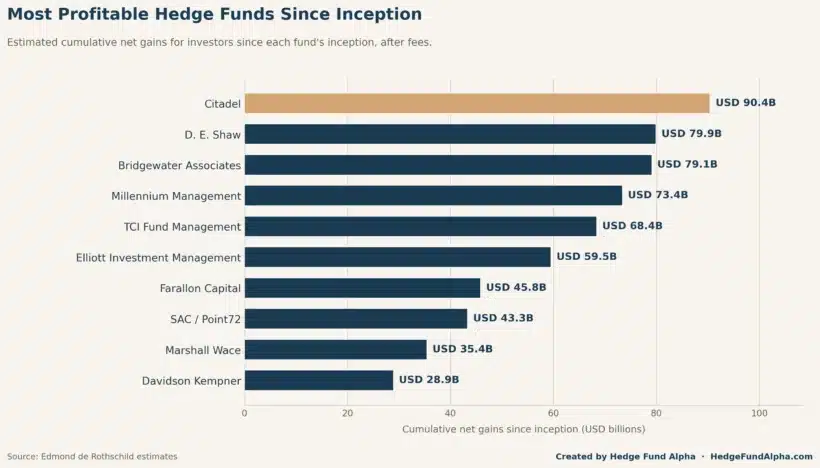
The second set uses absolute dollar gains for investors, a method employed by LCH and Edmond de Rothschild.
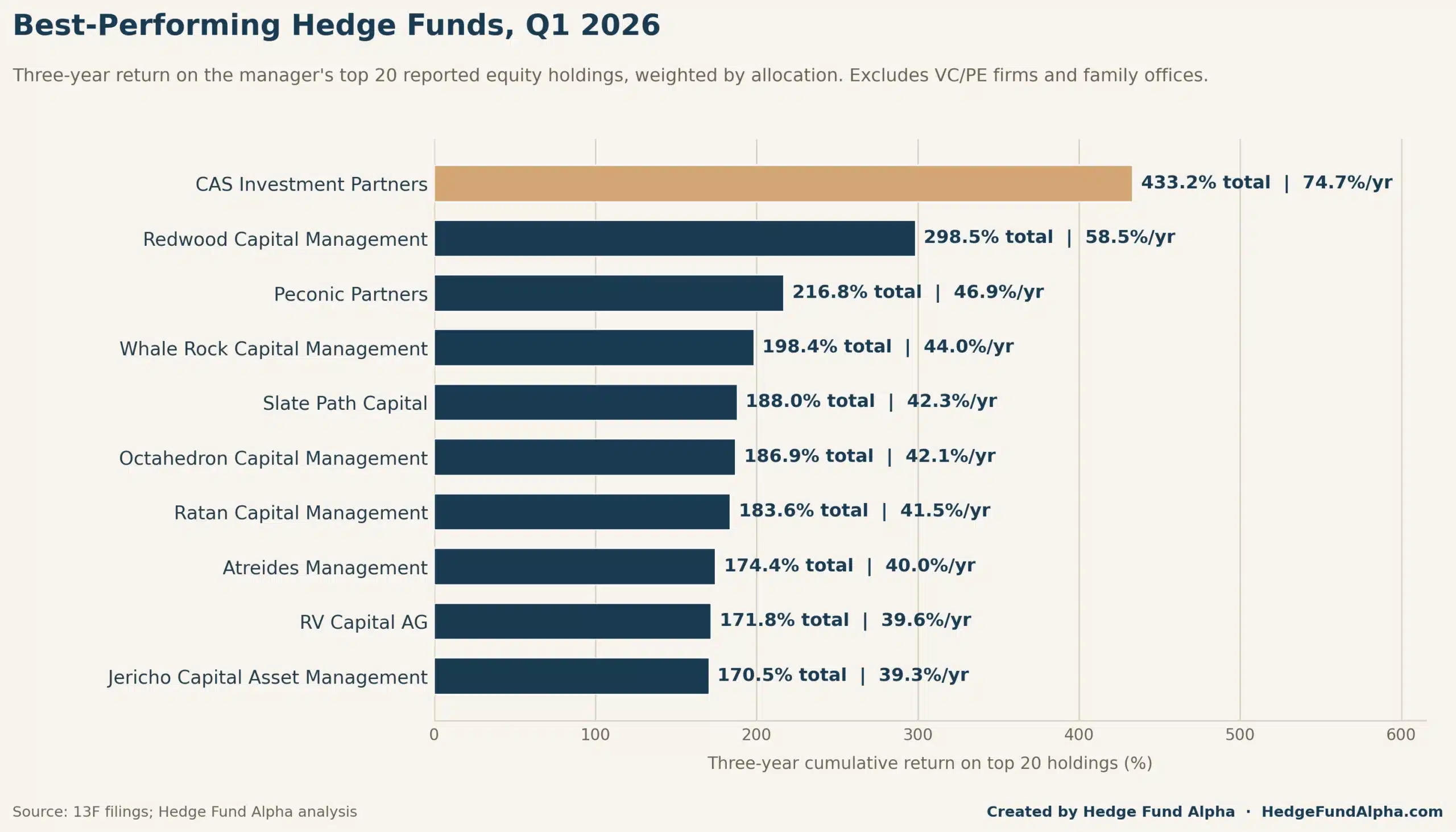
Best-Performing Hedge Funds in Q1 2026 by Three-Year Performance of Top Holdings
The best indicator of a hedge fund’s performance isn’t quarterly or even annual returns. It’s based on the longer term. Thus, this list of the best-performing hedge funds as of Q1 2026 is based on the managers’ three-year performance using their top 20 stock holdings, weighted according to the manager’s allocation. These are 13F-disclosed long U.S. equity positions, so they don’t include shorts, non-U.S. stocks, or net-of-fee performance. This list excludes venture capital/ private equity firms and family offices.
As of Q1 2026, the best-performing hedge funds based on three-year performance are:
1. CAS Investment Partners, 433.2% over three years, 74.7% annualized
Founded and managed by Clifford Sosin, CAS Investment Partners describes itself as a “value-focused investment manager.” It has $2.4 billion in discretionary assets under management based on its latest Form ADV filed for Q1 2026. The firm’s goal is to outperform the S&P 500 over time, and it holds three primary beliefs regarding investing. Sosin seeks to purchase assets for far less than they’re worth or sell assets for much more than what they’re worth. He also aims to act independently based on reasoning and facts, ignoring market volatility. Finally, he wants to be judged just for outperforming low-fee index-based products.
CAS Investment Partners invests in both credit and equities on a long- and short-term basis using three criteria. Sosin must understand how the company can earn profits and how changes might impact its performance. He seeks a margin of safety involving cumulative future cash flows, and he thinks creatively about risk to avoid permanent capital loss.
2. Redwood Capital Management, 298.5% over three years, 58.5% annualized
Redwood Capital Management is managed by Jonathan Kolatch. According to its latest Form ADV for Q1 2026, the firm has $12.3 billion in AUM. Via various investment vehicles, Redwood targets opportunistic credit and other special situations looking across a wide range of industries and geographies. The firm focuses on distressed and stressed investments, mostly in fixed income, seeking to identify opportunities that others are selling or avoiding securities because of either company-specific or industry issues. Using fundamental research, Redwood looks at a variety of sources such as financial filings, publications, and third-party data, also holding conversations with management and industry experts.
3. Peconic Partners, 216.8% over three years, 46.9% annualized
Founded and led by William Harnisch, Peconic Partners is a long/short equity hedge fund firm with $2.8 billion in regulatory AUM based on its Form ADV filing for Q1 2026. Peconic aims to mitigate risk while maximizing returns, tapping its collective and synergistic insights to do so. Deep experience drives the firm’s stock-picking approach. Peconic Partners utilizes a thematic strategy that aims to generate long-term positive returns, no matter what the market environment.
4. Whale Rock Capital Management, 198.4% over three years, 44% annualized
Alexander Sacerdote founded Whale Rock in 2006 and continues to manage the firm, which had $13 billion in discretionary AUM based on its Q1 2026 Form ADV. The firm invests globally, focusing on the technology, media and telecom sectors. Using a fundamental approach driven by research, Whale Rock looks for significant technological and economic shifts such as the AI boom, seeking to unearth both winners and losers with sizable exposures to these product cycles. The firm manages multiple strategies, including its Flagship funds, Long Opportunities Funds and Hybrid Funds.
5. Slate Path Capital, 188% over three years, 42.3% annualized
Founded and operated by David Greenspan, Slate Path Capital had $12 billion in discretionary AUM in Q1 2026, according to its Form ADV for the quarter. The firm targets long-term risk-adjusted capital growth via a fundamental, research-based selection process. Slate Path operates global long/short funds mostly targeting stocks, although the firm also holds sizable non-equity positions on both the long and short sides. The firm’s funds also invest in digital assets like bitcoin, Ethereum and other cryptocurrencies.
6. Octahedron Capital Management, 186.9% over three years, 42.1% annualized
Octahedron is an outlier on this list, as it’s a crossover firm that’s a hybrid between a hedge fund and venture capital firm. It was founded in 2020 by Ram Parameswaran to invest in both public and private tech firms. Octahedron operates a long/short equity strategy, serving as an investment advisor for a range of hedge funds and maintaining a concentrated, long-biased portfolio with eight to 12 stocks. The firm had discretionary AUM of $594.2 million as of Q1 2026.
7. Ratan Capital Management, 183.6% over three years, 41.5% annualized
Founded by Nehal Chopra in 2009, Ratan is a Tiger seed that focuses on fundamental value and event-driven investing, seeking securities that are mispriced and driven by corporate catalysts such as mergers and bankruptcies. The firm had $401.9 million as of Q1 2026, according to its Form ADV filing. Ratan Capital is known for operating a high-conviction, concentrated portfolio of 35 to 40 stocks. The firm leans toward large-cap technology and semiconductor names.
8. Atreides Management, 174.4% over three years, 40% annualized
With $8.9 billion in AUM as of Q1 2026, according to its Form ADV filing for the quarter, Atreides looks at technology and consumer companies over the long term, bringing the perspective of a PE investor to high-growth companies in those sectors. The firm was founded in 2019 by Gavin Baker. Atreides operates long-biased, long/short equity strategies, including its 150/50 Technology Funds, which target a 150% long, 50% short gross exposure. Those funds especially focus on AI. Atreides also invests in private venture and growth companies through its Private Opportunities Funds.
9. RV Capital AG, 171.8% over three years, 39.6% annualized
Founded by Rob Vinall, this Switzerland-based fund had $713.3 million in discretionary AUM as of Q1 2026, according to its Form ADV for the quarter. It invests across all sectors around the globe, choosing investments according to four criteria. The first is whether the company will be flourishing in 10 years or longer, while the second is whether it’s constructing a long-term competitive advantage. The third is whether management sets the right example, and the fourth is whether the price is attractive. RV buys if all four criteria are met, intending to hold for the long term. The firm operates a very concentrated portfolio with about 10 names.
10. Jericho Capital Asset Management, 170.5% over three years, 39.3% annualized
Jericho Capital was founded by Josh Resnick in 2009. The firm had $10.1 billion in discretionary AUM as of Q1. Aiming to generate superior risk-adjusted returns, Jericho invests on both the long and short side of the stock market, targeting the global technology, media and entertainment, telecommunications, and consumer sectors. The firm invests in both developed and emerging markets via its Main Strategy and Special Opportunities Strategy, which is more concentrated than the Main Strategy.
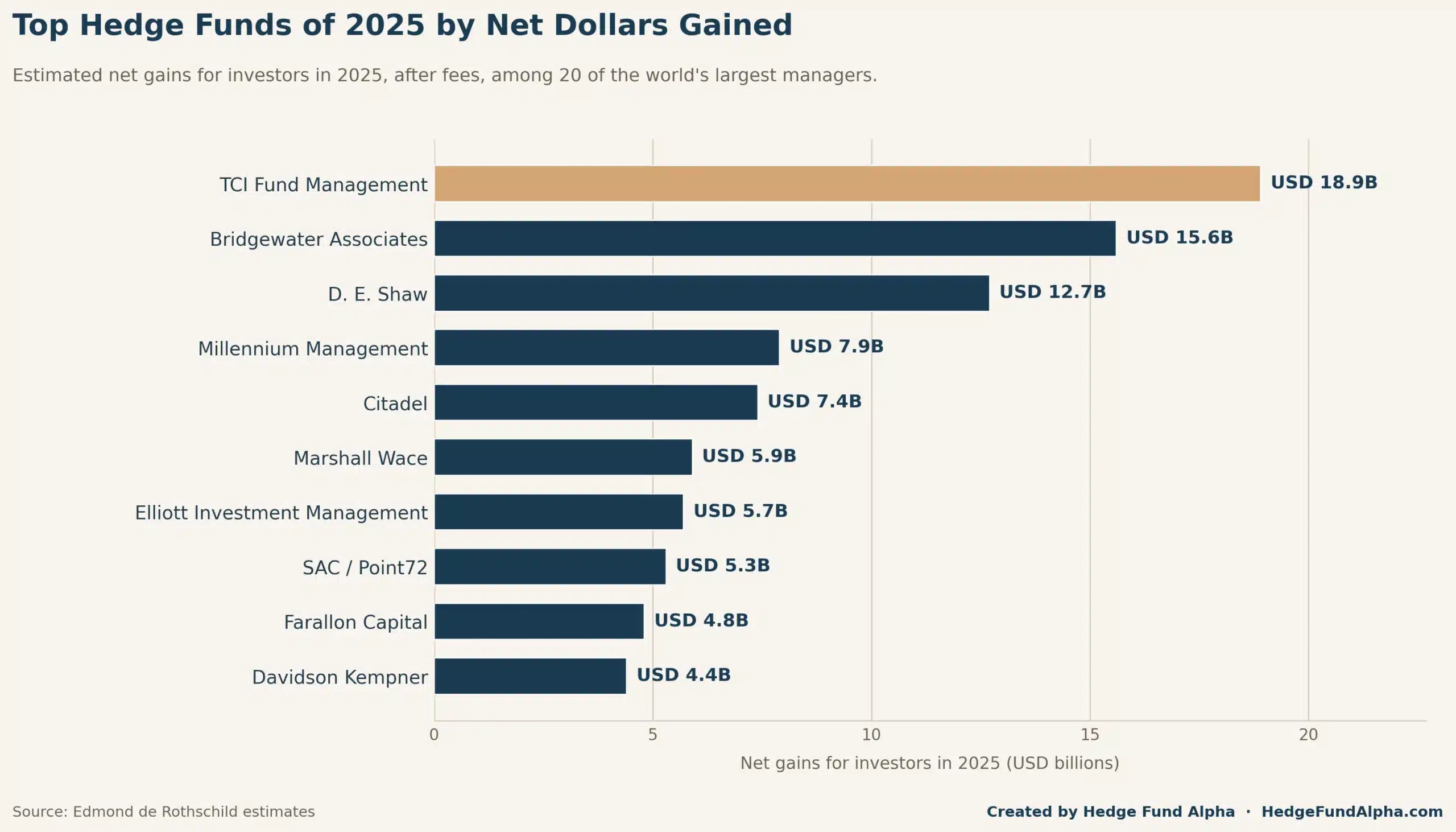
Best-Performing Hedge Funds of 2025 by Billions Gained
Although it’s always a good idea to assess long-term returns when looking at hedge funds, annual leaderboards are also good to review. This list is a bit different than the list above. It’s based on estimates from Edmond de Rothschild. Looking just at the top 10 of what many would agree are the world’s top 20 greatest money managers (other funds may have better 2025 returns), the best-performing hedge funds for 2025 based on billions earned net of fees were:
1. TCI Fund Management, $18.9 billion net in 2025, $68.4 billion net since inception
Sir Christopher Hohn’s TCI Fund Management is a value-oriented, fundamental investment firm that invests globally in robust businesses that have sustainable competitive advantages. Based on a PE approach, the firm conducts deep fundamental research and engages with company management. TCI invests with a long-term horizon in mind. It’s an opportunistic investor that sometimes looks for corporate transformations and special situations. TCI will catalyze outcomes via activism when necessary. The firm’s Master Fund maximizes alpha through high concentration.
2. Bridgewater Associates, $15.6 billion net in 2025, $79.1 billion net since inception
This behemoth founded by Ray Dalio is a global macro firm that combines systematic quantitative models with fundamental macroeconomic principles, targeting uncorrelated returns. The firm operates two main strategies, the Pure Alpha and All Weather. Pure Alpha is an actively managed fund that aims to generate outsized returns, while the All Weather fund is a passively managed, risk-balanced beta fund.
3. D. E. Shaw, $12.7 billion net in 2025, $79.9 billion net since inception
D.E. Shaw is a massive multi-strategy hedge fund that invests globally. A pioneer in quantitative investing, the fund’s core strategy combines systematic modeling with discretionary, fundamental research to tap into inefficiencies in the market and pull out sources of return that are hard to find. D. E. Shaw utilizes advanced algorithms, machine learning and data processing to spot significant inefficiencies around the globe. Human-driven financial analysis is the basis of the fund’s discretionary strategies, which aim to capitalize on event-driven situations and macro trends. The firm especially targets relative value, frequently taking up a long position on undervalued assets and going short on overvalued ones.
4. Millennium Management, $7.9 billion net in 2025, $73.4 billion net since inception
Israel Englander’s Millennium Management is also a massive multi-strategy fund, although it’s a “pod shop,” using a decentralized structure that allocates capital to more than 300 different teams around the globe. The strategy rests on rigorous risk management, forced diversification that spans a range of uncorrelated assets, and strict stop-loss limits.
5. Citadel, $7.4 billion net in 2025, $90.4 billion net since inception
Founded by Ken Griffin, Citadel is another multi-strategy fund that also operates on a decentralized structure, although it utilizes a platform model. It deploys capital across five primary strategies: equities, fixed income and macro, commodities, credit, and quantitative strategies. Citadel taps into deep fundamental research, quant modeling and cutting-edge technology to take advantage of idiosyncratic opportunities, ignoring the direction of the broader market.
6. Marshall Wace, $5.9 billion net in 2025, $35.4 billion net since inception
Known for its pioneering alpha capture system called TOPS, or Trade Optimized Portfolio System, Marshall Wace combines crowd-sourced views from Wall Street analysts to target market-neutral returns. The firm utilizes quant, systematic, and fundamental long/short equity strategies.
7. Elliott Investment Management, $5.7 billion net in 2025, $59.5 billion net since inception
Also a multi-strategy fund, Paul Singer’s Elliott is widely known for its aggressive activist strategies, although it also invests in distressed debt and takes up hedge or arbitrage positions. The firm looks for companies that are either undervalued or poorly managed, snapping up sizable stakes to force major operational or management changes or to engineer corporate breakups, all aimed at enhancing shareholder value.
8. SAC/ Point72, $5.3 billion net in 2025, $43.3 billion net since inception
Steve Cohen’s Point72 is a multi-strategy firm that takes a diversified approach that combines human-led fundamental equities and global macro strategies with computer-driven systematic trading. The firm also invests in venture capital and private credit, all with a goal of generating uncorrelated returns.
9. Farallon Capital, $4.8 billion net in 2025, $45.8 billion net since inception
Although he’s retired now, Tom Steyer founded Farallon Capital in 1986. The multi-strategy hedge fund rests on fundamental, bottom-up research, targeting superior risk-adjusted returns across complete market cycles. Farallon allocates capital dynamically across asset classes and regions in search of mispriced opportunities. The firm targets a wide range of strategies, including merger and risk arbitrage, credit, long/short equity, real estate, and strategic capital and direct investments.
10. Davidson Kempner, $4.4 billion net in 2025, $28.9 billion net since inception
Using a bottom-up, fundamental approach, Davidson Kempner invests in both the public and private markets, targeting stressed or distressed companies and opportunistic investments triggered by events or value propositions. Davidson Kempner aims for attractive risk-adjusted returns with low correlation to the equity and fixed-income markets.
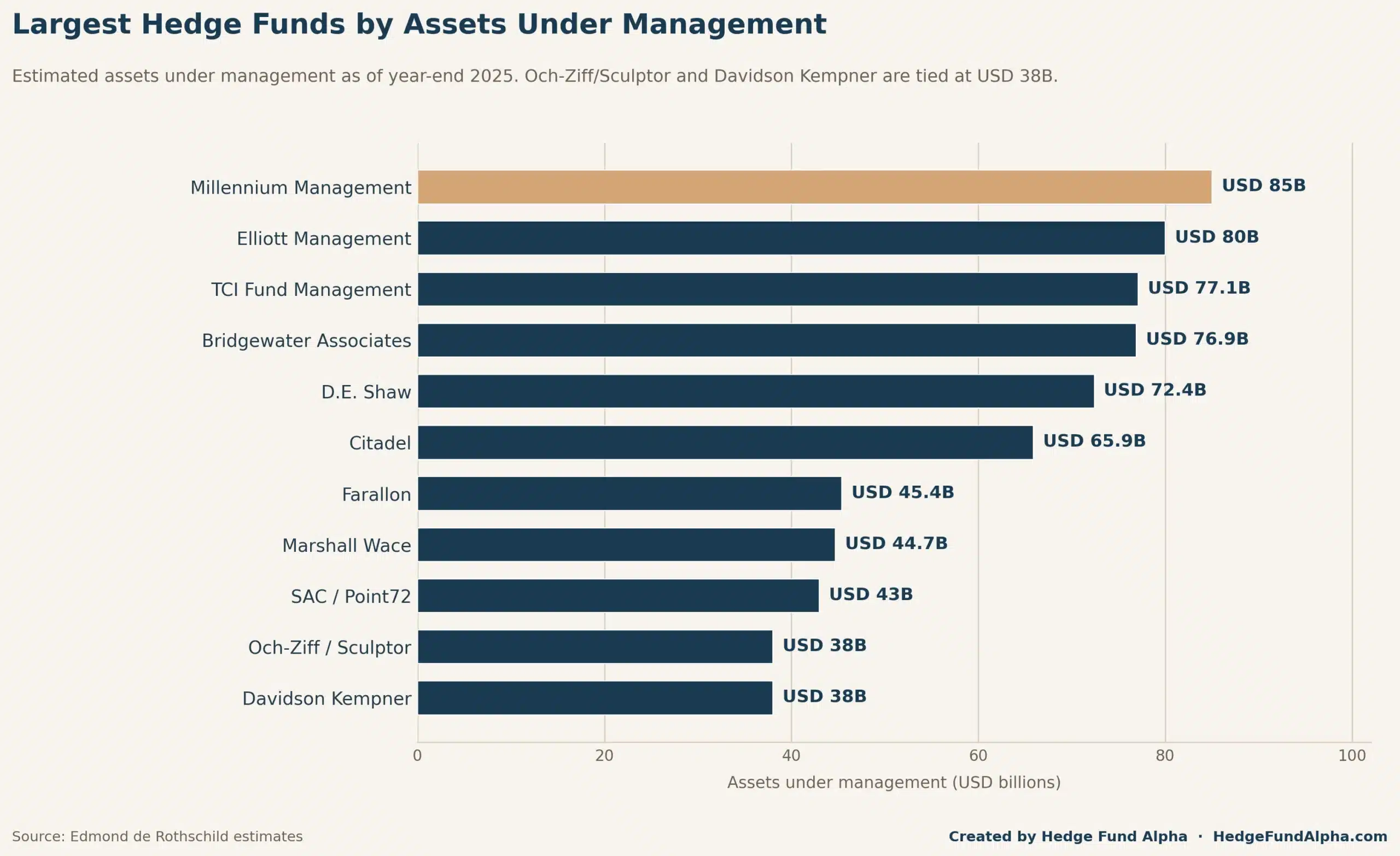
The Top Hedge Funds Based on AUM
Now we come to the biggest and the best hedge funds. Here’s a ranking of the greatest money managers based on AUM as of the end of 2025. This is based on estimates from Edmond de Rothschild.
- Millennium Management, $85 billion
- Elliott Management, $80 billion
- TCI Fund Management, $77.1 billion
- Bridgewater Associates, $76.9 billion
- D.E. Shaw, $72.4 billion
- Citadel, $65.9 billion
- Farallon, $45.4 billion
- Marshall Wace, $44.7 billion
- SAC/Point72, $43 billion
- Och Ziff/ Sculptor and Davidson Kempner, tied at $38 billion
FAQs
What is the most successful hedge fund ever?
Depending on how you measure success, the most successful hedge fund is either Citadel or Renaissance Technologies’ Medallion Fund. Citadel is the most profitable based on absolute total dollar gains, having generated over $90 billion since inception. Renaissance Technologies’ Medallion Fund has the best track record based on numbers from a few years ago, although more recent returns aren’t available. The fund is closed to outside investors.
What are the big five hedge funds?
The big five hedge funds are Ray Dalio’s Bridgewater Associates, Israel Englander’s Millennium Management, Ken Griffin’s Citadel, Paul Singer’s Elliott Investment Management, and quant pioneer D. E. Shaw.
Why don’t 13F rankings match a fund’s actual return?
It’s very rare for 13F rankings to match a fund’s actual return because 13F filings only disclose long U.S. equity positions, excluding shorts, cash and derivatives. Additionally, there’s a 45-day lag between the end of the quarter and the reporting date, meaning the numbers are already stale. Further, the 13F rankings don’t account for management fees or trade timing.
What is Bridgewater Associates known for?
Ray Dalio’s Bridgewater is one of the largest and most profitable hedge funds in the world, known for its enormous scale, pioneering All Weather strategy, and unconventional idea meritocracy corporate culture.
Is it hard to get into Millennium Management?
Yes, it is astonishingly difficult to get into Millennium. The firm is one of the top multi-manager hedge funds around the globe, and its acceptance rates are far lower than those of Ivy League universities. In a recent period, more than 50,000 applications were submitted for entry-level and internship programs with about 190 positions, amounting to an acceptance rate of less than 0.5%.
How did Ken Griffin get so rich?
Ken Griffin of Citadel built the most profitable hedge fund in history. Through early risk-taking, innovation and data-driven investing, Griffin built his roughly $48 billion to $50 billion net worth (based on Forbes and the Bloomberg Billionaires Index). He started trading while still a student at Harvard University, coding and building his own algorithms designed to tap into mispricings in convertible bonds.