

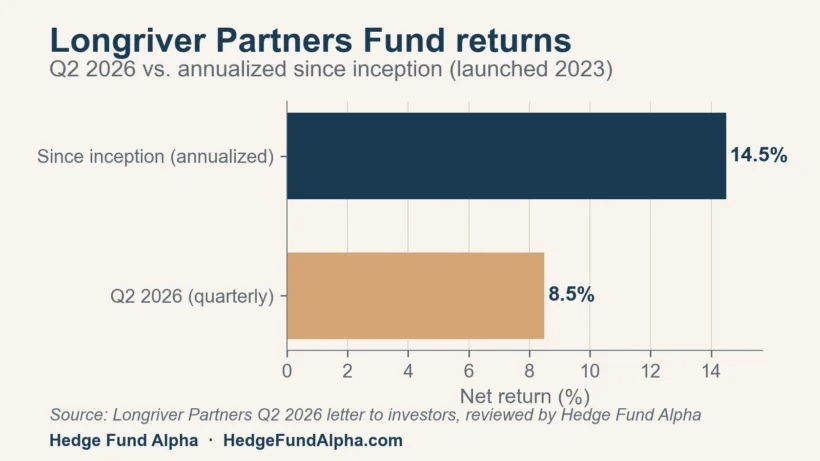
The Longriver Partners Fund returned 8.5% net for the second quarter, erasing the first quarter’s decline. The fund has gained 60.5% since inception, amounting to an annualized compound return of 14.5%. In his Q2 2026 letter to investors, which was reviewed by Hedge Fund Alpha, Graham Rhodes reminded investors that his strategy is to “ride the long-term value” created by their companies.
Read more hedge fund letters here
He also had a dire warning about what could happen to AI if it follows in the footsteps of China following its 2001 hypergrowth phase and shared a great paradox for fund managers when it comes to AI.
The development of AI
Over the last two-and-a-half years, artificial intelligence has developed rapidly. Two years ago, Rhodes questioned whether customers would come to AI and where its value would accrue. Then last year, he said that AI was moving from hype to habit. This year, he said the most important change is the arrival of agents, especially coding agents. These semi-autonomous systems both plan and execute work instead of just returning answers.
According to Rhodes, the question is now how work can be rebuilt around agents working continuously alongside humans, which could significantly boost the economic value of AI and the magnitude of demand. He also said it raises more difficult questions like who will control the work and who will get paid. Another question is whether the massive build-out of AI infrastructure that was needed to support exploding demand will earn an adequate return.
Rhodes believes the answers to these questions will “shape the future of business,” including at Amazon (NASDAQ: AMZN), KLA (NASDAQ: KLAC), Meta Platforms (NASDAQ: META), NVIDIA (NASDAQ: NVDA) and Taiwan Semiconductor (NYSE: TSM), all of which are in Longriver’s portfolio.
Tapping Codex
Graham himself has been using Codex for multiple projects and has discovered that agents are constrained by the number of jobs you can find for them, a much larger number than the number of questions you can come up with for a chatbot. Additionally, he said work changes how AI can be priced, noting that cheap AI models are not cheap if they misunderstand the task, require repeated prompting, or create errors that take too long to fix.