



Last updated: June 2026 – Security analysis is the process of evaluating stocks, bonds, and other financial instruments to determine their intrinsic value, risk, and return potential. The term gained prominence through the 1934 book Security Analysis, in which Benjamin Graham and David Dodd established the foundational principles of modern investment analysis and value investing.
The Origins of Security Analysis – Graham & Dodd
Historically, the professional field of security analysis was created during the Great Depression. It took shape with the 1934 publication of the landmark textbook Security Analysis by Benjamin Graham and David Dodd at Columbia University. These core ideas shaped the philosophy of their most famous student, Warren Buffett. Graham later summarized it in The Intelligent Investor. The approach revolved around treating a stock not as a trading ticker, but as a fractional ownership in a real business.
Graham and Dodd focused on three core principles:
- calculating a business’s intrinsic value (its true underlying worth based on facts, rather than market perception)
- demanding a strict margin of safety (buying at a deep enough discount to absorb human error or bad luck)
- treating daily price ups and downs like the unpredictable moods of Mr. Market, an emotional business partner whose moods should be exploited, not followed
While the classical approach heavily prioritized tangible assets and balance-sheet liquidation value, modern security analysis has adapted to a digital economy.
Today, the definition has expanded to integrate massive datasets, algorithmic models, and the evaluation of intangible assets like technological moats and network effects. Yet, even as data tools evolve, the core mission remains identical to the 1934 mandate: piercing through market noise to measure the gap between price and value.
Security Analysis vs. Related Terms
Security analysis is the broad process of valuing individual assets, such as stocks or bonds, to decide whether their market prices are justified. It is often confused with fundamental analysis, but fundamental analysis is only one approach within security analysis, alongside methods like technical and quantitative analysis.
Financial analysis is different. It focuses on a company’s internal financial health and performance and is mainly used for internal business decisions rather than choosing investments.
Portfolio management sits at a higher level. It brings together multiple already-evaluated securities and combines them into a diversified, risk-balanced portfolio designed to meet long-term financial goals.
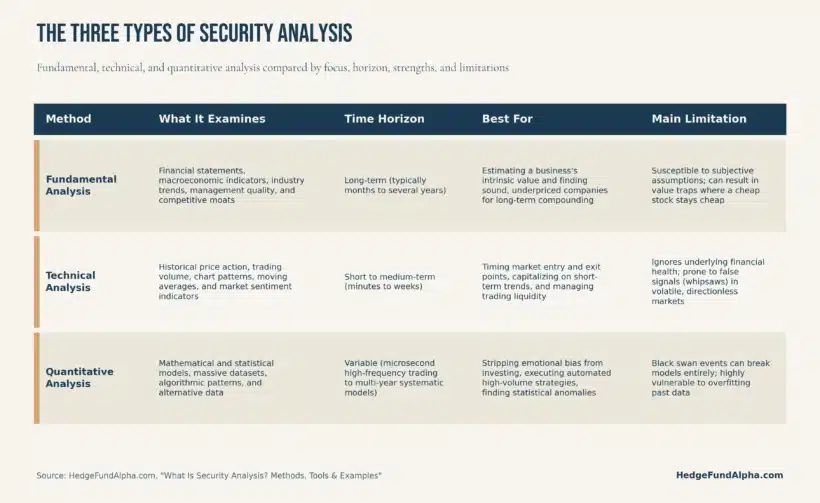
Types of Security Analysis: Fundamental vs. Technical vs. Quantitative
To execute security analysis effectively, modern practitioners generally deploy three distinct methodologies: fundamental, technical, and quantitative analysis. Fundamental analysis serves as an investigator of business reality. It, in detail, examines financial statements, corporate governance, and macroeconomic trends. The goal is to determine what an asset is truly worth.
Conversely, technical analysis bypasses the inner workings of the company entirely. It focuses instead on price charts, trading volume, and market psychology. It attempts to predict where the price is heading next based on historical patterns.
Bypassing human subjectivity altogether is quantitative analysis. It relies on advanced mathematics, computer algorithms, and massive datasets. Its purpose is to uncover statistical anomalies and execute automated trades.
Finally, the core difference lies in their guiding philosophies. Fundamental analysis asks why a business has value. Technical analysis asks when market sentiment will shift. Quantitative analysis asks how statistical probabilities can be mathematically exploited.
| Studies (What it examines) | Time Horizon | Best For | Main Limitation | |
|---|---|---|---|---|
| Fundamental Analysis | Financial statements, macroeconomic indicators, industry trends, management quality, and competitive advantages (moats). | Long-term (typically months to several years). | Determining a business’s “intrinsic value” and finding fundamentally sound, underpriced companies for long-term compounding. | Highly susceptible to subjective assumptions; can result in “value traps” where a cheap stock stays cheap indefinitely. |
| Technical Analysis | Historical price action, trading volume, chart patterns, moving averages, and market sentiment indicators. | Short to Medium-term (ranges from minutes to weeks). | Timing market entry and exit points, capitalizing on short-term trends, and managing trading liquidity. | Ignores the underlying financial health of the business; prone to false signals (“whipsaws”) during highly volatile or directionless markets. |
| Quantitative Analysis | Mathematical and statistical models, massive historical datasets, algorithmic patterns, and alternative data (e.g., credit card tracking, web scraping). | Variable (from microsecond high-frequency trading to multi-year systematic risk models). | Stripping emotional bias from investing, executing high-volume automated strategies, and identifying microscopic statistical anomalies. | “Black swan” events can cause models to break entirely; highly vulnerable to “overfitting” (building a model that works perfectly on past data but fails in the real world). |
Types of Securities
The primary goal of security analysis is always to identify the gap between market price and actual value. However, the methodology changes completely depending on the asset class being evaluated.
Stocks
Analyzing a stock is fundamentally an exercise in business valuation. Analysts typically use either a top-down or a bottom-up approach. A top-down approach begins with the broader economy, then examines the industry, and finally evaluates the company. A bottom-up approach focuses primarily on the company’s individual strengths and weaknesses.
The analysis starts with a review of the company’s three core financial statements. These include the income statement, balance sheet, and cash flow statement. Analysts usually examine several years of data to identify trends in revenue growth, profit margins, cash generation, and debt levels.
Financial data alone is not enough. Analysts also conduct a qualitative assessment of the business. They evaluate factors such as competitive advantages, brand strength, market position, and the management team’s track record.
The final step involves forecasting the company’s future earnings and free cash flows. Analysts then enter these projections into valuation models. Common methods include the Discounted Cash Flow (DCF) model and Comparable Company Analysis. These tools help estimate the stock’s intrinsic value and determine whether it is fairly priced by the market.
Bonds
Unlike equity analysis, bond analysis focuses entirely on safety, predictability, and capital preservation rather than growth. The process centers on whether the borrower can fulfill its legal obligation to repay the debt. Analysts evaluate an issuer’s creditworthiness by examining leverage and interest coverage ratios on the balance sheet. They use these metrics to determine whether corporate profits can comfortably cover annual interest payments.
Because bond prices move in the opposite direction of interest rates, the process also requires a macroeconomic evaluation of central bank policies and inflation trends. The analyst calculates the bond’s Yield to Maturity (YTM). They also review contract terms, including whether the issuer has the right to repay the bond before maturity through a call provision.
Funds and ETFs
Mutual funds and ETFs are baskets of assets rather than individual businesses. As a result, the analysis focuses on the fund’s structure, costs, and efficiency instead of corporate operations. Analysts first review the fund’s expense ratio, as high management fees can severely drag down performance over time.
For passive index funds, the analyst measures the tracking error to ensure the fund accurately mirrors its target index. For active funds, analysts use statistical metrics such as the Sharpe Ratio to evaluate risk-adjusted returns. These measures help determine whether a fund manager’s historical outperformance reflects genuine skill or simply results from taking on excessive market volatility.
Derivatives
Derivative analysis is highly mathematical and depends entirely on the behavior and volatility of the underlying asset the contract is tied to. The process begins with a preliminary analysis of that underlying asset to determine its price trend.
The analyst then measures implied volatility, which reflects the market’s expectations for future price movements. This metric directly influences how expensive the options contract will be. Finally, analysts use quantitative pricing models, such as the Black-Scholes model, to estimate the theoretical fair value of the contract. This valuation is based on current asset prices, interest rates, and the time remaining until the contract expires.
Hybrids
Because hybrid securities sit directly between equities and fixed-income assets, they require a dual-track evaluation process. The analyst begins with a debt-style safety check by examining the company’s cash flows. This helps determine whether it can reliably afford the fixed preferred dividend or convertible bond interest payments.
Next, for convertible securities, the analyst calculates the conversion parity to determine the exact point at which it becomes profitable to swap the debt for regular common stock. The final step involves evaluating the optionality of the security. This determines whether the combination of income protection and equity upside justifies paying a premium over a standard stock or bond.
Risks in Security Analysis
Even the most thorough security analysis cannot eliminate risk. The primary goal of an analyst is not to completely avoid risk, but to accurately identify, measure, and price it. When evaluating any asset, analysts must constantly account for three major types of financial risk.
Market risk refers to the possibility that an investment will lose value due to broad economic shifts that affect the entire market. These shifts impact all securities, not just a single company. Factors such as rising interest rates, inflation, political instability, or recessions can drag down even fundamentally strong stocks. An analyst may correctly identify a high-quality business, but a broader market downturn can still reduce its price.
Credit risk is primarily relevant when analyzing bonds and other fixed-income securities. It is the risk that a borrower, whether a company or government, will fail to make required interest payments or will default on principal. Security analysts assess this risk by examining debt-to-equity ratios, cash flow strength, and credit ratings assigned by agencies such as Moody’s or S&P. The objective is to ensure investors are adequately compensated for lending risk.
Liquidity risk refers to the danger that an investor cannot buy or sell a security quickly without significantly affecting its price. Highly liquid assets, such as large-cap stocks on major exchanges, can usually be traded instantly at market value. In contrast, smaller micro-cap stocks or thinly traded corporate bonds may have low trading volumes. In stressed markets, investors trying to exit positions quickly may be forced to accept steep discounts.
The analyst’s mandate is to incorporate these risks directly into valuation models. Higher levels of market, credit, or liquidity risk require a higher expected return. They also require a wider margin of safety before an investment can be justified.
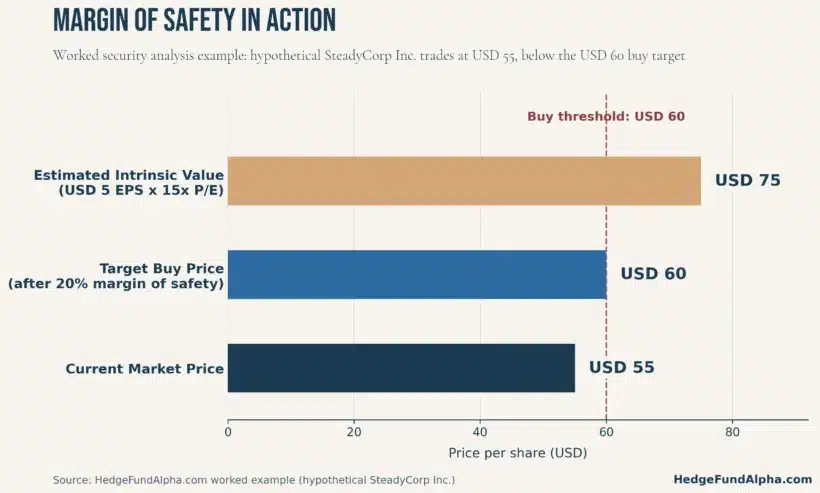
A Worked Example
To understand how an analyst combines these concepts, consider a practical equity valuation using the price-to-earnings (P/E) multiple approach. Assume the company being analyzed is a hypothetical consumer goods business called SteadyCorp Inc.
The analysis begins with a review of the company’s audited financial statements. This step helps establish a baseline measure of profitability. The review shows that SteadyCorp generated earnings per share (EPS) of $5 during the last twelve months.
The analyst must then determine a fair price for those earnings. To do so, they examine the historical trading patterns of both SteadyCorp and its closest industry peers. Based on this comparison, the analyst concludes that a P/E multiple of 15x is an appropriate benchmark for a stable business of this type.
The final step is to multiply the company’s earnings by the justified valuation multiple. Using an EPS of $5 and a P/E ratio of 15x produces an estimated intrinsic value of $75 per share. This figure represents the company’s underlying economic worth. It is independent of the stock’s day-to-day market fluctuations.
However, because financial projections can be altered by unforeseen economic shifts or calculation errors, the analyst channels Benjamin Graham’s philosophy and applies a strict 20% margin of safety. This discount acts as a built-in cushion, lowering the maximum target buy price to $60.
The final step is comparing this risk-adjusted target against the current market reality. Checking the live ticker, the analyst sees that Mr. Market is currently offering the stock at $55.
The Analyst’s Decision: Because the market price of $55 sits below the calculated target buy price of $60, the stock possesses an adequate margin of safety. The analyst would officially classify the security as undervalued and issue a “Buy” recommendation, expecting the market price to eventually rise toward its true intrinsic value of $75.
Where Security Analysis Is Used Today
Today, security analysis serves as the foundation of global investment markets. It connects traditional business evaluation with modern data analysis.
For anyone entering the professional investment field, security analysis is a central component of the Chartered Financial Analyst (CFA) curriculum. Across all three exam levels, candidates must master financial statement analysis, equity valuation, and fixed-income analysis. These areas make up a large portion of what they are tested on. In response to industry change, the CFA program now also includes training in Python, data visualization, and artificial intelligence.
In the day-to-day workforce, this discipline is practiced along two distinct paths.
The sell-side consists of analysts at investment banks. They study company fundamentals and publish research reports. They also issue “buy/sell/hold” ratings and build valuation models for institutional clients.
The buy-side includes analysts and portfolio managers at hedge funds, wealth management firms, and pension funds. They review sell-side research and conduct their own internal security analysis. Their goal is to invest capital and generate market-beating returns.
The modern security analyst’s toolkit has evolved far beyond basic spreadsheets. Today’s professionals routinely use quantitative and AI-driven tools. Through institutional terminals like FactSet and S&P Capital IQ Pro, analysts can apply natural language processing (NLP) to scan and score the tone of hundreds of earnings call transcripts at once.
They also use automated software to run valuation comparisons and analyze alternative data. This includes tracking credit card spending trends or analyzing satellite imagery of retail parking lots. These tools help analysts detect changes in a company’s financial health weeks before official public reporting.
Key Takeaways
Security analysis is the disciplined practice of evaluating financial instruments to measure the gap between their current market price and their true economic worth. The discipline was pioneered by Benjamin Graham and David Dodd. It was later popularized by Warren Buffett. This philosophy treats a stock as fractional ownership in a real business rather than as a speculative trading ticker.
At the center of this approach are three basic concepts. The first is calculating a company’s intrinsic value using fundamental data. The second is demanding a strict margin of safety to absorb human error or unexpected setbacks. The third is viewing daily price fluctuations as the erratic behavior of Mr. Market. Graham described Mr. Market as an emotional business partner whose moods should be exploited rather than followed.
Putting this strategy into action requires a straightforward comparison between value and price. It also requires adjusting for risk. As shown in our example, a stable company that generates $5.00 in earnings per share and deserves a 15x P/E multiple has an intrinsic value of $75.00 per share.
The analyst then applies a 20% margin of safety. This reduces the maximum target purchase price to $60 per share. If Mr. Market offers the stock at $55, the analysis identifies a potential buying opportunity. The stock trades below its estimated intrinsic value and provides an additional cushion against risk.
Frequently Asked Questions
What is security analysis in simple terms?
It is the process of studying financial assets, like stocks or bonds, to figure out what they are actually worth. This helps investors decide if the current market price is a good deal or if the asset is overpriced.
What are the three types of security analysis?
The three main types are fundamental analysis (studying business health and financial statements), technical analysis (tracking historical price charts and market trends), and quantitative analysis (using mathematical models, computer algorithms, and massive datasets).
Who wrote the book Security Analysis?
The 1934 textbook was written by Benjamin Graham and David Dodd, both professors at Columbia University. They are widely considered the pioneers of value investing and were mentors to Warren Buffett.
What are the objectives of security analysis?
The primary goals are to calculate an asset’s true intrinsic value, identify whether a security is underpriced or overpriced by the market, project future earnings, and protect capital by ensuring there is a clear margin of safety before buying.
Is security analysis the same as fundamental analysis?
Not exactly, but they are closely related. Security analysis is the big-picture goal of figuring out what an investment is worth. Fundamental analysis is the main method used to do that by looking at a company’s financial health and business performance.
Is the Security Analysis book still relevant?
Yes, it is still viewed as the “bible” of value investing. While the specific 1934 corporate examples are outdated and the modern economy relies heavily on tech and digital data, the core principles: buying with a margin of safety and treating a stock as real business ownership, remain entirely timeless.
What is the difference between security analysis and portfolio management?
Security analysis is about evaluating and picking individual investments, like deciding whether to buy a specific stock or bond. Portfolio management is about combining all those different investments into a balanced group to manage overall risk and reach a long-term financial goal.