


Few presentations at the 2026 Global Alts New York conference carried as much warnings as the one from Jim Chanos, President and Founder of Chanos & Company L.P. Chanos built his reputation over four decades shorting overvalued and fraudulent businesses, most famously calling Enron before its collapse, and sat down with Bloomberg News reporter Natalia Kniazhevich on day two of the conference for a wide-ranging conversation. His message was that investors pay premiums for promises, and right now the market is paying historically extraordinary premiums for some very speculative ones.
SpaceX: A Hopes and Dreams IPO
The conversation opened with one of the biggest IPOs in history. SpaceX was set to go public that Friday, with Bloomberg reporting the deal four times oversubscribed. Chanos was unsparing.
A $75 billion IPO at a valuation of close to $2 trillion for a company with revenues of $19 billion and negative free cash flow, he said, is a hopes and dreams IPO. The company is not worth $1.75 trillion under any reasonable set of assumptions over the next five years. The TAM for space may be infinite, he noted wryly, which is exactly why you can construct whatever narrative you want, colonies on Mars, factories on the moon, data centers in orbit, to justify the number. But justifying a valuation and earning it are different things. Chanos borrowed a line from the conference’s walk-on video to sum up the setup: “Bull markets you put a premium on promises, and in bear markets you put a discount on reality. And right now we’re clearly in the former, not the latter.”
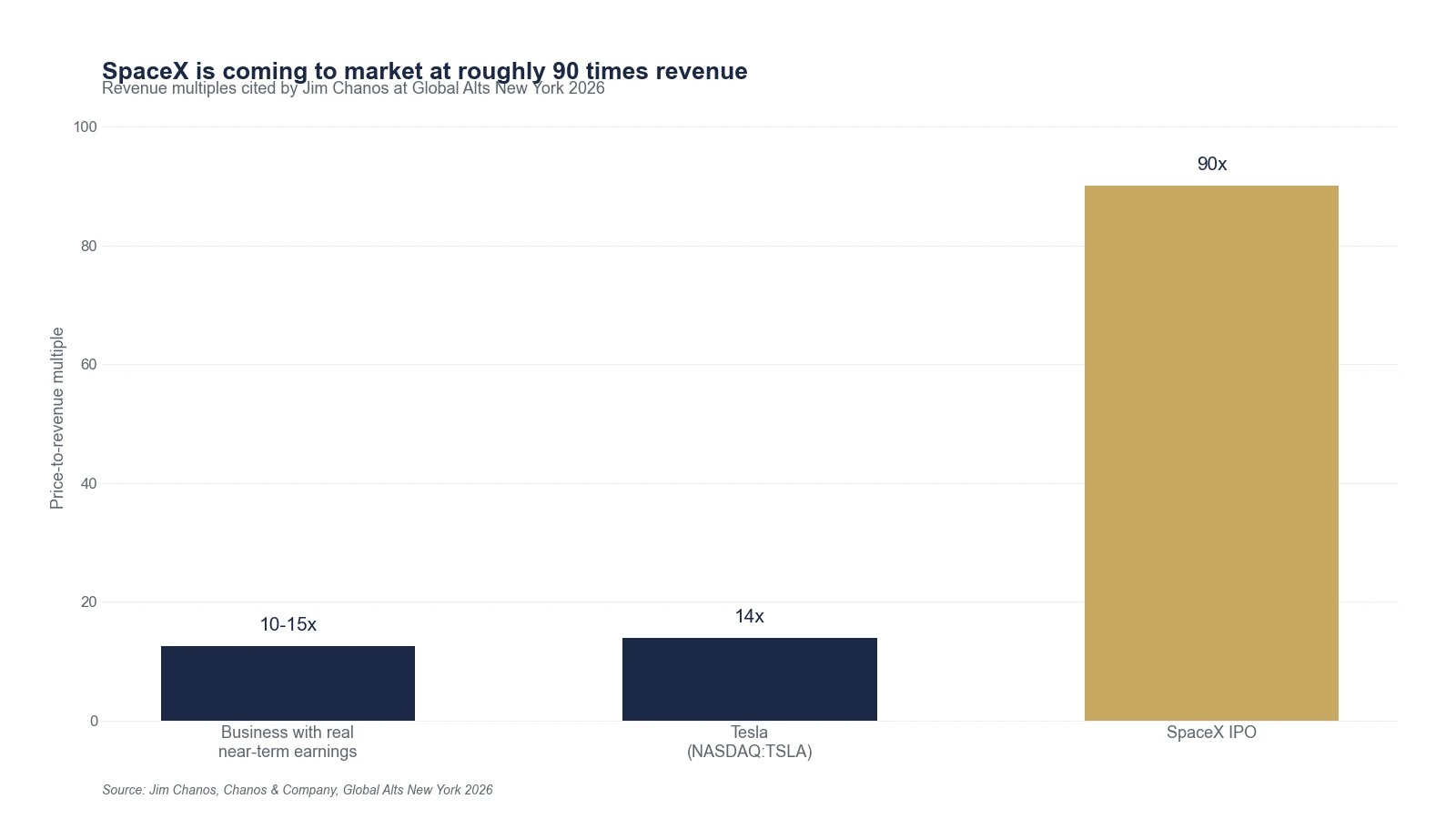
Chanos drew a comparison to Tesla Inc (NASDAQ:TSLA), which he described as a template for how CEO premium gets priced into a stock. Tesla, he argued, trades at roughly 14 times revenue based on promises about robotics and full self-driving that have not yet materialized. Without those promises it would trade as an automobile manufacturer, putting it around $30 to $40 per share rather than above $400. SpaceX is coming to market at roughly 90 times revenues, a completely different animal than the 10 to 15 times at which a business with real near-term earnings would trade.
On whether he would short SpaceX, Chanos said he would need to see where it traded first.He noted that Starlink, the mobile satellite internet business and the company’s core profitable segment, had seen slowing growth in the prior quarter, meaning even the defensible piece of the business is not accelerating. Getting to a couple hundred billion in value on the businesses that actually exist today is possible, he said. Whether the remaining $1.5 trillion in the asking price reflects fair compensation for future optionality is where his skepticism sits.