

AI Bottlenecks, Traditional Recoveries, and the Capacity Response Ahead
Record industry sales are hiding radically different cycle positions across leading edge logic, memory, packaging, analog, automotive, and mature node semiconductors.
Key Takeaways
- WSTS now projects global semiconductor sales of approximately $1.51 trillion in 2026, up 90% from 2025. The expansion is highly concentrated: memory is forecast to grow about 250%, compared with 10% for analog and 3% for sensors and optoelectronics.
- AI has not killed semiconductor cyclicality. It has desynchronized the industry. Leading edge logic, HBM, advanced packaging, networking, and test are in a capacity constrained expansion while traditional markets sit in different stages of recovery and normalization.
- The same scarcity producing exceptional economics is also producing a broad capital spending response. SEMI expects semiconductor equipment sales to increase 23.2% to $165.9 billion in 2026.
- For active fund managers, the job is no longer to decide whether semiconductors are early cycle or late cycle. It is to identify each company’s actual subcycle, the duration and margins embedded in valuation, and the indicators that would signal a transition to the next phase.
Investment Thesis
Semiconductor demand can change in a matter of months, while new fabrication, memory, packaging, and test capacity can take years to plan, build, equip, and qualify. Inventory also sits across manufacturers, distributors, contract manufacturers, and end customers, which makes true consumption difficult to see. Shortages encourage strategic ordering. Scarcity supports pricing. High returns attract investment. Eventually, the capacity created by that investment pressures utilization, pricing, and margins.
Artificial intelligence has not repealed those economics. It has, however, changed their timing and composition.
Leading edge logic, high bandwidth memory, advanced packaging, high speed networking, and semiconductor test are in an AI driven, capacity constrained expansion. Industrial analog is emerging from a long inventory correction. Automotive and mature node demand remain uneven. PCs and smartphones are normalizing rather than experiencing anything close to the current growth in accelerated computing.
The result is an industry that can contain shortages, recoveries, normalizations, and future overcapacity risk at the same time. There is no longer one synchronized semiconductor cycle. The dispersion inside the industry is the cycle.
My central conclusion is that AI is extending the current semiconductor expansion while also producing the investment response that can eventually correct it. The AI exception changes the timing and composition of the cycle. It does not remove the cycle.
Cyclical Economics, Unequal Moats
At the industry level, the basic economics are still capital cycle economics. Fixed investment is enormous. The cost of producing one more wafer is often far below the cost of leaving expensive equipment idle, and unused production time can never be recovered. When demand weakens, suppliers may defend utilization through price, mix, or volume decisions. A modest demand correction can therefore become a much larger earnings decline.
Supply also responds far more slowly than demand. Customers can cut orders within weeks, but a fabrication plant, process transition, HBM ramp, or advanced packaging expansion can take years. By the time capacity approved during a shortage comes online, the shortage that justified it may already be easing.
Inventory makes the cycle even harder to read. Chips can build throughout the supply chain, and customers facing allocation may order more than they need because they expect suppliers to fill only part of the request. Reported demand can therefore exceed true consumption at the exact point when confidence is highest.
I am of the camp that looks at semiconductors as commodities, but at the same time, recognizes that not every semiconductor should be treated this way. The amount of differentiation varies materially across the value chain:
- DRAM and NAND are closest to conventional commodities because supply, inventory, and pricing dominate near term earnings.
- Leading edge foundry capacity is differentiated by process technology, yield, reliability, packaging capability, and customer trust. It is still exposed to utilization and customer investment cycles.
- Fabless designers can have substantial moats in architecture, software, and customer relationships while still depending on the capital allocation decisions of their customers.
- Equipment suppliers can operate as differentiated oligopolies while still selling into a cyclical capital spending system.
A moat can improve the economics of a cycle, extend its duration, and preserve returns through a downturn. It cannot, however, abolish the cycle.
One Industry, Several Cycle Positions
The way I see it, the industry now has two broad systems. The first is the AI infrastructure cycle: leading edge logic, HBM, advanced packaging, high speed networking, optical connectivity, power delivery, and increasingly complex test. The second is the traditional semiconductor cycle: much of analog, automotive, industrial, mature node, PC, and smartphone demand. These systems are connected, but they are not synchronized.
| Subsector | Current phase | Primary driver | Leading indicators |
|---|---|---|---|
| HBM and advanced DRAM | Shortage and expansion | AI accelerators and memory intensity | Contract pricing, capacity, yields, wafer trade ratio |
| Leading edge logic | Strong expansion | AI, high performance computing, and custom silicon | Utilization, hyperscaler capital spending, advanced node mix |
| Advanced packaging and test | Capacity expansion | System complexity and bottlenecks | Lead times, equipment orders, test intensity |
| Industrial analog | Early recovery | Inventory normalization | Bookings, distributor inventory, factory utilization |
| Automotive | Uneven recovery | Vehicle production and semiconductor content | Customer inventories, regional auto demand |
| Mature nodes | Mixed | Industrial, automotive, consumer, and policy capacity | Utilization, pricing, Chinese supply additions |
| PC and smartphone | Normalization | Replacement demand and on device AI | Unit shipments and channel inventory |
The Aggregate Numbers Are Extraordinary, but Misleading Without Context
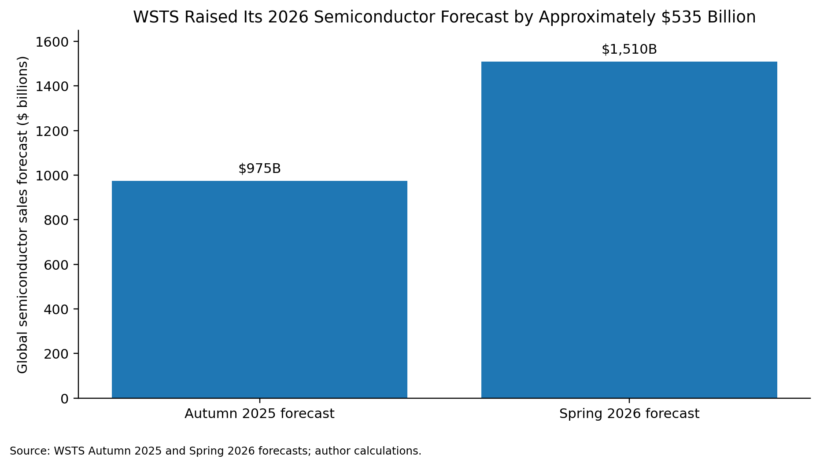
WSTS reported that global semiconductor sales reached $795.6 billion in 2025, an increase of 26.2%. Its Autumn 2025 forecast expected the market to approach $975 billion in 2026. The Spring 2026 forecast raised that estimate to $1.51 trillion, a revision of roughly $535 billion, or 55%, in approximately six months. The new forecast represents approximately 90% growth from 2025. This is not a small adjustment. It is a completely different industry outlook from the one investors had only six months earlier.
Figure 1. The 2026 industry forecast changed dramatically within six months
The monthly data tells the same story. SIA reported that May 2026 semiconductor sales reached a record $120.6 billion on the WSTS three month moving average basis, up 104.1% year over year and marking the fifteenth consecutive month of sequential growth.
The important point is not only how large the forecast has become. It is where the growth is coming from. WSTS expects memory to increase approximately 250% in 2026 to more than $800 billion, while logic is projected to grow 37%. Microprocessors are expected to grow 20%, analog 10%, discrete semiconductors 8%, and sensors and optoelectronics only 3%.
Figure 2. The headline expansion is not broadly distributed across the industry
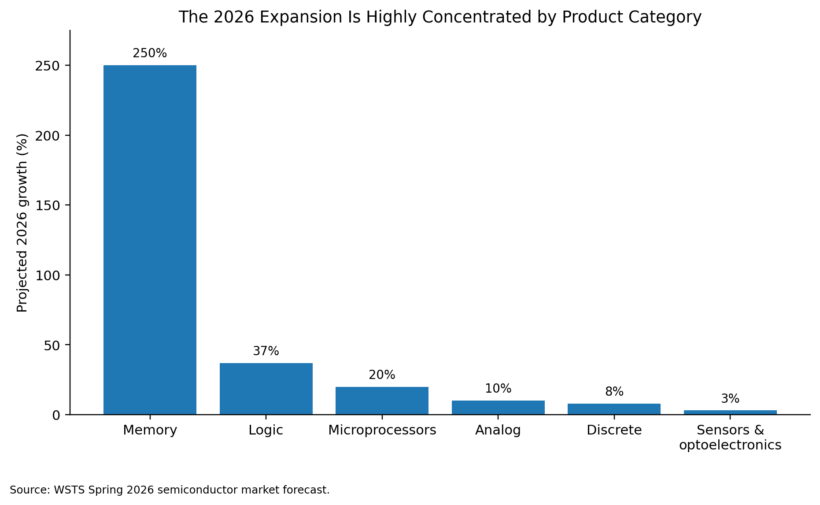
An industry growing 90% while its product categories range from approximately 3% to 250% is not experiencing one uniform cycle. To me, that is the clearest evidence for the thesis. The dispersion is not a footnote to the cycle, but rather is the cycle.
Dollar Growth Is Not Unit Growth
WSTS reports sales in dollars, not physical chip units. That matters because aggregate revenue can rise through higher unit volumes, higher memory pricing, greater semiconductor content per system, a shift toward expensive AI accelerators, rapid HBM growth, more leading edge wafers, more advanced packaging content, and changes in regional mix.
An AI accelerator that combines leading edge logic, multiple HBM stacks, high speed interconnects, and advanced packaging contributes far more industry revenue than a conventional analog or mature node device. The industry can therefore report extraordinary dollar growth without comparable unit growth across every end market.
The question is not simply how fast semiconductor revenue is growing. The question is how much of that growth reflects sustainable workload and unit demand, and how much reflects pricing, product mix, and temporary scarcity. The aggregate number alone cannot answer that.
Company Results Reveal the Split More Clearly Than the Index
TSMC: Leading Edge Scarcity and Exceptional Economics
TSMC reported second quarter 2026 revenue of $40.2 billion, a gross margin of 67.7%, and an operating margin of 60.3%. Revenue increased 33.7% year over year, and management guided third quarter revenue to a range of $44.6 billion to $45.8 billion. The company also expects full year 2026 revenue growth slightly above 40% in U.S. dollar terms.
The technology mix matters just as much. Nodes at 7 nanometers and below represented 77% of second quarter wafer revenue, including 30% from 3 nanometers, 33% from 5 nanometers, 11% from 7 nanometers, and 3% from 2 nanometers. Rapid growth, an advanced node mix, and unusually high margins are consistent with exceptional leading edge demand, favorable mix, and strong utilization.
Figure 3. Advanced technologies dominate the current TSMC revenue mix
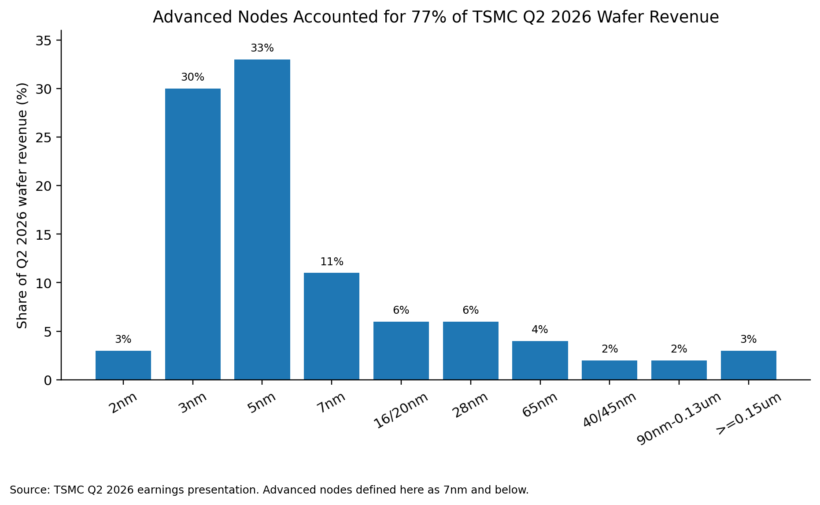
That does not mean all foundry capacity is equally strong. The relevant scarcity is concentrated in advanced nodes and the manufacturing ecosystem supporting accelerated computing. Mature node economics remain tied to automotive, industrial, consumer, and regional capacity cycles. Foundry demand is no longer a precise enough description. Investors have to distinguish among nodes, customers, end markets, yields, utilization, and packaging availability.
Texas Instruments: Several Cycles Inside One Company
To me, the first quarter results from Texas Instruments provide one of the clearest examples of the split. Data center revenue increased approximately 90% year over year, industrial grew more than 30%, communications equipment grew approximately 25%, automotive increased only in the mid single digits, and personal electronics was approximately flat.
Figure 4. End market growth rates inside Texas Instruments diverged sharply
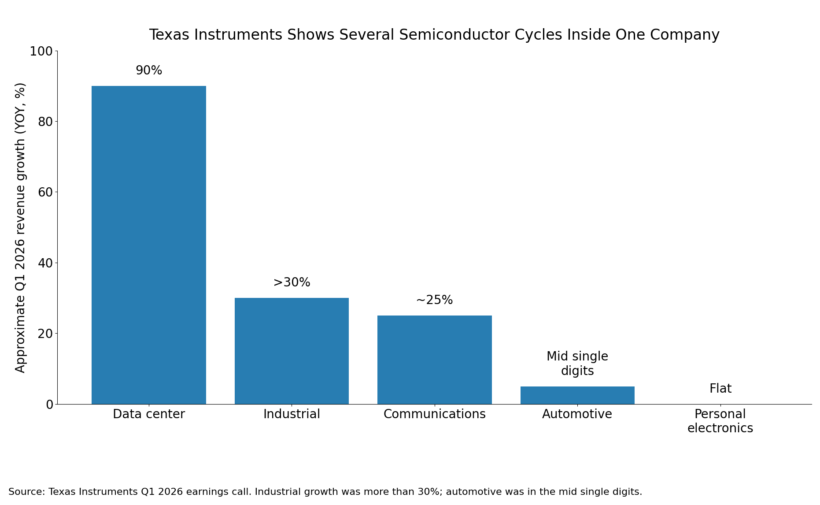
These are not just different conditions across separate semiconductor companies. They are materially different demand cycles operating inside the same diversified analog and embedded processing supplier. Company revenue can hide important differences between end markets just as aggregate industry revenue can hide differences between product categories.
onsemi: Ordinary Consolidated Growth, Extraordinary AI Growth
onsemi reported first quarter revenue of approximately $1.51 billion, up 5% year over year and down 1% sequentially. Within that relatively ordinary consolidated result, AI data center revenue grew more than 30% sequentially and more than doubled year over year. Management also described the broader company as having moved beyond its cyclical trough.
That contrast is the thesis in miniature. One company can hold an AI business in rapid expansion while its traditional automotive and industrial businesses remain in much earlier stages of recovery.
HBM Is Changing Memory Economics
High bandwidth memory is creating an unusual interaction between AI demand and conventional memory supply. Micron has described an approximate three to one wafer capacity trade ratio between HBM and DDR5, with that ratio increasing in future HBM generations. In simple terms, producing HBM consumes substantially more wafer capacity than producing conventional server memory.
The result is a reinforcing sequence:
- AI accelerator demand increases HBM requirements.
- HBM consumes disproportionate wafer and cleanroom capacity.
- Less capacity remains available for conventional DRAM.
- Tighter conventional supply supports pricing and profitability.
- Higher returns encourage investment in additional DRAM, HBM, and supporting capacity.
The near term effect is supportive of memory pricing. The longer term outcome depends on how quickly AI workloads, HBM yields, packaging availability, and total DRAM capacity evolve relative to one another.
Micron’s June 2026 commentary is an important counterweight to any claim that a conventional memory glut is imminent. The company expects industry supply to improve gradually in 2028, but it said it still does not have a clear view of when supply will fully catch demand.
HBM can remain both structurally valuable and supply constrained for years while still participating in a capital cycle. High returns attract capital even when physical constraints delay the response.
The Supply Response Is Already Underway
Semiconductor equipment spending is one of the clearest forward indicators of future capacity. SEMI expects total semiconductor manufacturing equipment sales to reach $165.9 billion in 2026, an increase of 23.2%. Wafer fabrication equipment is projected to grow 23.1% to $143.9 billion. Within that total, DRAM equipment is forecast to increase 39.0%, NAND equipment 30.7%, and foundry and logic equipment 18.9%. Test equipment sales are projected to grow 31.0%, while assembly and packaging equipment is expected to rise 9.6%.
Figure 5. AI demand is producing a broad capital spending response
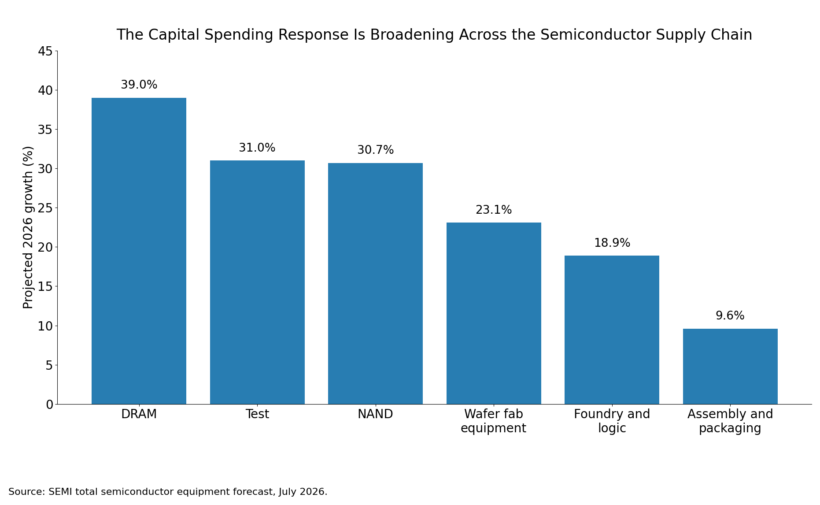
I do not think this means a downturn is imminent. Equipment can be installed gradually, advanced capacity may remain constrained, and demand may continue to exceed supply for longer than expected.
What it does show is that the capital cycle mechanism capable of producing the next correction is already operating. The important transition will occur when equipment spending, wafer capacity, HBM output, and advanced packaging availability begin growing faster than underlying AI workload demand. Semiconductor downturns are usually created by investment decisions made during the shortage, not by decisions made after the shortage is already over.
The Historical Pattern: Secular Growth and Cyclical Corrections Coexist
The current dispersion is unusual in scale, but separate semiconductor subcycles are not entirely new. Semiconductor history repeatedly shows that transformative end markets can create genuine secular demand while inventory, capital spending, and expectations still move ahead of near term consumption.
| Period | Primary expansion | Correction mechanism | Relevance today |
|---|---|---|---|
| 1990s | PCs, memory, and communications | Capacity and inventory periodically exceeded demand | Secular adoption did not prevent pricing and utilization cycles |
| 2000 through 2001 | Internet and telecommunications infrastructure | Customer spending and inventory expectations reversed | Transformative technology can still be overbuilt |
| 2017 through 2019 | Server, smartphone, and memory demand | Pricing, inventory, and capacity corrected | Rational supply can extend a cycle but cannot eliminate it |
| 2020 through 2022 | PCs, consumer electronics, and later automotive shortages | Demand reallocation, strategic ordering, and excess inventory | Shortages and gluts can coexist inside one industry |
| 2023 through 2026 | AI accelerators, HBM, advanced packaging, and networking | Still developing; the capital response is accelerating | Current growth is more concentrated and more capital intensive |
The point is not that every major technology buildout must collapse. The point is that long run usefulness does not guarantee that every unit of near term capacity earns an acceptable return. The internet was transformative. So were smartphones and cloud computing. Each still produced periods when inventory, capital structures, or capacity moved ahead of demand.
The Counterargument
AI demand may grow quickly enough to absorb every unit of capacity the industry can build. Training requirements remain substantial, inference demand is expanding, lower inference costs may create additional usage, and sovereign, enterprise, and consumer adoption could extend infrastructure demand for years. AI systems are also becoming more memory intensive, which broadens demand beyond any single accelerator architecture.
The latest WSTS, TSMC, Micron, and equipment data also suggest that the industry is not currently close to a generalized demand collapse.
Still, secular demand growth and industry cyclicality are not mutually exclusive. The semiconductor cycle does not require AI adoption to fail. It only requires expectations, inventory, or capacity to grow temporarily faster than profitable consumption. Suppliers and customers have to forecast demand years in advance, and those forecasts will never be perfectly coordinated. Capital will be committed at different points, capacity will arrive unevenly, technology will improve, and customer returns will vary.
The central risk is not that AI disappears, but rather that capacity growth eventually exceeds profitable demand at the prices and margins currently embedded in expectations.
Just To Be Clear
I am not calling an imminent semiconductor peak, a broad short of the industry, or the end of competitive advantages. I am also not arguing that high capital spending automatically creates excess capacity or that every semiconductor category will eventually correct at the same time.
What I am arguing is:
- The aggregate semiconductor growth rate overstates the breadth of the current expansion.
- Different semiconductor categories are exposed to materially different inventory, pricing, and capital cycles.
- The investment response to AI scarcity is already visible and will eventually alter the balance between supply and demand.
- Valuation has to be compared with each company’s normalized earnings and specific cycle position, not with the industry headline alone.
- Secular AI adoption and cyclical overinvestment can coexist.
What Would Strengthen or Weaken the Thesis
The thesis would strengthen if several indicators began to cluster. Advanced packaging lead times decline materially, HBM contract pricing weakens despite continued accelerator growth, manufacturer or customer inventories rise faster than end demand, equipment orders peak before newly announced capacity is completed, hyperscaler capital spending growth slows (which to me is a very likely possibility we could see soon), or semiconductor shares weaken despite continued upward earnings revisions.
The thesis would weaken if AI infrastructure revenue and economic returns consistently grow as fast as capital spending, new HBM and packaging capacity is absorbed without deterioration in utilization or pricing, conventional DRAM remains structurally constrained despite years of investment, and workload growth consistently exceeds efficiency improvements.
The most important signals will likely turn before aggregate semiconductor sales decline. In the meantime, I’ll be watching the following:
- Demand: Hyperscaler capital expenditures, AI related revenue, accelerator deployments, cloud backlog, inference consumption, and customer concentration.
- Supply: Advanced node utilization, HBM capacity, packaging lead times, equipment orders, test capacity, and announced fabrication expansions.
- Pricing: HBM contracts, conventional DRAM pricing, wafer pricing, accelerator rental rates, and inference costs.
- Inventory: Manufacturer inventory, distributor inventory, customer days of inventory, cancellations, and strategic reservations.
- Returns: Incremental revenue per dollar of capital spending, depreciation growth, gross margins, free cash flow, and return on invested capital.
- Market expectations: Earnings revisions, valuation dispersion, and whether stock prices weaken despite apparently strong reported fundamentals.
Investment Implications
The practical implication to me is fairly simple. I think investors should stop treating semiconductors as one trade, and security selection should begin with four questions.
1. Where is scarcity producing extraordinary economics?
Leading edge foundry, HBM, advanced packaging, networking, test, and process control are benefiting from genuine bottlenecks and increasing technical complexity. Companies exposed to these areas may continue producing exceptional results as long as supply remains constrained and customer returns justify further spending.
2. Where is the market extrapolating scarcity indefinitely?
Investors should identify the utilization, pricing, and margin assumptions embedded in consensus estimates and valuation. A high quality business can still be a poor investment if the market assumes shortage economics will persist long after capacity normalizes.
3. Where are fundamentals recovering from a trough?
Industrial analog, selected automotive categories (This is mainly where I’m looking), mature node utilization, and portions of consumer demand may offer a different opportunity: normalized earnings recovery rather than direct exposure to the AI infrastructure boom. The attractive security may be the company whose current earnings understate normalized cash generation, even if its reported growth is slower than the AI leaders.
4. Where is current investment creating future risk?
Memory equipment, leading edge logic equipment, packaging, test, and government supported mature node capacity all benefit from the present investment wave. Their future risk emerges when today’s orders become capacity that grows faster than demand. Equipment suppliers often remain fundamentally strong until customers begin reducing future budgets, which makes bookings and order rates more useful than trailing revenue alone.
The most attractive opportunity will not necessarily be the company reporting the fastest current growth. It may be the company whose position in its specific subcycle, normalized earnings, and valuation are most widely misunderstood.
Conclusion
The semiconductor cycle has not disappeared, and it won’t, but it has fragmented.
AI has concentrated extraordinary demand in leading edge logic, HBM, advanced packaging, networking, and test, while industrial analog, automotive, consumer, and mature node markets occupy different stages of inventory normalization and end demand recovery. The industry can therefore report record aggregate sales while its underlying categories experience shortages, recoveries, and ordinary replacement cycles at the same time.
The same investment extending the AI expansion is also creating its eventual supply response. That does not mean a correction is imminent, and it does not require AI adoption to fail. It means expectations, capacity, and capital spending can eventually grow faster than profitable demand even during a transformational technology expansion.
For active managers, the relevant question is no longer whether semiconductors as a whole are early cycle or late cycle. The task is to identify each company’s actual cycle exposure, determine what duration and margins are already embedded in valuation, and recognize when improving reported fundamentals begin to hide a deteriorating forward balance between demand and supply.
AI is an exception to the timing and composition of the semiconductor cycle. It is not an exemption from cyclicality.
Primary Sources
- World Semiconductor Trade Statistics, Spring 2026 forecast, Global Semiconductor Market Surges Beyond $1.5 Trillion in 2026.
- World Semiconductor Trade Statistics, Autumn 2025 forecast, Global Semiconductor Market Approaches $1 Trillion in 2026.
- World Semiconductor Trade Statistics, 2025 results, Global Semiconductor Market Grows 26% in 2025 to $796 Billion.
- Semiconductor Industry Association, May 2026 global semiconductor sales report, July 6, 2026.
- TSMC, Second Quarter 2026 Results and Earnings Presentation, July 16, 2026.
- Texas Instruments, First Quarter 2026 Earnings Call, April 22, 2026.
- onsemi, First Quarter 2026 Results, May 4, 2026.
- Micron Technology, Fiscal First Quarter 2026 and Fiscal Third Quarter 2026 Earnings Call Prepared Remarks.
- SEMI, July 2026 total semiconductor equipment forecast, July 14, 2026.
- Semiconductor Industry Association, 2024 Factbook and 2025 State of the U.S. Semiconductor Industry.