


A reference for institutional buyers evaluating Hedge Fund Alpha’s structured dataset of hedge fund investor letters and investment conference coverage: what it covers, how it is organized, and how to license it.
Hedge Fund Alpha maintains a structured dataset built from more than a decade of investor letters and investment conference coverage. This page is a standing reference for that structured hedge fund data: what it contains, how it is organized, and how institutional buyers evaluate and license it. Detailed schema, sample records, and methodology are shared with prospective buyers under a mutual non-disclosure agreement.
Coverage
The dataset draws on two bodies of source material, both catalogued since 2011 and both numbering in the thousands of items. The first is hedge fund investor letters. The second is investment conference data: position-level coverage of presentations delivered at investment conferences. Together they reach across a range of strategies and geographies, and the discretionary managers behind them, from 2011 through the present.
Point-in-time by construction
Each item carries the publication timestamp from the date it was originally covered. That makes the dataset a set of point-in-time records: it reflects what a manager wrote or said at the moment they wrote or said it, not a present-day reconstruction assembled with hindsight. For a buyer studying how a view formed, or when information became available, that provenance is the dataset’s defining property rather than an afterthought.
What each record captures
At a high level, each record brings together several categories of information drawn from the source material:
- Manager commentary, what managers state in their own words.
- Positioning, the companies and themes managers discuss.
- Performance context, how managers frame results and expectations.
- Conviction signals, the strength and direction of the views expressed.
This page describes the kinds of information captured, not the underlying field structure. The detailed schema is part of what is shared under non-disclosure agreement.
One structure across both formats
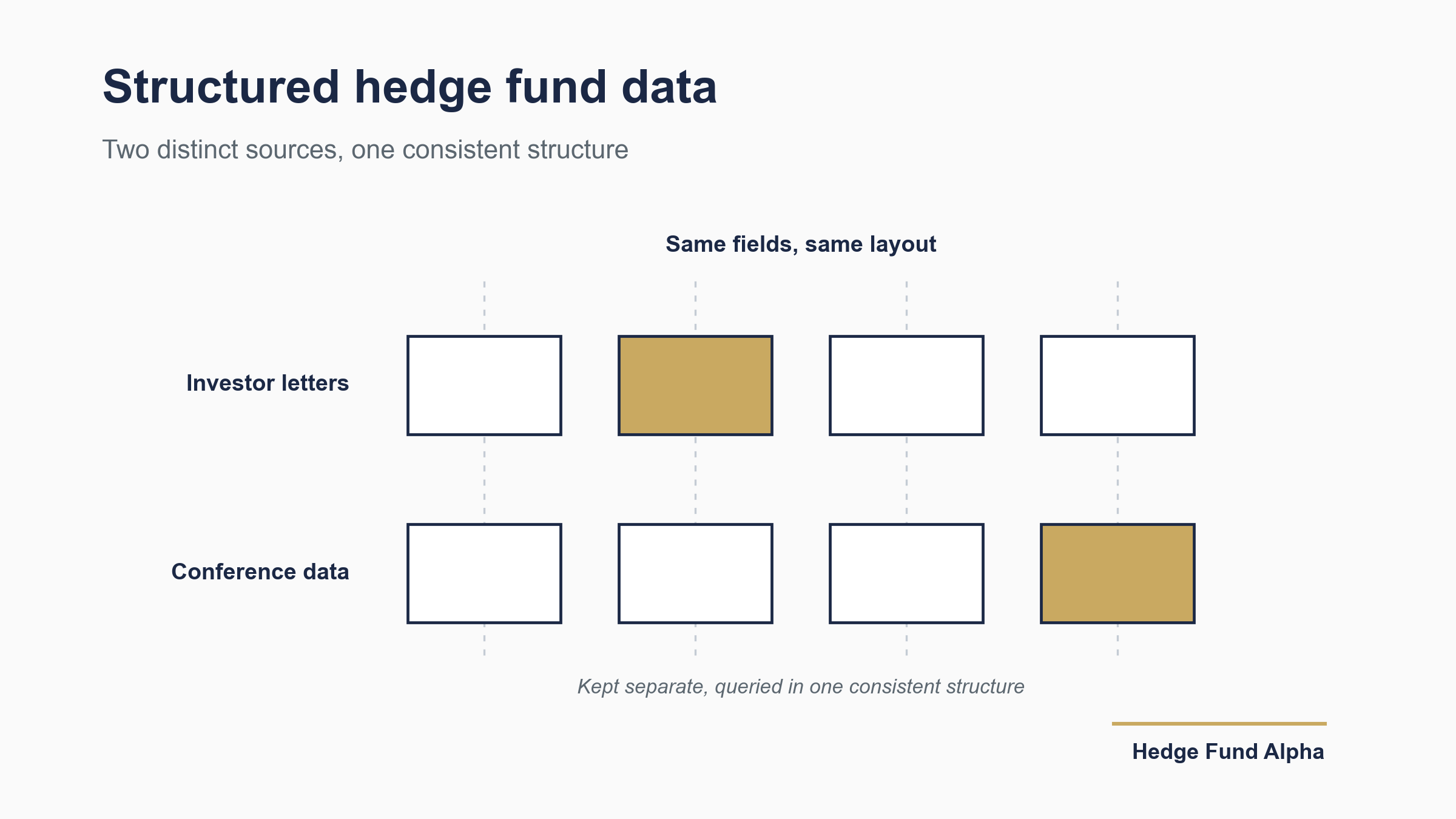
Investor letters and conference coverage are delivered in a single consistent structure. A buyer works across both without reconciling two layouts, and can assemble one view of how a manager’s positioning develops over time, whether the manager expressed it in a written letter or from a conference stage.
Rights and provenance
The source material reflects a range of acquisition paths, from fully public documents to material that calls for more careful handling. Rather than apply a single policy to the whole corpus, every record is classified against a rights framework that has been reviewed by counsel, and the classification sits at the record level. Buyers filter the dataset to match their own compliance posture: a firm whose counsel takes a conservative view works with a narrower subset, while a firm with broader latitude can use more. The rights position travels with each record.
How buyers use it
The dataset is built for institutional use. It suits quantitative and systematic teams that work the full corpus programmatically as readily as research teams that follow particular managers or themes. Common uses include tracking manager conviction and positioning over time and across groups of funds, following how commentary on specific companies and themes develops in managers’ own words, and testing signals derived from that commentary against a consistent historical record.
Licensing and evaluation
Prospective buyers evaluate the data before committing. Sample records, coverage statistics, the rights framework, and technical documentation are provided under a mutual non-disclosure agreement. Diligence materials are prepared to institutional standard, including a trial license, a mutual non-disclosure agreement, a due diligence questionnaire response prepared against industry-standard templates, and a data tear sheet. Firms interested in evaluating or licensing the dataset can contact Hedge Fund Alpha at [email protected].
