

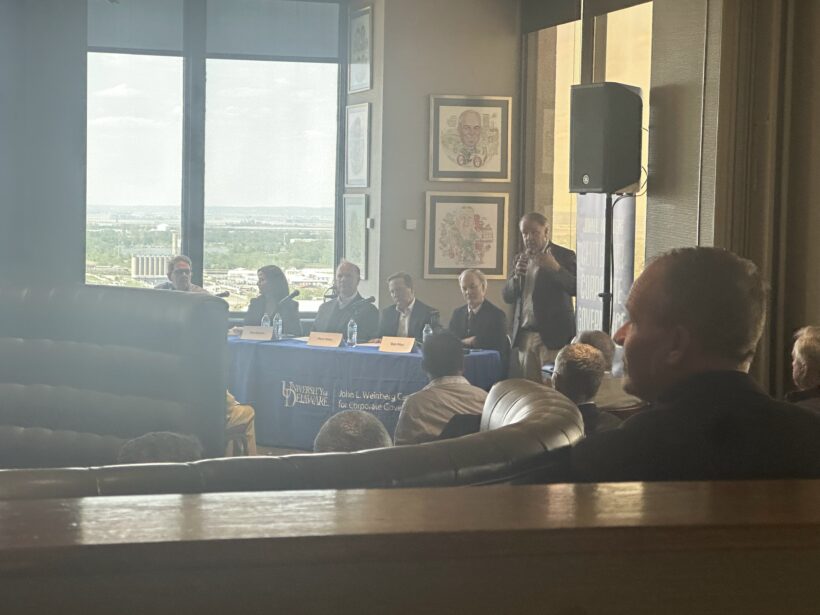
At the When Value Investing Meets Corporate Governance 2026 event – a joint program between the Gabelli Center for Global Security Analysis at Fordham University and the John L. Weinberg Center for Corporate Governance at the University of Delaware, held in Omaha during Berkshire Hathaway weekend – two back-to-back panels assembled big names in governance, law, and long-duration investing.
The event was conceived and organized by Stephanie Cuba, and co-anchored by two moderators: Robert P. Miles, author of The Warren Buffett CEO and one of the earliest Berkshire chroniclers, who led Session 1; and Lawrence A. Cunningham, Presiding Director of the John L. Weinberg Center for Corporate Governance at the University of Delaware, who led Session 2. The thesis of both panels was the same: without corporate governance even sound business strategies eventually come apart. The event took place on Friday May 1st, one day before the Berkshire Hathaway Inc. annual meeting.

Session 1 panelists included Ron Olson, name partner at Munger, Tolles and Olson and a former longtime director of Berkshire Hathaway; Thomas Gayner, CEO of Markel Group; Robert Robotti, President and Chief Investment Officer of Robotti and Company; and Lauren Templeton, founder and CEO of Templeton and Phillips Capital Management and an independent director of Fairfax Financial Holdings. Session 2 panelists included Mark Miller, President of Constellation Software and Executive Chairman of the Volaris Group; Paul Johnson, Executive Director of the Gabelli Center for Global Security Analysis at Fordham University; Sy Lorne, a director of Markel Group and former General Counsel of the U.S. Securities and Exchange Commission; and Lois Zabrocky, President and CEO of International Seaways and a director of Tidewater.
What Corporate Governance Actually Is
The first panel opened with a direct question: what is corporate governance? Moderator Miles noted that a preceding discussion had touched on capital allocation, culture, and degrees of centralization without explicitly defining the concept itself. Olson answered with brevity; In his view, corporate governance begins with hiring the right CEO. It then requires understanding the culture of the organization and endorsing it – he was explicit that a director who cannot endorse the culture ought not to be on that board. Protecting that culture is itself an act of governance. Boards must also develop a genuine understanding of the risks inside the business, a point Olson said the SEC has increasingly scrutinized, backed by a decade of reinforcing case law.