

Tom Bailey, Head of Research at HANetf comments on latest SIPRI global defense spending data:
Global military spending increased for the 11th consecutive year in a row in 2025, totalling almost $2.9trillion, according to the latest data from the Stockholm International Peace Research Institute.
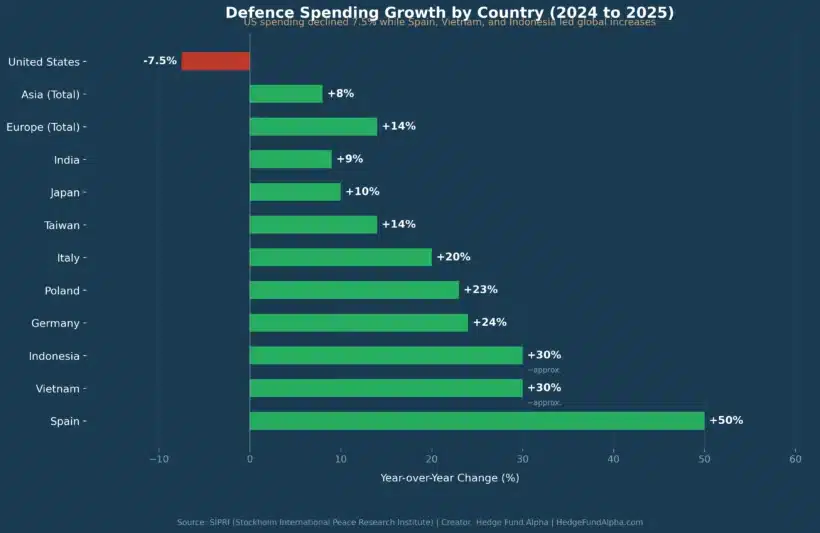
But while military spending increased to a new record high, the 2024 to 2025 growth rate was lower than the previous year. The primary reason for this was a decline in US military spending, following Trump’s return to the White House. The data shows that US spending fell by 7.5%, primarily reflected the US cutting its financial military assistance for Ukraine.
This reduction is US spending, however, is likely to be reversed. The Trump administration has stated its goal of increasing the country’s defense spending to $1.5trillion, a roughly 50% increase. At the same time, the war in Iran has seen the US burn through key missile stockpiles at an alarmingly fast rate, while the US Air Force and Navy have both stated their intention to scale up their purchase of F-35 jets.
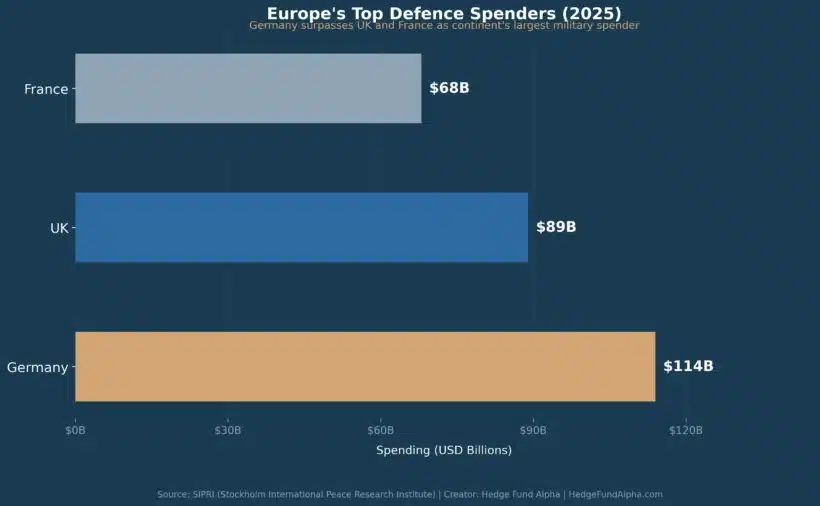
Despite the 2025 reduction in US military spending, global spending was still able to grow, owing to the rapid pace of increases elsewhere. Europe continued on its rearmament trajectory, growing spending by 14%, with the continent as whole spending $864billion. As a result, European defense spending has now doubled over the past decade. Germany increased its spending by 24%, reflecting the Merz government’s strong commitment to upping spending and the use of off-budget spending to get around German fiscal constraints. That brought its 2025 spend to $114billion, far surpassing the UK’s $89billion and France’s $68billion, making Germany the biggest spender on defense in Europe.
Other countries also saw rapid increases, with Poland’s defense spend up by 23%, bringing its total military spend to 4.5% of GDP. Meanwhile, Italy increased spending by 20% and Spain by 50%, despite the latter’s opposition to the recent NATO spending commitments.
Asian countries also surged their spending, with the region spending over 8% more. India’s defense spend increased by almost 9% and Japan’s by almost 10%, reflecting growing tensions and concerns in the Indo-Pacific region. Taiwan, meanwhile, upped its defense spend by 14%, reflecting its goal of reaching 5% of GDP by 2030. Smaller countries saw even faster growth, with both Vietnam and Indonesia increasing spending by nearly 30%.
The latest SIPRI data reinforces that global defense spending continues to rise, extending what is now a multi-year rearmament cycle. But one of the less recognised beneficiaries of this trend has been South Korea. Unlike many Western defense contractors, which are still largely driven by domestic procurement, Korean companies are increasingly export-led. In recent years, South Korean defense exports to NATO European members have increased by 200x, and the country is expanding its export footprint across Asia and the Middle East.
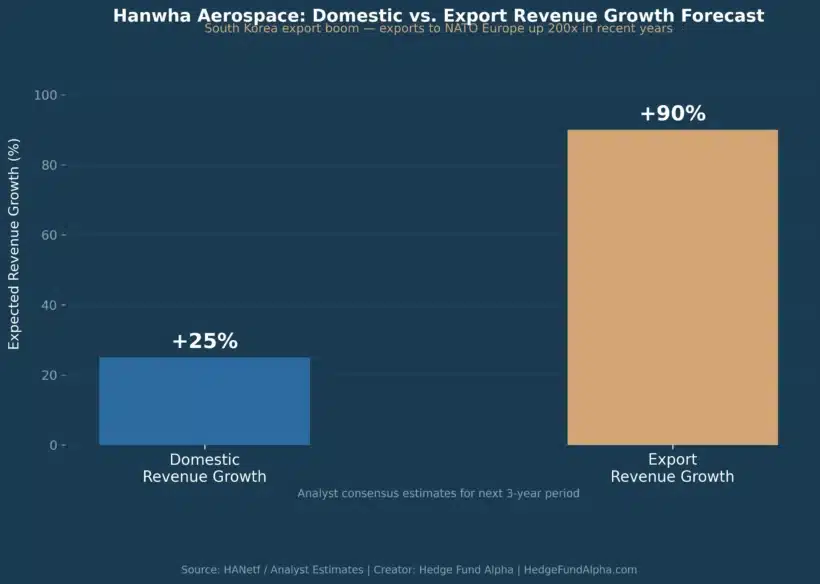
When it comes to companies Hanwha Aerospace, Korea Aerospace Industries and LIG Nex1, analysts expect export revenues to grow materially faster than domestic demand over the next three years. In the case of Hanwha Aerospace, its export revenue is expected to grow by 90% compared to around 25% for domestic.
South Korea’s competitive advantages in the defense export market are numerous. Its equipment is typically 30–50% cheaper than Western alternatives and can be delivered on much shorter timelines. That combination is particularly attractive for countries facing fiscal constraints but under pressure to increase defense spending. The speed of delivery has proven critical at a time when many Western suppliers face multi-year backlogs.
Demand is also broadening geographically. Korean missile and air defense systems are seeing increasing adoption in the Middle East, where recent successful use to fend of Iranian attacks is supporting further orders.
South Korea stands out as one of the clearest beneficiaries of rising global defense spending, offering direct exposure to the export side of the rearmament cycle.