


Last updated: June 2026 – Li Lu, founder of Himalaya Capital, is a renowned Chinese-born American value investor. He was inspired to get into investing after he attended a lecture by Warren Buffett at Columbia University. Lu founded Himalaya in 1997, a firm known for its disciplined and value-oriented approach to investing. At Himalaya Capital, Li Lu has long run a concentrated portfolio, which has 14 holdings as of Q1 2026. While he frequently makes very few changes to his portfolio, Q1 2026 was a lively one with a lot of changes for such a small portfolio compared to Q4 2025.
Li Lu’s portfolio is concentrated in technology and financial names, although he does have one energy company and one consumer discretionary name. Most notably, Lu has been dumping massive numbers of Bank of America shares since Q1 2025. The stock was once his top position, and for multiple quarters, but it has since plunged to number six on the list – with a new preference for technology and financial-related names emerging since then.
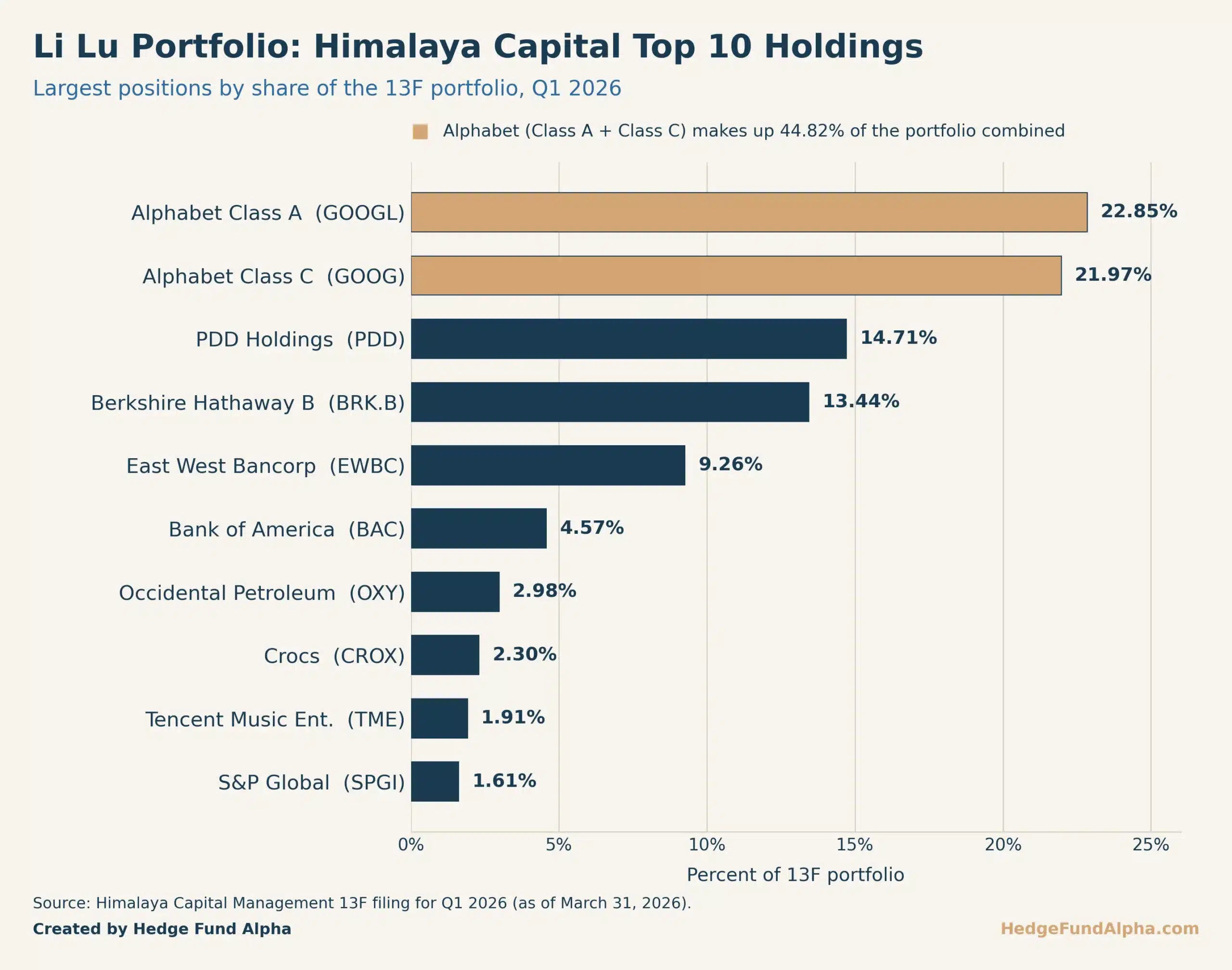
Li Lu’s Portfolio Holdings – Top 10
| Stock | Ticker | % of the portfolio | Current price | Position value | 52 week low | 52 week high |
| Alphabet Class A | NASDAQ:GOOGL | 22.85 | $367.72 | $731 million | $162 | $408.61 |
| Alphabet Inc Class C | NASDAQ:GOOG | 21.97 | $364.75 | $703 million | $163.33 | $404.47 |
| PDD Holdings | NASDAQ:PDD | 14.71 | $86.53 | $471 million | $81.56 | $139.41 |
| Berkshire Hathaway Inc Class B | NYSE:BRK.B | 13.44 | $477.91 | $430 million | $455.18 | $516.85 |
| East West Bancorp Inc | NASDAQ:EWBC | 9.26 | $124.52 | $296 million | $90.32 | $127.52 |
| Bank of America | NYSE:BAC | 4.57 | $54.04 | $146 million | $43.66 | $57.55 |
| Occidental Petroleum | NYSE:OXY | 2.98 | $58.63 | $95.3 million | $38.80 | $67.45 |
| Crocs | NASDAQ:CROX | 2.3 | $119.30 | $73.6 million | $73.20 | $121.26 |
| Tencent Music Entertainment | NYSE:TME | 1.91 | $9.44 | $61.2 million | $8.44 | $26.70 |
| S&P Global | NYSE: SPGI | 1.61 | $420.67 | $51.7 million | $381.60 | $579.05 |
*Source: Himalaya Capital Management 13F filing for Q1 2026, as of March 31, 2026.
**Stock prices as of morning hours June 4, 2026.
Li Lu’s Full Portfolio
Alphabet (NASDAQ:GOOGL) (NASDAQ:GOOG)
Alphabet accounts for a massive share of Li Lu’s portfolio. Himalaya Capital holds more than 2.5 million Class A shares and 2.45 million Class C shares of the tech giant. Lu has owned Class C shares (GOOG) since Q2 2020 and Class A (GOOGL) shares since Q2 2022.
His only activity in Class A since then was to buy more shares in Q4 2022. For Class C, Lu boosted his share count in Q2 2022 and then sold some in Q1 2025. He didn’t do anything with his shares of either class in Q1 2026 versus Q4 2025. GOOGL accounts for 22.85% of his portfolio as of Q1 2026, while GOOG stock accounts for 21.97%. Those percentages are both a slight increase quarter over quarter.
PDD Holdings (NASDAQ:PDD)
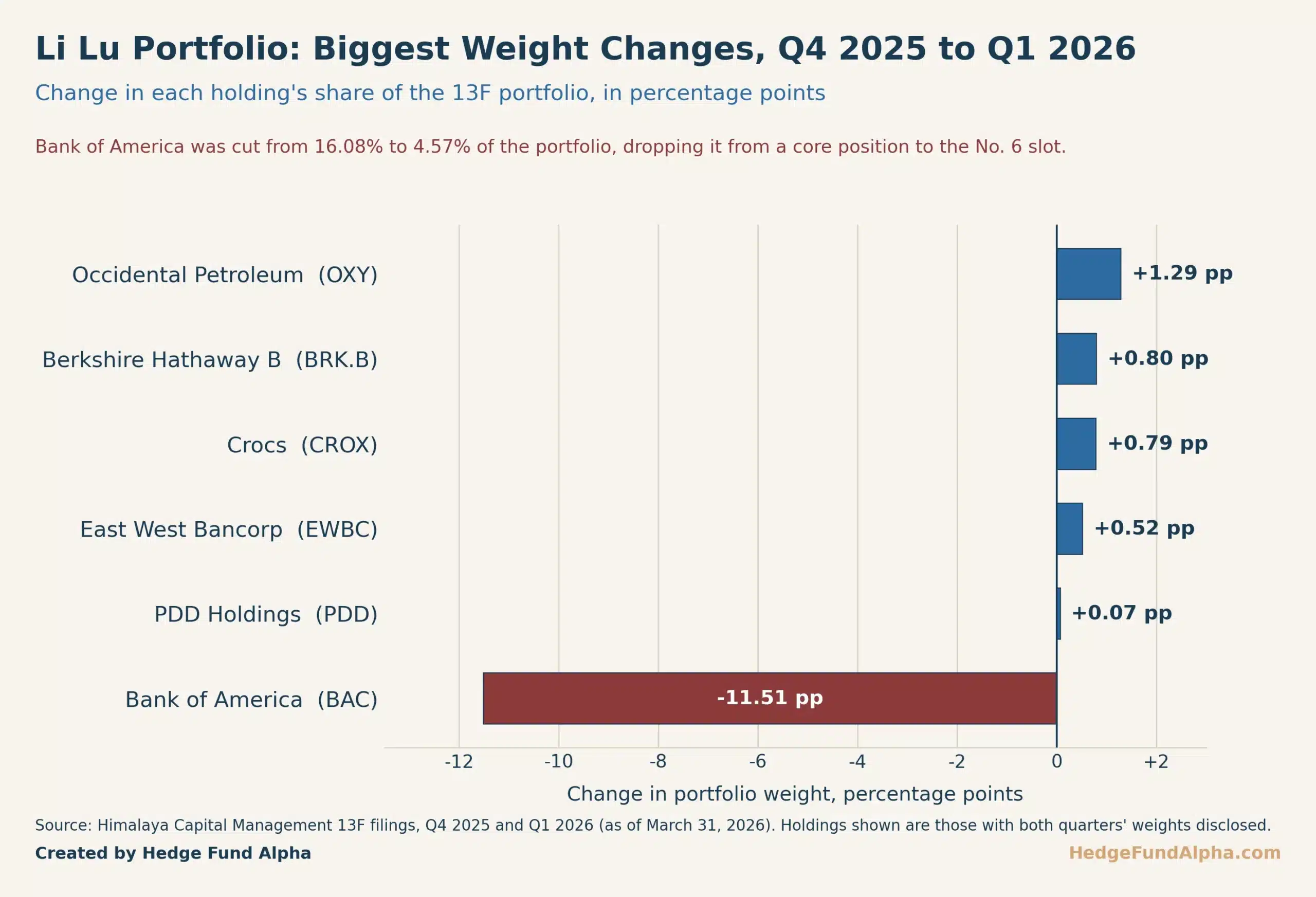
Lu originally bought a small number of shares of PDD, formerly known as Pinduoduo, in Q4 2020, but he unloaded all of those shares in Q4 2021. He established his current holding of 4.6 million shares in Q2 2025, and he kept his share count unchanged between Q4 2025 and Q1 2026. PDD accounted for 14.71% of Lu’s portfolio in Q1 2026, up from 14.64% in Q4 2025 despite the lack of any activity in the holding.
Berkshire Hathaway (NYSE:BRK.B)
Li Lu’s portfolio contains about 900,000 shares of Class B Berkshire Hathaway shares. The stock accounted for 13.44% of his portfolio in Q1 2026, up from 12.64% in Q4 2025. Himalaya Capital has held these same shares since Q3 2021, keeping the share count unchanged since then.
East West Bancorp (NASDAQ:EWBC)
Li Lu owns 2.8 million shares of East West Bancorp, which was a new position for him in Q1 2023. He boosted the share count by 21% in Q2 2023, but has since left it unchanged. East West Bancorp accounts for 9.26% of Himalaya’s portfolio, up from 8.74% in Q4 2025.
Bank of America (NYSE:BAC)
One of the most aggressive changes to note in Li Lu’s 13F for Q1 2026 was his shedding of more than 70% of his stake in Bank of America. The bank was his number one holding as recently as Q4 2024, when it accounted for more than 29% of Lu’s portfolio.
He initially slashed his position in Bank of America in Q1 2025, unloading 23.4% of the position or 4.2 million shares before selling another 24.7% of his shares in Q2 2025. Now the 70%+ cut in the share count during Q1 2026 has sent Bank of America tumbling down the list of Li Lu’s holdings, moving it down to the sixth slot. In Q4 2025, the bank accounted for 16.08% of Himalaya’s portfolio, but in Q1 2026, it’s just 4.57% of the portfolio.
Lu originally bought Bank of America in Q1 2020, boosting his positions in Q4 2021 and Q1 2023.
Occidental Petroleum (NYSE:OXY)
Lu also held his share count in Occidental Petroleum the same in Q1 2026, at 1.5 million shares. The size of the position within the portfolio rose from 1.69% to 2.98%. Himalaya Capital has owned shares of Occidental Petroleum since Q2 2024, not selling or adding to the position at all since then.
Assuming Lu bought OXY shares on the way down in Q2 2024, this position has finally started to pay off for him. Occidental Petroleum traded as low as $59.48 a share during Q2 2024 and has since traded as high as $67.45 a share.
Crocs (NASDAQ:CROX)
In another significant move, Lu boosted his stake in Crocs by more than 40% to 890,000 shares during Q1 2026, which helped increase the position size from 1.51% to 2.3% of the portfolio. He had just established this position in Q4 2025. Crocs stock has had a bumpy ride but has since taken off, rising as high as $121.26 a share.
Tencent Music Entertainment (NYSE:TME)
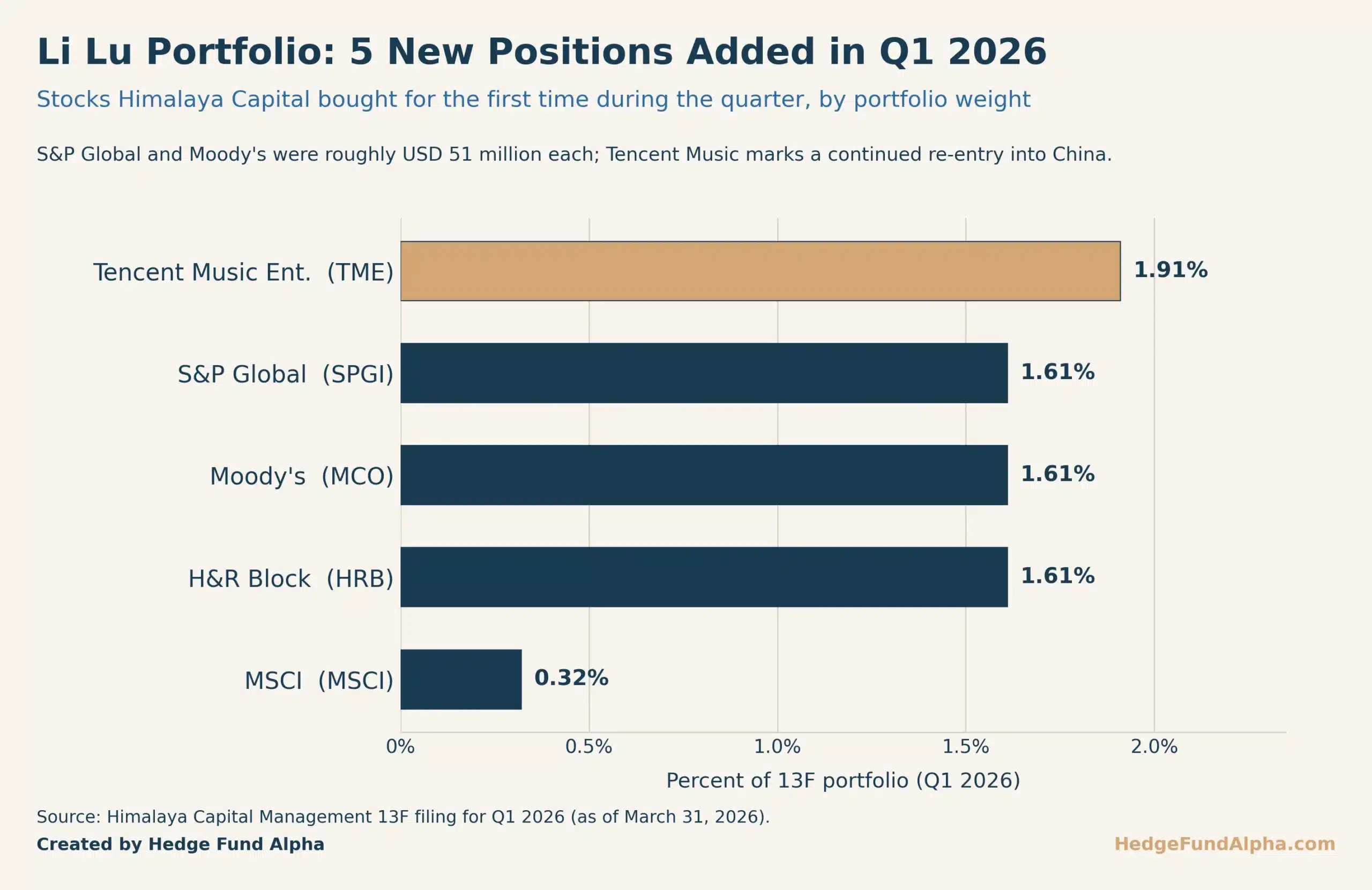
Lu added a new position in Tencent Music Entertainment during Q1 2026, snapping up 6.6 million shares to make it 1.91% of the portfolio.
S&P Global (NYSE:SPGI)
Another new position for Li Lu’s portfolio during Q1 2026 was S&P Global. He established a small position of about 120,000 shares, making the stock 1.61% of his portfolio.
H&R Block (NYSE:HRB)
Lu also picked up some shares of H&R Block during Q1 2026, again keeping the position small at around 1.61% of the portfolio. He bought 1.6 million shares during the quarter.
Moody’s (NYSE:MCO)
Moody’s was another new position for Lu during Q1 2026. Lu bought about 120,000 shares, making Moody’s stock a 1.61% position within his portfolio.
Apple (NASDAQ:AAPL)
Lu kept his share count in Apple the same at about 111,000 shares in Q1 2026, making the iPhone Maker 0.88% of his portfolio. Apple was a new holding for Lu in Q4 2020. He sold some 58% of his shares in Q3 2024 and then 65% of his shares in Q1 2025 but has left his share count untouched since then.
MSCI (NYSE:MSCI)
Finally, Lu established a new minuscule position in MSCI during Q1 2026, buying 19,000 shares to make it 0.32% of the portfolio.
Q1 2026 Portfolio Analysis
The Q1 2026 13F displays one of the most active and interesting structural turnarounds for Li Lu’s portfolio in years. Historically, he has run a very static portfolio with high concentration, often not making a single move in a quarter.
Financial themes in Li Lu’s portfolio
However, during Q1 2026, Lu aggressively unwound his position in Bank of America to seed five newcomers to his portfolio. The massive cut to Bank of America is a move within a wider theme for Li Lu’s portfolio. He has been gradually but steadily downsizing his exposure to large-cap U.S. banks to take sizable profits from those long-term holdings.
Notably, Himalaya Capital has never owned shares of Tencent Music Entertainment, S&P Global, H&R Block, Moody’s or MSCI before, even though these stocks have been trading a long time. During Q1 2026, Lu slashed his Bank of America position to diversify within the financial data sector and buy a basket of stocks. He bought about $51 million worth of both S&P Global and Moody’s, which represents a classic move within value investing — picking up shares in a financial duopoly that boasts almost impenetrable moats.
MSCI is another financial-related stock move, albeit a starter position for the portfolio. Meanwhile, H&R Block is a surprise play on value and cash flow.
Reentry into China
The other new position, Tencent Music Entertainment plays into Lu’s deep structural expertise in the Chinese media and technology landscape. In fact, Lu’s purchase of PDD Holdings in Q2 2025 marked a reentry into China, and his purchase of Tencent Music Entertainment in Q1 2026 continues this trend.
He previously held positions in Chinese EV and battery maker BYD and e-commerce and cloud giant Alibaba, and he’s known for his deep experience and expertise in Chinese equities. In fact, Lu was an early mover in China, gaining wide recognition for spotting BYD in the early 2000s and famously introducing it to the late Charlie Munger and Warren Buffett.
Keeping It Concentrated
Despite the significant number of moves in Li Lu’s portfolio during Q1 2026, he maintained his strategy of a concentrated, static portfolio. A massive chunk of his portfolio is concentrated in the top five names, positions that were held steady during the quarter.
Notable Investments
Among others, Berkshire Hathaway (BRK.B) is one of the crucial holdings in Li Lu’s fund Himalaya Capital. The late Charlie Munger was a keen admirer of Li Lu’s investment philosophy, often calling him the “Chinese Warren Buffett.” The respect goes in both directions since Li Lu looked up to both Buffett and Munger from the beginning of his investment career.
In one moment, Li Lu was the frontrunner for managing Buffett’s portfolio once he stepped down from his duties. Soon after, Lu resigned from that race and decided to move his investment career in the other direction. Thus, it doesn’t come as a surprise that Lu keeps Berkshire Hathaway shares as a part of a core holding.
Another example that is worth mentioning is Li Lu’s investment in Gazprom during the ’90s and the breakup of the USSR. In that period, the Russian economy plummeted, and devaluation of the currency reached a peak of 90%.
These factors allowed investors willing to take the risk to buy shares at huge discounts. Lu earned massive returns from the Gazprom investments, mainly from ridiculously low prices of stocks. As the ’90s came to an end, the price of stocks rose, and investors who bought shares five years earlier earned 10 or more times what they invested.
Li Lu’s Investment Philosophy
Li Lu’s Approach to Value Investing
Li Lu is known for utilizing value investing strategies. Throughout his career, he was often searching for undervalued companies trading below their intrinsic value. He also digs deep when conducting company analysis, trying to find potential in a company. He knows well enough that low stock price is not the only factor that drives sales.
From his current portfolio, we can easily see that he insists on a long-term investment horizon. He rarely pays attention to current stock value and frequent short-term fluctuations in price. From his experience, he prefers investing in companies that can bring long-term returns.
He heavily relies on some aspects of value investing, like margin of safety and compound returns. He uses margin of safety as a risk management strategy to protect his portfolio from sudden market surges. Additionally, since he prefers to hold onto positions for a long time, he enjoys capitalizing on compounded returns.
However, he is often critical of the value investing strategy and points out that he rarely follows these principles by the book. While he understands the importance of deep analysis, he says that rarely will anyone invest in a company based on its fundamentals, but rather, they will look at the stock price. He emphasizes the ability to predict price fluctuations because then you will know the right moment to act.
One of his pieces of advice regarding maximizing returns through value investing is based on going through history. An investor should go through market history and identify periods when it went to extremes in a particular sector. Then find what companies provided the maximum margin of safety and managed to come on top. From these examples, you can learn how to identify stocks that are trading at low valuations today.
He also has his view on margin of safety. When calculating the margin of safety, investors should look at the P/E and P/B multiple of the company to determine if the company is over or undervalued.
His take on this is “if the quality of the asset is very high, your demand for the asset will be low. You need to have an insight as to what those assets could generate for you.” This practically requires that the investor not solely focus on the margin of safety, but rather, study the company’s fundamentals. That way, you can anticipate what that holding could bring in a specific time frame.
Take A Look At Three Key Concepts In Value Investing, According to Li Lu:
Investment Principles and Guidelines
Besides some value investing principles that Lu holds onto, he also points out the importance of understanding the market. He has mentioned several times that the market is not perfect, but you need to learn how to understand it. Through the market, you will sell your stocks, and to do that, you need to know how the market functions.
Once you understand that the market is not perfect, Lu advises investors to avoid trading frequently. By understanding the market, you need to know how to identify the specific time when it is good to invest. His preferred investment is to bet rare and big. Lu doesn’t hold more than 20 holdings in his portfolio, so he likes to keep it concentrated.
This can be seen as a contradiction that investors were always attached to. Diversification was seen both as a risk management tactic and a way to reach higher returns. However, Lu has stuck with his investment philosophy through most of his career, and he is not backing down.
Lu mentioned in several interviews that he enjoys the most when he identifies a stock for life. These opportunities rarely happen, but when they do, he rarely gives up. To be sure that you found a stock worth holding for life, it should combine a cheap price on the asset, the fundamental quality of the asset, and the chance to bring constant returns on a compounded growing basis.
Take A Look At Li Lu: How I Got Started In Value Investing?:

Focus on Undervalued Companies
A solid part of Li Lu’s investment approach is identifying undervalued stocks. He is ready to dig deep through companies’ financial reports, researching their competitive landscape, and identifying potential factors that could bring an edge.
What also helps him find hidden gems is that he is ready to invest when and where others wouldn’t dare to. Although sector condition is important, Lu is ready to invest in a sector that currently doesn’t show much promise. He trusts his research and is willing to see chances where others see only risks.
Some of the best examples where we can see the success of his approach are these companies:
- BYD Company (OTCMKTS:BYDDF). Lu discovered this at the time it was a small, relatively unknown Chinese company. He purchased shares when they were worth next to nothing and later sold them when BYD became a powerhouse. Today, Buffett, Western Capital Group and The Vanguard Group are among the biggest investors in BYD.
- Vale SA (NYSE:VALE). Lu invested in this Brazilian mining company’s stock at its lowest value, when commodity prices were low. Once the market turned around and mining products gained value, Lu harvested major returns.
- Hanwha Solutions Corp (KRX:009830). This was another gem hidden in the eyes of most investors. Lu’s background included unearthing Chinese and South Korean companies that had the potential to make it big. This South Korean company, although complex in structure, had strong fundamentals and brought Lu significant returns.
Investment Process and Criteria
How Lu chooses his investment targets can be seen by navigating one of the most famous case studies that he discussed during a Columbia University lecture. He started the identification process by going through The Manual of Stocks. He immediately jumps to 52-week lows. He takes his time trying to get as much as possible out of that one page.
One day in 1998, clothing company Timberland caught his eye. The whole business was valued at around $300 million at its book value after a 52-week low. He found this interesting and decided to go deeper into analysis. He wanted to find what is valued at $300 million.
Almost all of that $300 million book value was working capital. Since it is a retail company, the majority of that was inventory of goods for the season. He then looked at the previous two years and found out that the company collected around $100 million at the end of the quarter. It had $200 million in liquid assets and an additional $100 million in buildings. That provided solid downside protection.
The next thing to factor in is how much the company was earning. To calculate that, Lu identified pre-tax and pre-interest earnings. Then he compared it with the unleveraged capital needed for the business. In sales, that was about $800 million to $850 million. Its operating margin was 13%, ending up with $110 million in pre-tax earnings per year.
So he considered all these figures and found that the company had $200 million in liquid assets and $100 million in buildings, and the capital used for business was $200 million. That meant that the return on capital was about 50%, which meant that there was potential.
The problem was that the whole retail sector took a hit from the Asian financial crisis. Lu then checked how much international sales took off the total Timberland sales. It was at a solid 27%. However, for the Asian market, it was only 10%. This means that even if the sales in Asia dropped to zero, it wouldn’t mean much in the big picture.
The company was highly insider-owned since it was a family company. It had shareholders who filed lawsuits due to missing earnings guidance. He investigated deeper and saw a chance to approach the family and talk. It turned out that the son of the owners had the same friends as Lu. He investigated the family, and it turned out they were honest.
Lu put all his findings on paper and saw a good company with growing sales, high returns on invested capital, and low downside risks. All these factors pointed to a potentially good investment. He invested big, and it turned out to be a great investment decision. Over the next two years, the stock value rose by 7x.
Risk Management Strategies
As a value investor, Li Lu always points out the importance of a margin of safety. He advocates for identifying potential investments with the largest margin of safety so that it can provide a massive barrier against potential risks.
One of the concepts of value investing is understanding and trusting the company’s fundamentals. However, investors cannot control so many different factors. That is why the margin of safety (MoS) needs to be concrete. In case management makes a mistake, there is the MoS as a self-defense mechanism.
Although a concentrated portfolio may seem like the complete opposite of risk management, Lu’s deep analysis and convictions in his chosen companies mitigate risks. Often he points out that a really good investor should trust his hunches. If you are scared of the crowd, you will never be a good investor.
As one of his biggest regrets, he mentioned a lack of belief in himself when he refused to invest in a company in which he had very detailed insight, just because no one else wanted to invest in it. Thus, deep analysis and the knowledge that he chooses the right companies also work as a risk management technique.
Deep analysis acts as a risk management strategy in value investing. This can be seen from many examples, starting with Benjamin Graham and moving to Warren Buffet, and it can be seen in the Li Lu example. By identifying fundamentally sound companies, he is making sure that they have stable cash flow, capable management and competitive advantages.
From there, he invests in the long term and follows the value investing approach. He is not swayed by sudden market twists because he knows that a good company will come up top.
A final part of his risk management strategy is his exit strategy. An investor of Li Lu’s reputation knows when it is time to get out. This can be seen from his investment in BYD. He invested early and big. After the shares reached their peak, he sold the whole holding, earning him massive returns.
Li Lu Performance Evaluation
Evaluating Li Lu’s portfolio performance can be tricky due to several factors. As the first and most obvious, Lu keeps most of his investment operations as private as possible, making it difficult to find relevant performance data.
Since Lu is a value investor, using traditional benchmarks to measure performance may be misleading. This is due to the different aims of his investment approach and different risk/ reward landscapes that surround this investment strategy.
However, from publicly available data, we can conclude that since the inception of Lu’s fund, he has managed to achieve over 30% compound annual returns. Lu’s portfolio achieved peak performance during the whole of 2021 and in Q1 and Q2 2022.
Influence on Value Investing
Li Lu is one of the most successful value investors, an approach that is not very popular in the investing world. His success story sheds some light on this strategy, and he has gained quite a few followers. He advocated for looking beyond the current share price and focusing on the fundamentals.
When compared to other value investors, he is often overlooked. He is mostly responsible for this because he likes to keep a low profile. However, due to his background, he has had a major impact on American investors by introducing them to Chinese companies. Since then, many hedge funds have gone on a buying spree of Chinese companies.
Lu likes to share his insights and knowledge through lectures, writings and interviews, inspiring a new generation of value investors. He also frequently mentioned that he learned the basics of value investing from Warren Buffett and the late pioneer Benjamin Graham.
One of his key tips to all investors is to be ready to invest in dirt-cheap stocks if they can prove that the companies have something to offer in the long term. That approach came from the beginnings of value investing. Lu saw that someone needs to keep reminding people how much they can earn by just doing good fundamental research.
Himalaya Capital Management
Himalaya Capital Management is an investment company founded by Li Lu in 1997. The base of operations is in Seattle, Washington, which reflects Li Lu’s value investment approach. Li Lu and his partners are focused on locating value investing opportunities both in the United States and China.
Through his work at Himalaya Capital, Li Lu opened a door for American investors to the Chinese market. This evolved into a trend that is still active.
While looking for potential investment opportunities Lu emphasizes strong company fundamentals that have competitive advantages and a responsible management team. Himalaya Capital’s portfolio is highly concentrated, rarely owning more than 15 to 20 holdings at any given time.
By utilizing Li Lu’s skillful approach, Himalaya Capital has been one of the best-performing funds in the world for decades. The fund averages 30% returns annually, while in recent years those percentages are even higher.
FAQs
What Companies Does Li Lu Own?
Li Lu currently owns shares in 13 companies, including two classes in one company:
• Alphabet (Class A and C shares)
• PDD Holdings
• Berkshire Hathaway
• East West Bancorp
• Bank of America
• Occidental Petroleum
• Crocs
• Tencent Music Entertainment
• S&P Global
• H&R Block
• Moody’s
• Apple
• MSCI
Does Li Lu Own Alibaba?
Li Lu doesn’t own any Alibaba shares. He included this company in his portfolio on two occasions. The first time it was in Q1 2018, selling his shares in Q4 2019. The second time he bought shares in Q1 2020 and sold it very soon, in Q2 the same year.
When Did Charlie Munger Invest in Li Lu?
Charlie Munger met Li Lu in 2003 at Thanksgiving lunch and was impressed by him. When in 2004 Li Lu started a new fund, Munger backed him with his money.
Benjamin Graham was regarded as a father of value investing. He was a tutor of Warren Buffett, which is often regarded as his crucial disciple. Li Lu was immensely impressed by the work of Buffett and his partner Charlie Munger. All of these people were considered to be the top value investors in their prime. Li Lu is today maybe the biggest influence on young investors to learn and utilize value investing principles.
But, just like Buffett adjusted Graham’s approach, so did Lu. He is not following Graham’s recommendations in the book, but he is a believer in investing in good companies. That is why he emphasizes the importance of deep analysis and margin of safety. From his long-term and concentrated approach, we can learn more than a thing or two. But, if we decide to follow him, we should be ready for his by today’s standards, unconventional approach.
Did Li Lu sell Bank of America?
Lu sold more than 70% of his holdings in Bank of America during Q1 2026.
What is Li Lu’s biggest holding?
Li Lu’s biggest holding is Class A shares of Alphabet.
Does Li Lu own any Chinese stocks?
Li Lu picked up shares of Tencent Music Entertainment in Q1 2026 and continues to own shares of PDD Holdings
Related Content
- Michael Burry Portfolio: Investments and Insights
- Cathie Wood Stocks: Winning Investment Strategy
- Supercharge Your Investments: Ray Dalio Portfolio Guide
- Invest Like a Legend: Exploring The Stanley Druckenmiller Portfolio
- Mohnish Pabrai Portfolio: Get Inside The Mind of a Guru
- Bill Ackman Portfolio Guide: Your Path to Wealth Creation
- Read Hedge Fund Letters here