

Last Updated: July 2026
Michael Burry, the contrarian investor who famously anticipated the 2008 housing crash in The Big Short, has officially filed his final 13F for Scion Asset Management. Disclosed as of September 30, 2025, Scion’s closing portfolio marks a dramatic and highly concentrated exit from the public markets.
Burry’s final portfolio repositioning was dominated by a major bearish bet against the artificial intelligence boom. He expressed this view through large put option positions in Palantir (PLTR) and Nvidia (NVDA). Although these bearish positions accounted for most of the fund’s reported notional value, Burry also maintained a small long portfolio. The holdings were defensive and company-specific, completing Scion’s final regulatory snapshot before the fund closed.
The Scion Asset Management Portfolio Today (Final 13F)
| Rank | Ticker | Position | Type | Value | Shares |
|---|---|---|---|---|---|
| 1 | PLTR | Palantir Technologies (Cl A) | PUT option | ~$912.1M | 5,000,000 |
| 2 | NVDA | Nvidia | PUT option | ~$186.6M | 1,000,000 |
| 3 | PFE | Pfizer | CALL option | ~$152.9M | 6,000,000 |
| 4 | HAL | Halliburton | CALL option | ~$61.5M | 2,500,000 |
| 5 | MOH | Molina Healthcare | Common | ~$23.9M | 125,000 |
| 6 | LULU | Lululemon Athletica | Common | ~$17.8M | 100,000 |
| 7 | SLM | SLM Corp (Sallie Mae) | Common | ~$13.3M | 480,054 |
| 8 | BRKR | Bruker Corp 6.375% Pref Series A | Preferred | ~$13.1M | 48,334 |
Source: Scion Asset Management LLC Form 13F-HR for Q3 2025 (as of September 30, 2025), filed with the SEC (EDGAR, CIK 0001649339). Option lines are shown at the value of the underlying shares, per SEC 13F rules, not the premium paid.
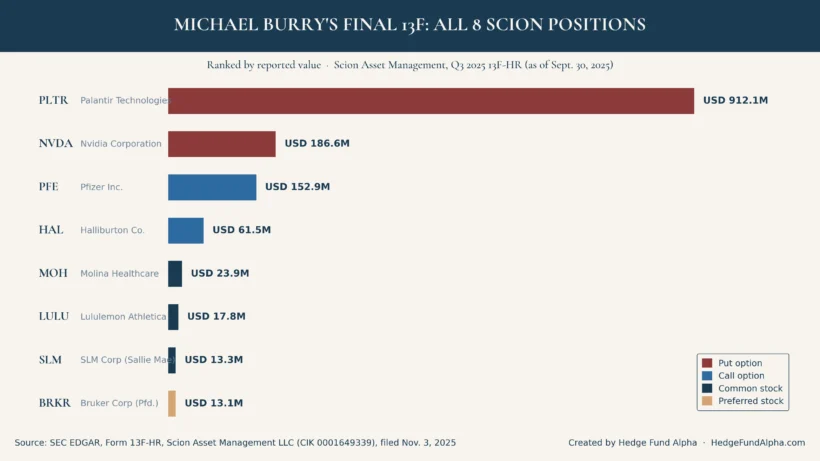
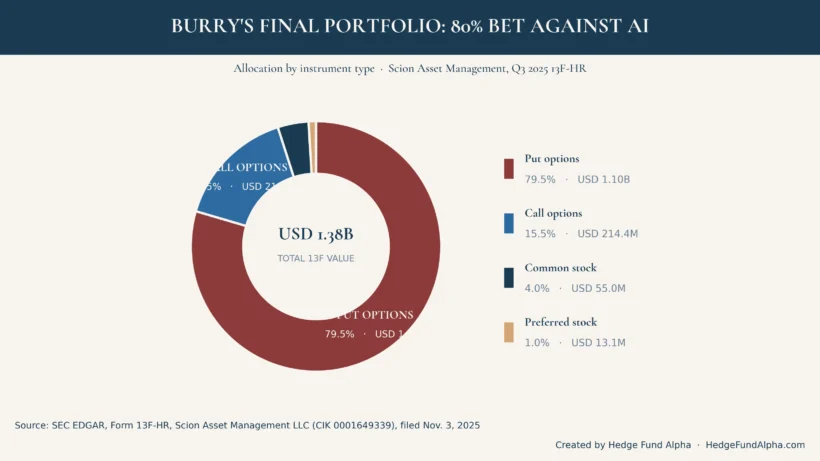
Scion Asset Management’s final disclosed portfolio was heavily concentrated in derivatives. The vast majority of its reported exposure reflected Michael Burry’s bearish view on the artificial intelligence trade. Approximately $1.10 billion, or nearly 80% of the portfolio’s reported $1.38 billion value, consisted of put options against Palantir Technologies and Nvidia.
The largest position was a put option on Palantir, representing roughly $912.1 million in notional exposure tied to 5 million underlying shares. It was followed by a put option on Nvidia, with approximately $186.6 million in notional exposure linked to 1 million underlying shares. These positions did not represent direct ownership of the companies. Instead, they reflected Burry’s expectation that the AI-driven rally had become overextended and that the stocks could decline in value.
While the bearish AI positions dominated the portfolio, Scion also maintained a much smaller group of bullish option positions. The fund held call options on Pfizer with approximately $152.9 million in notional exposure, representing 6 million underlying shares, alongside call options on Halliburton worth roughly $61.5 million in notional exposure covering 2.5 million underlying shares. These positions suggested selective optimism in healthcare and energy, contrasting with the fund’s broadly bearish stance toward the AI sector.
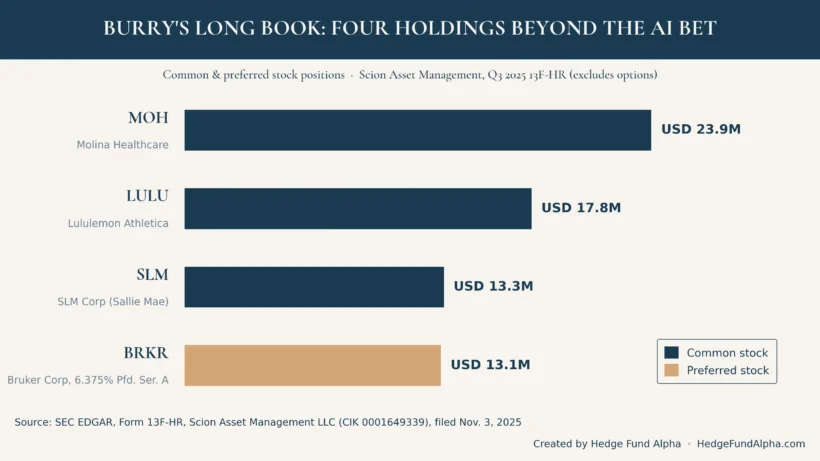
Scion’s outright equity portfolio was comparatively modest, totaling only about $68 million. Its largest common stock holding was Molina Healthcare, valued at approximately $23.9 million across 125,000 shares. Other major long positions included Lululemon Athletica (100,000 shares, valued at $17.8 million) and SLM Corp (Sallie Mae) (480,054 shares, worth $13.3 million). The portfolio also included Bruker Corporation 6.375% Series A Preferred Stock, a preferred security rather than common equity, valued at approximately $13.1 million across 48,334 shares. Compared with the fund’s massive derivatives exposure, these long holdings represented a relatively small allocation focused on a handful of defensive and company-specific opportunities.
Burry’s Bet Against the AI Trade
Michael Burry’s most notable move in Scion Asset Management’s final portfolio was a major bearish bet. It targeted two of the biggest beneficiaries of the artificial intelligence boom: Palantir Technologies and Nvidia. Rather than directly shorting the stocks, Burry used put options, financial contracts that give the buyer the right, but not the obligation, to sell shares at a predetermined price. A put option increases in value if the underlying stock declines, making it a way to profit from falling prices while limiting the potential loss to the amount paid for the option.
The positions represented approximately $912 million in notional exposure against Palantir and $187 million against Nvidia, for a combined total of roughly $1.1 billion. Importantly, notional value does not represent the amount Burry invested in purchasing the options. Instead, it reflects the value of the underlying shares controlled by the contracts, showing the scale of the market exposure rather than the actual cash spent.
The trade reflected Burry’s contrarian approach of identifying areas where investor expectations may have become detached from fundamentals. His most famous example was the 2008 housing market collapse. He recognized excessive optimism and structural weaknesses in subprime mortgages before the broader market. The AI trade reflected a similar thesis. Rather than betting against artificial intelligence itself, the position suggested that valuations of leading AI companies had become overly dependent on continued growth expectations.
The shift was particularly significant because it marked a complete repositioning of Scion’s options portfolio. As of June 30, 2025, the fund held bullish call options on companies including UnitedHealth Group, Regeneron Pharmaceuticals, Lululemon Athletica, Meta Platforms, Estée Lauder, JD.com, Alibaba, ASML, and VF Corp. By September 30, 2025, those positions had been eliminated and replaced by large put options on Palantir and Nvidia. Burry was not reversing an earlier bullish stance on Palantir or Nvidia. Instead, he established entirely new bearish positions, marking a clear shift from selective bullish exposure to betting against the AI-driven rally.
Michael Burry’s Investment Strategy
Value Investing Principles
Michael Burry became widely known after predicting the 2007–2008 financial crisis and inspiring Michael Lewis’s The Big Short. However, his investment reputation was built long before that trade through a disciplined value investing approach.
Burry adopted many of the principles established by Benjamin Graham, while adapting them to modern markets. At the core of his strategy is detailed fundamental analysis aimed at identifying companies trading below their intrinsic value. However, he understands that a low valuation alone does not make a company attractive. Some undervalued businesses are cheap for a reason due to weak management, excessive debt, or poor long-term prospects.
Instead, Burry focuses on companies with strong balance sheets, sustainable cash flows, and durable competitive advantages. His analysis extends beyond financial metrics to include the quality and track record of management teams. He evaluates factors such as leadership decisions, corporate culture, incentives, ethical standards, and the ability to create long-term shareholder value.
Burry also examines the broader industry environment, including competitors, market trends, and a company’s ability to maintain or strengthen its position over time. The goal is to identify businesses with lasting advantages rather than those benefiting from temporary market conditions.
Like Graham, Burry favors long-term investing over short-term market speculation. He is willing to tolerate volatility when his research suggests that a company’s underlying value is significantly higher than its current market price.
Contrarian Approach
Burry’s investment style is defined by his willingness to go against prevailing market sentiment. Rather than following popular trends, he searches for situations where investor expectations have become disconnected from underlying fundamentals.
His contrarian approach relies heavily on deep research. An overlooked or unpopular company is not automatically a good investment; some businesses remain undervalued because they face serious structural problems. Burry’s process focuses on separating temporary market pessimism from genuine business weakness.
By investing in companies trading below their intrinsic value, Burry attempts to create a margin of safety. Buying assets at a discount can limit downside risk while providing significant upside potential if the market eventually recognizes their true value.
The most famous example of this approach was his bet against the subprime mortgage market before the 2007–2008 financial crisis. While many investors considered the trade misguided, Burry’s extensive research revealed weaknesses in the housing market that others overlooked. The position ultimately generated substantial returns for Scion Capital and established his reputation as a contrarian investor.
However, Burry’s approach also carries risks. His prediction that Tesla’s stock would decline in 2020 demonstrated the challenges of contrarian investing. Despite his bearish view, Tesla shares continued rising significantly before he exited the position. This highlights two major risks: markets can remain irrational longer than expected, and even a well-researched thesis can fail if timing is incorrect.
Successful contrarian investing requires patience, conviction, and the ability to withstand periods of uncertainty. It demands extensive research and emotional discipline, as investors must often maintain positions while the broader market disagrees with their view.
Portfolio Diversification Strategies
Although Burry is known for making concentrated investments, he still considers diversification an important risk management tool. Rather than owning a large number of companies, he typically invests in a limited selection of high-conviction opportunities across different industries.
His portfolios have included companies from sectors such as healthcare, technology, energy, financial services, consumer goods, and travel. While the number of holdings is often relatively small, exposure across different industries helps reduce the impact of sector-specific risks.
Beyond traditional equities, Burry has also expressed interest in real assets and scarce resources, particularly water, farmland, and gold. His thesis is based on the idea that long-term scarcity can create significant investment opportunities. As global populations grow and demand for essential resources increases, assets linked to food production, water supply, and precious metals could become increasingly valuable.
Burry has highlighted water as one of the world’s most important long-term resources, arguing that limited freshwater availability could create economic challenges and investment opportunities in the future. Similarly, his interest in farmland reflects the view that agricultural land represents a productive asset with intrinsic value, offering potential protection against inflation and currency depreciation. Gold, meanwhile, has historically served as a store of value during periods of financial instability and monetary uncertainty.
Burry also uses financial instruments such as put options to hedge against market downturns and excessive valuations. These positions allow him to protect capital or profit from declines in areas where he believes investor expectations have become unrealistic.
Overall, Burry’s investment philosophy combines concentrated positions in undervalued companies with exposure to scarce real assets and selective hedging strategies. His approach reflects a broader belief that investors should focus on fundamental value, long-term trends, and protection against periods of market stress.
Take A Look At Michael Burry’s Investing Formula:
Background of Scion (Scion Capital -> Scion Asset Management)
Michael Burry founded Scion Capital in 2000, initially managing a concentrated value-oriented portfolio based on deep fundamental research. The firm’s defining moment came in the mid-2000s, when Burry concluded that the U.S. housing market was built on increasingly risky subprime mortgages. Acting on that conviction, he purchased credit default swaps (CDS) linked to subprime mortgage-backed securities, effectively betting that the housing market would collapse.
The trade generated extraordinary profits for Scion when the financial crisis unfolded in 2007 and 2008. It cemented Burry’s reputation as one of the few investors to correctly anticipate the crisis. His investment thesis and the events surrounding the trade were later chronicled in Michael Lewis’s bestselling book The Big Short. The book reinforced Burry’s reputation as an investor willing to make contrarian bets before they became consensus views.
After returning outside capital and closing Scion Capital in 2008, Burry spent several years managing only his personal investments. In 2013, he returned to external asset management by launching Scion Asset Management. Although the firm’s investment universe evolved over time, its philosophy remained largely unchanged.
Scion continued to pursue concentrated, high-conviction investments driven by fundamental research and a willingness to challenge prevailing market narratives. The fund’s final portfolio was dominated by bearish positions against leading AI companies. This reflected Burry’s long-established approach of identifying what he viewed as speculative excesses before they became widely recognized.
Is Michael Burry Still Running Scion?
Scion Asset Management’s Q3 2025 13F filing represents the final publicly disclosed portfolio of the fund. The filing, signed by Michael Burry on November 3, 2025, showed Scion’s reported positions as of the end of September 2025, including its large bearish options exposure against Nvidia and Palantir. However, the filing should be viewed as a snapshot of Scion’s disclosed holdings rather than a complete picture of Burry’s current investments, as 13F reports only reveal certain U.S.-listed securities and are published with a delay.
Effective on November 10, 2025, Scion Asset Management terminated its registration as an investment adviser, ending the firm’s obligation to make regular regulatory disclosures. The deregistration followed an October 27, 2025 investor letter in which Burry announced that Scion would liquidate its funds and return capital to investors, apart from “a small audit/tax holdback,” by year-end. Explaining the decision, he wrote: “My estimation of value in securities is not now, and has not been for some time, in sync with the markets.” Following the wind-down, Burry launched the paid newsletter Cassandra Unchained, where he expanded on the AI valuation concerns that underpinned Scion’s final bearish positions in Palantir and Nvidia.
As a result, Scion’s Q3 2025 portfolio should be viewed as the firm’s final disclosed portfolio rather than Michael Burry’s final investment activity. It represents the last publicly available snapshot of his positions before the fund returned outside capital and ceased operations.
Frequently Asked Questions
What stocks does Michael Burry own?
Based on Scion Asset Management’s final Q3 2025 13F filing, Burry’s disclosed long holdings included Molina Healthcare, Lululemon Athletica, SLM Corp. (Sallie Mae), and Bruker Corporation preferred shares. The portfolio also included large put options on Palantir and Nvidia and call options on Pfizer and Halliburton. Put options are bearish bets that profit if a stock declines, rather than direct stock ownership.
Is Michael Burry still managing money or running Scion?
No. Scion Asset Management wound down after its Q3 2025 13F filing. In an October 2025 investor letter, Burry announced that the funds would be liquidated and capital returned to investors, explaining that “My estimation of value in securities is not now, and has not been for some time, in sync with the markets.” Scion’s SEC adviser registration terminated on November 10, 2025. The Q3 filing therefore represents the firm’s final publicly disclosed portfolio.
What is Michael Burry betting against?
As of September 30, 2025, Burry was betting against Palantir and Nvidia through put options totaling roughly $1.1 billion in notional exposure. The positions reflected his view that parts of the AI boom had become overvalued.
How did Michael Burry make his money?
Burry made his fortune through Scion Capital and his famous bet against the subprime mortgage market before the 2007–2008 financial crisis. The trade, later featured in Michael Lewis’s The Big Short, generated major returns for his investors.
Is Michael Burry a value investor?
Yes. Burry follows a Benjamin Graham-style value investing approach, focusing on undervalued companies with strong fundamentals. He combines deep research with a contrarian mindset and is willing to make large bets when he believes markets are mispricing assets.